


AI Assistant for Business: Benefits That Matter
For most teams, the question is no longer whether AI will shape customer communication. The real question is where it creates measurable value first.
If your business handles a steady flow of calls, lead inquiries, booking requests, support questions, or candidate screening, an AI assistant can do far more than answer simple FAQs. The right system can respond instantly, qualify intent, book meetings, update CRMs, route complex cases, and stay available 24/7 without adding headcount.
That matters in 2026 because customers expect speed, teams are overloaded, and missed conversations now translate directly into missed revenue.
An effective ai assistant for business is no longer just a chatbot living on a website. It is increasingly a live operational layer for inbound and outbound communication across sales, support, operations, and recruiting. And when it works well, the impact is simple: faster replies, lower manual load, better conversion, and more consistent service.
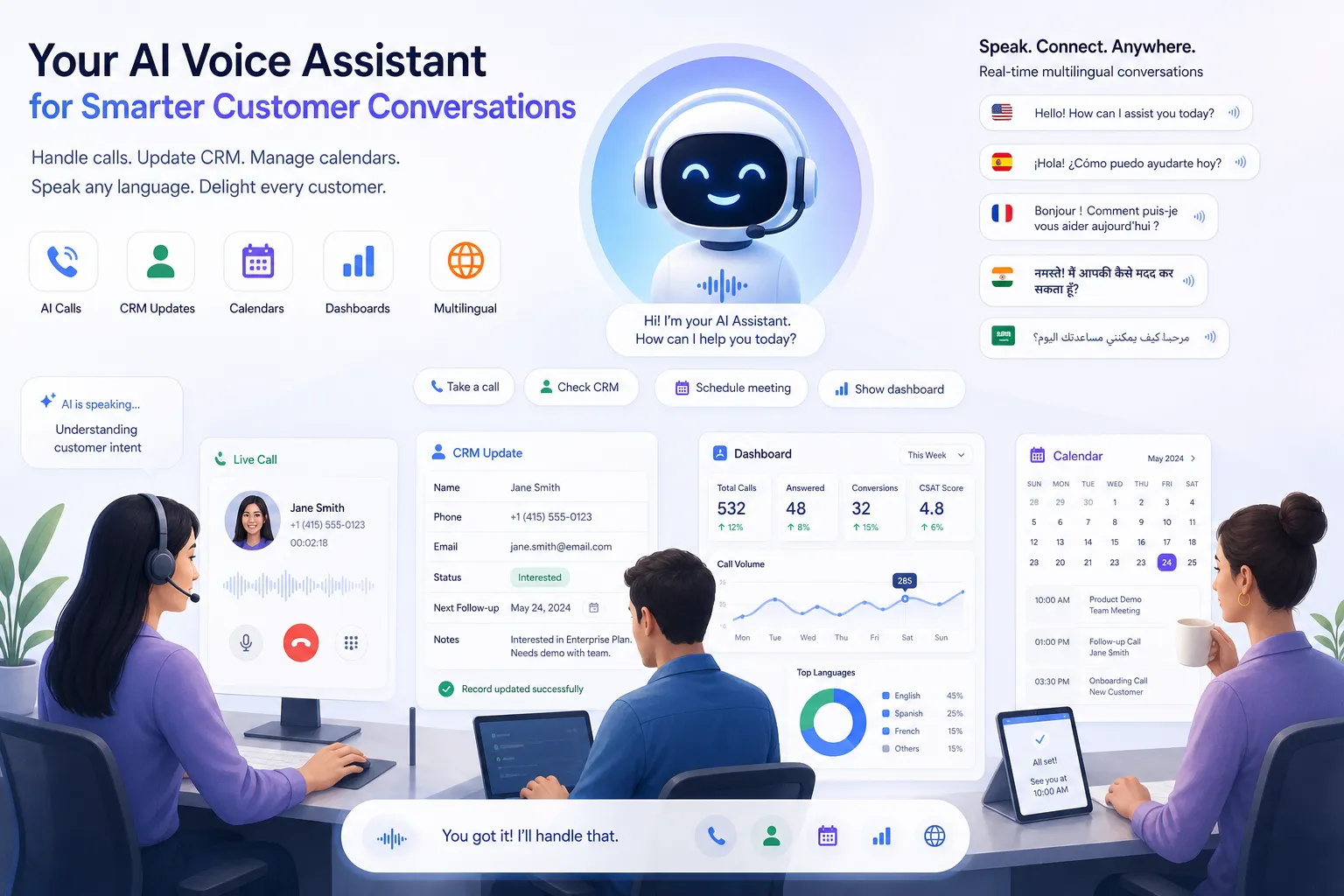
What an AI Assistant for Business Actually Does
At a practical level, a business AI assistant helps teams manage conversations and actions that would otherwise consume staff time.
That can include:
answering inbound phone calls
handling routine customer questions
qualifying new leads before they reach sales
booking appointments or demos
sending reminders and follow-ups
screening candidates
routing calls to the right person
updating business systems after each interaction
The important distinction is this: the best assistants do not just generate text. They listen, respond, trigger workflows, and move work forward.
For communication-heavy businesses, voice is especially important. Many customer interactions still start with a phone call, not a form fill. That is why AI voice agents are becoming one of the most useful categories inside conversational AI.
With Trikon, for example, businesses can launch a live AI voice agent in under 5 minutes with no code and no internal AI team. You can train it using your website, FAQs, PDFs, and documents, connect calendars and CRMs, configure inbound or outbound calling, and go live fast without a long implementation cycle.
Why Businesses Are Prioritizing AI Assistants Now
Competitor content tends to explain the technology well, but often stays too generic. The bigger business reality is that adoption is accelerating because communication bottlenecks are becoming expensive.
Teams are dealing with:
Business challenge | What happens without AI | What a strong AI assistant changes |
|---|---|---|
Missed inbound calls | Lost leads and frustrated customers | 24/7 answer coverage |
Repetitive support questions | Staff time gets drained | Instant FAQ handling and routing |
Slow lead response | Lower conversion rates | Immediate qualification and follow-up |
Scheduling back-and-forth | Delays and drop-off | Automated booking and reminders |
Multilingual demand | Inconsistent service across markets | Scalable responses in 30+ languages |
Manual admin after calls | CRM gaps and poor visibility | Automated notes, updates, and workflows |
Most businesses do not need experimental AI. They need something that works inside existing workflows and starts paying back quickly.
The Benefits That Actually Matter
Many articles list broad benefits like “productivity” or “innovation.” Those are true, but they are not what operators buy. What matters is whether the assistant improves speed, throughput, conversion, and consistency.
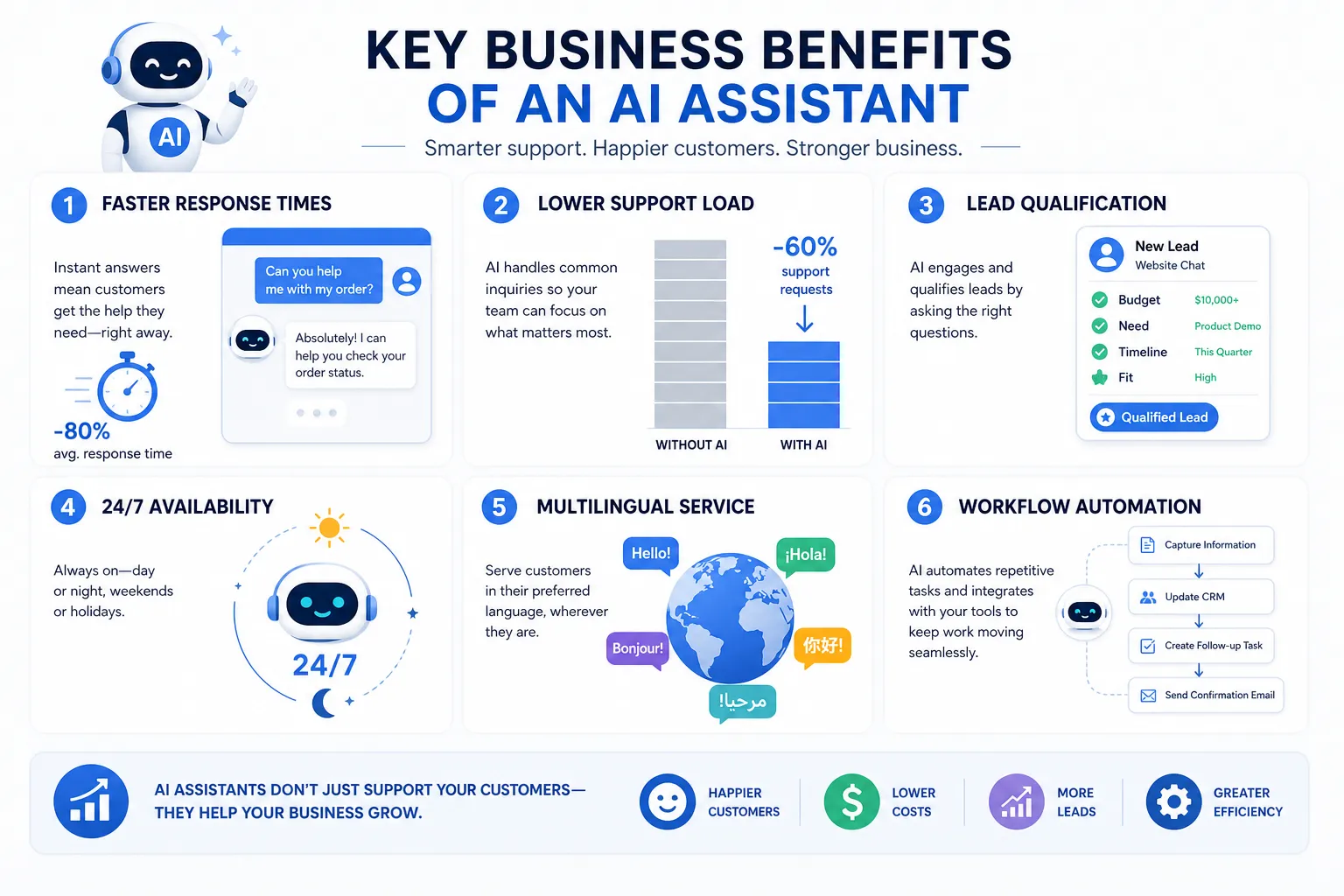
Faster Response Times
The first win is speed.
An AI assistant can answer the moment a customer calls, rather than after hold time, voicemail, or next-day follow-up. That matters in sales, support, admissions, and service businesses where timing influences conversion.
For inbound communication, Trikon’s AI voice agents are designed for natural real-time conversations with sub-second response times, so interactions feel live rather than robotic or delayed.
Lower Operational Load
A large share of business communication is repetitive. Think status checks, opening hours, qualification questions, payment basics, booking requests, or policy clarifications.
An AI assistant can absorb that front-line volume so human teams can focus on exceptions, high-value conversations, and closing work. This reduces pressure without sacrificing responsiveness.
Better Lead Handling
One of the biggest gaps in competitor content is lead operations. AI assistants are not just support tools. They are increasingly revenue tools.
A good assistant can:
answer first-touch sales inquiries instantly
ask qualification questions
detect intent and urgency
capture contact details accurately
book meetings on the spot
trigger follow-up sequences automatically
This is especially useful for small and mid-sized businesses that cannot afford to miss calls after hours or during peak demand.
Scalable Customer Communication
Hiring more people is slow. Training them is slower. Scaling AI is much faster.
An AI assistant allows businesses to handle spikes in demand without needing to increase staffing at the same rate. That is useful for seasonal campaigns, admissions cycles, promotions, recruiting bursts, or support surges.
With Trikon, businesses can deploy unlimited scalable agents with 24/7 availability, making it easier to grow communication capacity without growing complexity.
Consistency Across Every Interaction
Human teams vary by shift, workload, and training level. AI assistants bring repeatability.
That does not mean every conversation sounds scripted. It means the assistant can reliably give the right business-approved answer, ask the right next question, and follow the right routing or escalation path.
When the assistant is grounded in your own knowledge base, it becomes much more trustworthy for production use.
Knowledge-Grounded Answers, Not Guesswork
This is a major content gap in many competitor pieces. They explain that AI can answer questions, but often do not explain how to make those answers reliable.
For business use, the assistant should be grounded in real business knowledge, such as:
website content
FAQ pages
help center articles
PDFs
process docs
pricing pages
internal reference material
Trikon supports this directly, allowing teams to train an agent on websites, documents, PDFs, and FAQs so answers reflect actual company information rather than generic model output.
AI Assistant vs Traditional Automation
A lot of businesses already use forms, IVRs, ticketing rules, or scripts. Those help, but they break down when conversations become dynamic.
Here is the difference:
Traditional automation | Modern AI assistant |
|---|---|
Rule-based | Conversational and context-aware |
Menu-driven IVRs | Natural live dialogue |
Static FAQ trees | Flexible knowledge-grounded responses |
One-path workflows | Adaptive routing and qualification |
Separate systems | Integrated CRM, calendar, messaging, and workflows |
This is why AI assistants are replacing more than chat widgets. They are replacing fragments of disconnected communication tooling.
Where AI Assistants Deliver the Best ROI
The highest ROI use cases are usually the ones with high volume, repeatability, and direct business value.
Sales Teams
Sales teams benefit when the assistant can capture and qualify demand before a rep gets involved.
Use cases include:
inbound lead qualification
demo booking
missed-call recovery
outbound follow-up
reactivation campaigns
Customer Support Teams
Support teams benefit when the assistant can resolve common issues or route correctly without creating extra ticket noise.
Use cases include:
answering routine questions
order or appointment support
triage before human escalation
after-hours call handling
Operations and Service Businesses
Operations teams benefit when communication becomes structured and trackable.
Use cases include:
appointment reminders
service updates
delivery or scheduling coordination
inbound overflow management
Recruiting and Admissions
This is another under-covered area in competitor content. AI assistants are highly useful for screening, scheduling, and repetitive candidate or applicant communication.
Use cases include:
first-round candidate screening
application follow-up
interview scheduling
enrollment or admissions FAQs
What Good Implementation Looks Like
The biggest mistake businesses make is treating AI like a side experiment rather than an operational workflow.
A strong rollout usually has these elements:
A Narrow First Use Case
Start where the pain is obvious. For example:
missed inbound calls
repetitive support questions
lead qualification delays
scheduling friction
The goal is not to automate everything on day one. It is to prove value fast.
Reliable Knowledge Inputs
The assistant should be trained on your actual business information, not vague prompts. This is where websites, help docs, PDFs, and FAQs matter.
Integrated Workflows
A conversation should trigger useful action. Otherwise the team still does the work manually afterward.
Look for integrations with:
CRM systems
calendars
WhatsApp
phone numbers
workflow tools
analytics platforms
Trikon is built around this practical layer: CRM, calendar, WhatsApp, and workflow integrations help turn calls into updated records, booked meetings, and automated next steps.
Human Handoff When Needed
No business should automate without an escape hatch.
The best AI assistants know when to transfer a conversation to a human, and they pass context along so the customer does not have to repeat everything.
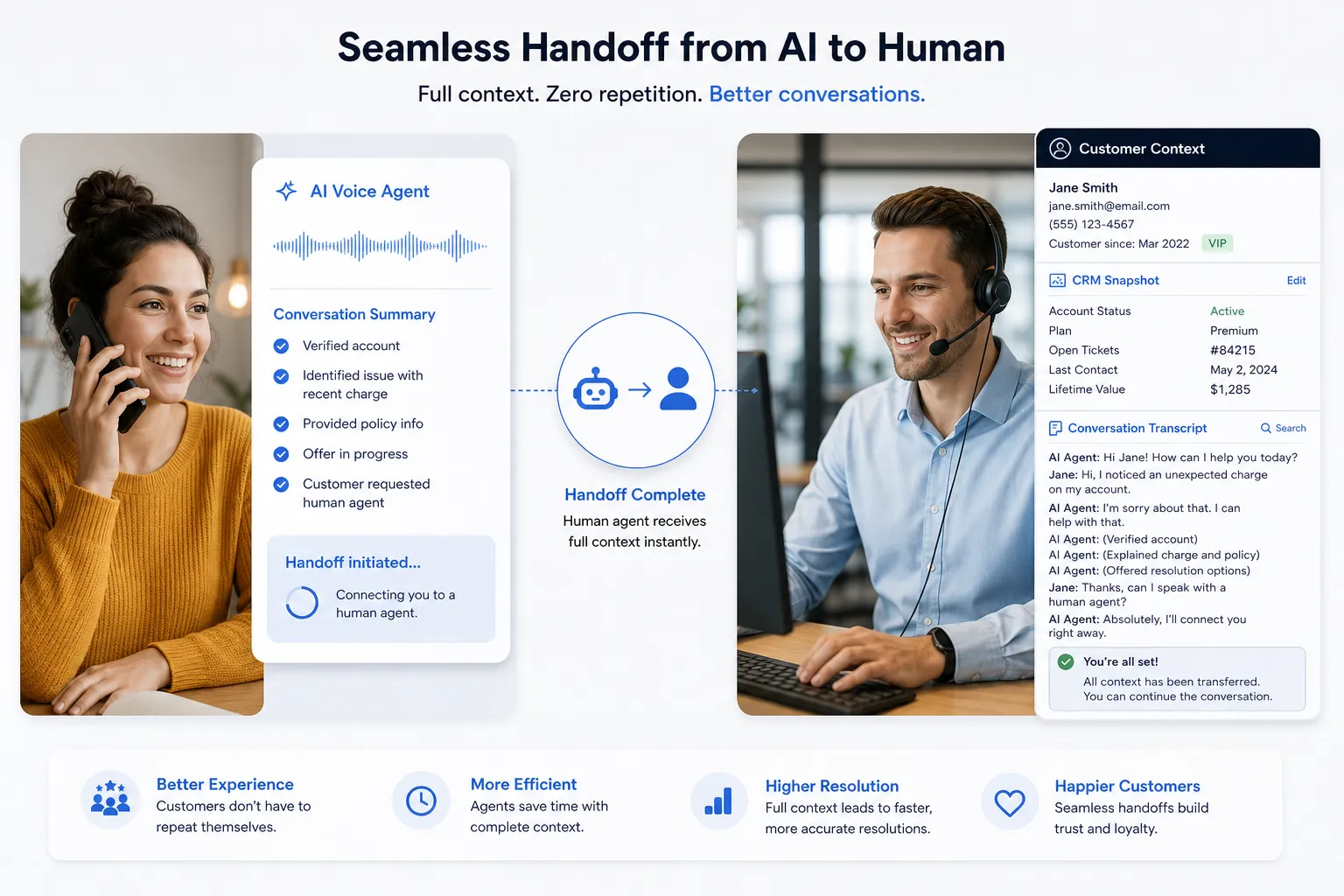
Trikon supports live human transfer with full context, which is critical for service quality. The AI should reduce friction, not create it.
What Competitor Articles Usually Miss
After reviewing the main themes across top-ranking content, several gaps stand out.
They Underplay Voice
Most articles talk broadly about AI assistants but focus more on chat, search, or general enterprise productivity. In reality, many of the most valuable business conversations still happen by phone.
Voice matters because it captures urgency, intent, and action in real time.
They Stay Abstract Instead of Operational
Competitor content often explains what AI is, but not what a team would actually deploy next week. Businesses need specifics: qualify calls, book demos, update CRM, follow up on WhatsApp, escalate with context.
They Ignore Time-to-Value
Lengthy implementation kills momentum. One of the strongest differentiators in this category is speed to launch.
Trikon stands out here because businesses can launch a live AI voice agent in under five minutes, without code, setup fees, or an internal AI function.
They Talk About Cost Savings but Not Revenue Protection
Reducing support load matters, but so does preventing missed opportunities. Faster lead response, after-hours call coverage, and better qualification all protect revenue.
They Do Not Explain Pricing Transparency
This matters more than many vendors admit. Hidden setup costs, consulting fees, and usage surprises create friction for adoption.
Trikon’s transparent pricing with no hidden fees or setup costs removes one of the biggest barriers for SMBs and growth-stage teams.
What to Look for in an AI Assistant Platform
If you are evaluating vendors, use this checklist.
Evaluation factor | Why it matters |
|---|---|
Speed to deploy | Faster testing and ROI |
No-code setup | Less dependency on technical teams |
Real-time voice quality | Better customer experience |
Multilingual support | Growth across markets |
Knowledge grounding | More accurate business responses |
Inbound and outbound calling | Broader operational use |
Human transfer | Better escalation handling |
CRM and calendar integrations | Useful automation after the conversation |
Transparent pricing | Easier buying decision |
Analytics and reporting | Ongoing optimization |
A platform does not need to be the most complex. It needs to be production-ready.
Why Trikon Fits the 2026 Business Reality
For modern teams, the winning solution is not generic AI. It is communication infrastructure that feels simple to launch and practical to operate.
Trikon is built for exactly that use case:
live AI voice agent deployment in under 5 minutes
no-code setup with no AI team required
natural real-time conversations with sub-second response times
multilingual support across 30+ languages
training on websites, documents, PDFs, and FAQs
support for inbound and outbound calling
live human transfer with full context
CRM, calendar, WhatsApp, and workflow integrations
transparent pricing with no hidden fees or setup costs
24/7 availability with scalable unlimited agents
That combination matters because most businesses do not want an AI project. They want a working assistant that starts handling real conversations now.
Final Verdict
An AI assistant for business matters when it does three things well: responds fast, reduces manual load, and improves outcomes across customer communication.
That is why this category is gaining traction so quickly. Businesses are under pressure to do more with fewer delays, fewer missed opportunities, and better consistency across channels. The companies that benefit most are not necessarily the biggest. They are the ones that move early on the most repetitive, high-volume communication tasks.
If your team handles inbound calls, outbound follow-up, lead qualification, booking, FAQs, or screening, the opportunity is already clear.
Trikon makes that opportunity practical. Instead of waiting months for a custom build, you can launch a production-ready AI voice agent in minutes, train it on your business knowledge, connect it to your workflows, and start turning conversations into action right away.
FAQ
How do I use AI to benefit my business?
Start with a high-volume, repetitive communication workflow such as answering inbound calls, qualifying leads, booking appointments, or handling FAQs. The fastest wins come from using AI to reduce manual effort while connecting it to your CRM, calendar, and follow-up workflows so each conversation leads to useful action.
What is the 30% rule in AI?
The “30% rule” is not a universal technical standard, but it is often used informally to describe the idea that AI should first target the most repetitive portion of work where meaningful efficiency gains are possible. In practice, businesses get the best results by automating the chunk of communication load that is predictable, high-frequency, and easy to measure.