


AI Call Assistant for Smarter Business Calls
Customer calls still decide revenue, retention, and reputation for many businesses. But modern teams are stretched thin: sales reps miss inbound leads, support teams drown in repetitive questions, operations teams chase confirmations, and recruiters lose candidates when follow-up is slow. That is exactly where an ai call assistant changes the game.
Instead of relying on voicemail, overflow staff, or patchwork call routing, businesses can now deploy an AI voice agent that answers instantly, speaks naturally, books meetings, qualifies leads, handles FAQs, and transfers complex conversations to a human with full context. The result is simple: fewer missed opportunities, faster response times, and a better caller experience at scale.
What makes this shift especially important now is that voice AI is no longer a custom enterprise project. With platforms like Trikon, businesses can launch a live AI voice agent in under 5 minutes with no code, no internal AI team, and no drawn-out implementation. You can train the agent on your website, FAQs, PDFs, and documents, connect your CRM and calendar, enable inbound and outbound calling, and start handling real customer conversations with sub-second response times.
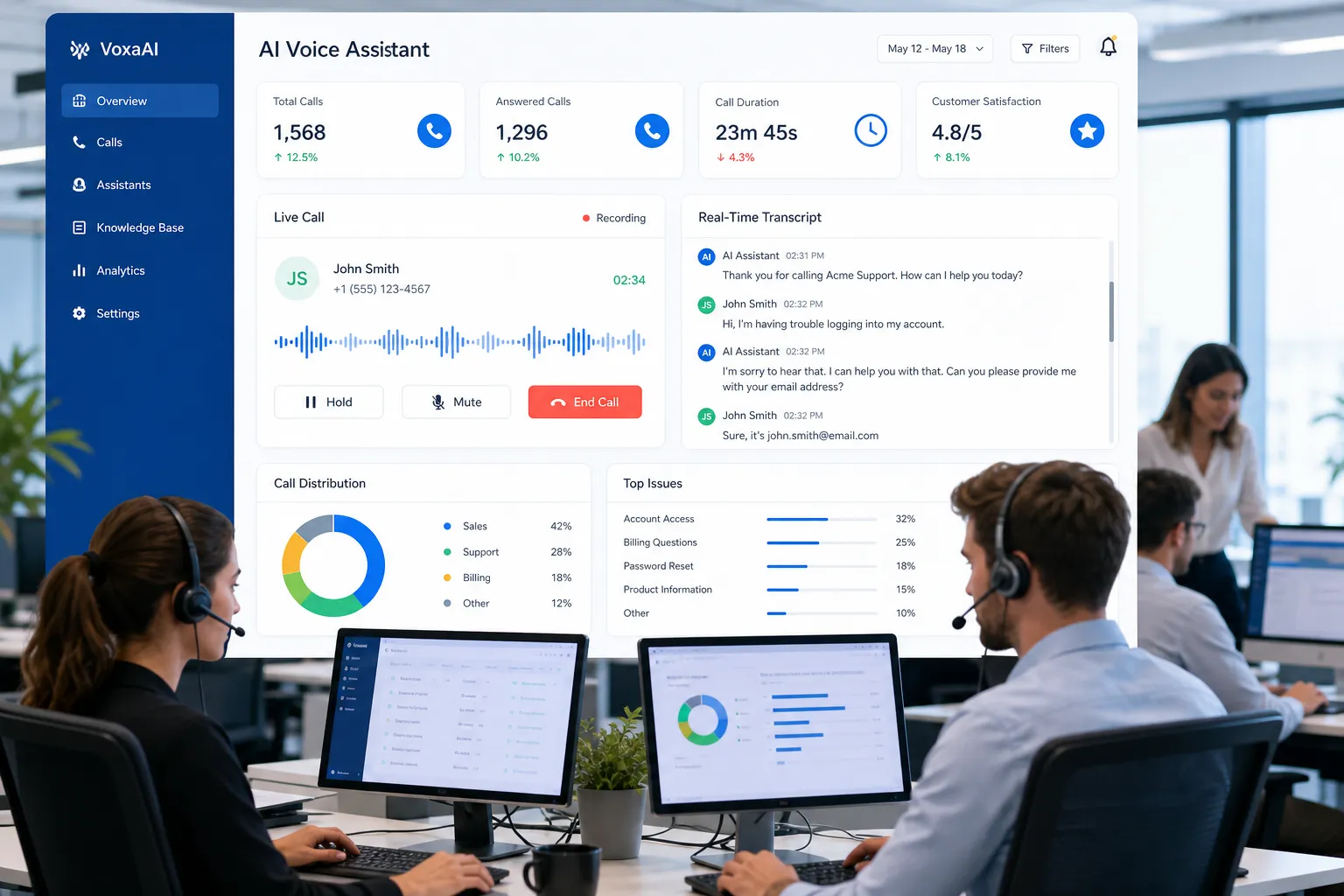
What an AI Call Assistant Actually Is
An AI call assistant is a voice automation system that can answer or place phone calls, understand spoken language, respond in real time, and take business actions during the conversation.
In practice, that means it can:
answer incoming calls 24/7
greet callers in a branded voice
understand why someone is calling
answer common questions from a knowledge base
qualify leads with predefined logic
book appointments into a connected calendar
trigger follow-ups by SMS, WhatsApp, or email
update a CRM automatically
transfer calls to a live person when needed
The best systems do not sound like rigid phone trees. They hold natural conversations, handle interruptions, ask clarifying questions, and keep context throughout the call.
AI Call Assistant vs Traditional IVR
A traditional IVR says, “Press 1 for sales, press 2 for support.”
An AI call assistant says, “Hi, how can I help today?” and understands the answer.
That difference matters. IVRs force callers into menus. AI voice agents let people speak naturally, which reduces friction and gets them to a resolution faster.
Why Businesses Are Replacing Voicemail and Overflow Handling
The biggest reason is not novelty. It is economics.
Missed calls are expensive. Slow responses cost deals. Repetitive calls consume skilled employee time that should be spent on higher-value work.
"78% of customers buy from the company that responds first." - Lead Connect
That one number explains why call handling speed matters so much for sales and service teams. If a lead calls and no one answers, the next business often gets the opportunity.
A second issue is availability. Most teams only cover calls during business hours, but buyers, patients, applicants, and customers do not operate on a perfect schedule. Questions come in after hours, on weekends, and during peak demand periods.
This is where Trikon fits naturally for growing companies. Instead of adding more headcount just to maintain coverage, teams can deploy unlimited scalable AI agents that stay available 24/7, manage both inbound and outbound conversations, and hand off only the calls that truly require a person.
How an AI Call Assistant Works
At a high level, an AI call assistant combines speech technology, language understanding, business logic, and integrations.
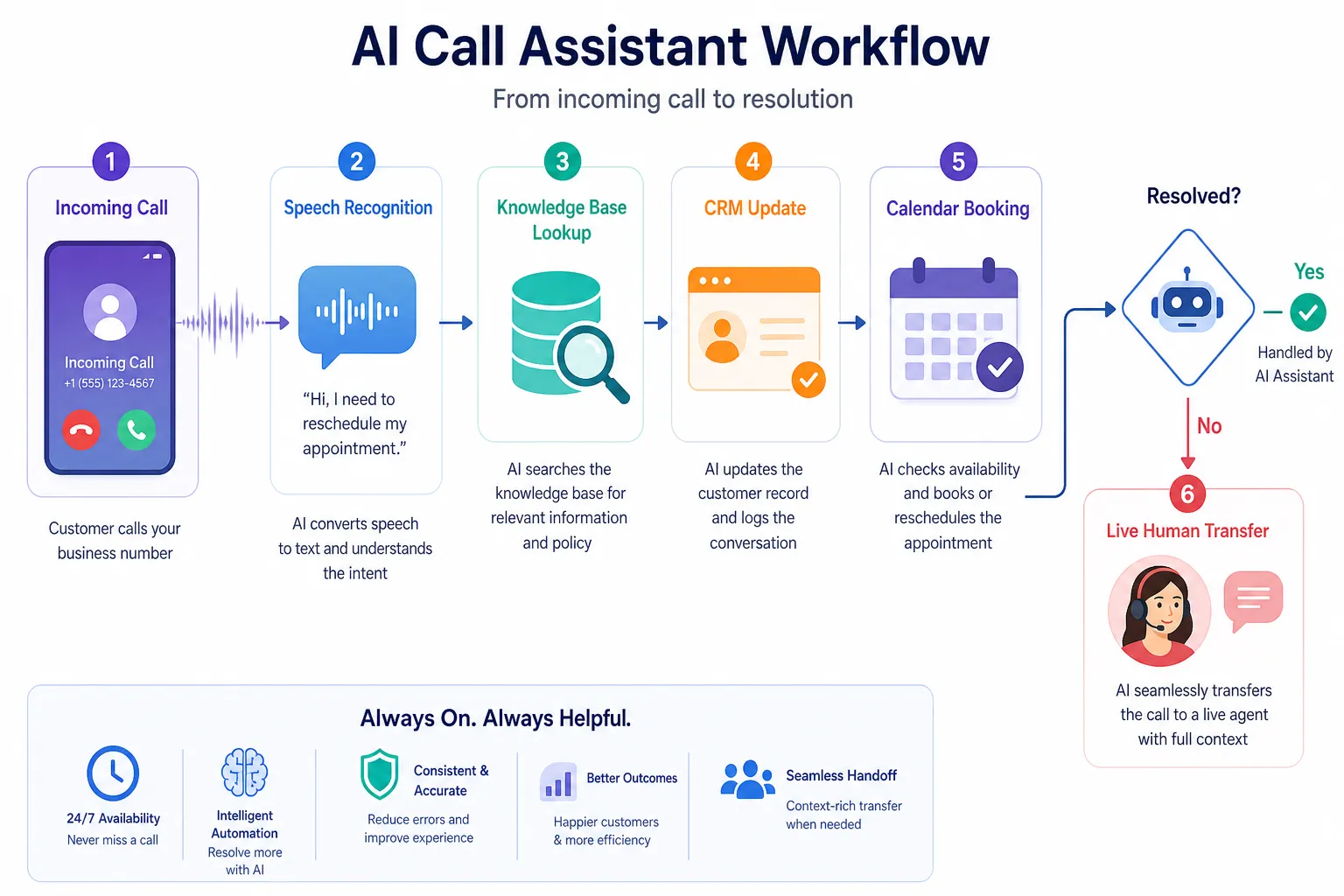
1. The Caller Speaks
The system answers the phone and captures the caller’s speech in real time.
2. Speech Is Converted Into Meaning
Speech recognition converts audio into text, and natural language understanding identifies the caller’s intent. For example:
“I want to reschedule my appointment”
“Do you serve my area?”
“I need pricing”
“Can I speak to sales?”
“I am calling about the job posting”
3. The Assistant Checks Its Knowledge
A capable platform does not guess. It references connected business knowledge such as:
website content
FAQ pages
product documentation
policy documents
PDFs
internal knowledge bases
This is a major differentiator. Trikon’s AI voice agent can be grounded on your real business content, which helps it deliver more accurate, on-brand responses instead of generic answers.
4. It Takes Action in the Workflow
The assistant can then trigger the next step automatically:
book a meeting in your calendar
create or update a CRM record
send a WhatsApp follow-up
route the call to a live rep
collect lead details
log the conversation
schedule a callback
launch an outbound reminder or confirmation call
5. A Human Steps In When Needed
For sensitive or complex cases, the best experience is not AI-only. It is AI plus seamless human takeover. Trikon supports live transfer with full context, so your team receives the reason for the call, captured details, and conversation summary before picking up.
That avoids one of the biggest caller frustrations: repeating everything twice.
The Core Business Problems It Solves
Many competing articles talk broadly about automation, but the real value comes from mapping the technology to operational pain points.
Missed Inbound Leads
If your team cannot answer every inquiry, an AI call assistant ensures every caller gets an immediate response, qualification, and next step.
Repetitive Support Questions
Many support calls are predictable: hours, pricing, order status processes, service areas, refund policies, and appointment availability. AI handles these at scale while your support team focuses on exceptions.
Appointment Booking Bottlenecks
Manual scheduling creates delays, back-and-forth, and no-shows. AI can book in real time, confirm details, and trigger reminders automatically.
Inconsistent After-Hours Coverage
AI gives your business a professional presence even when the office is closed. That matters for healthcare clinics, home services, education providers, legal teams, and high-intent local businesses.
Outbound Follow-Up Gaps
An AI voice agent can call leads, remind customers of appointments, re-engage stale prospects, or confirm attendance without tying up staff time.
Fragmented Systems
A voice tool without integrations creates more admin work. A modern platform should connect calls with CRM records, calendars, messaging, and workflows. Trikon is built for this unified model across AI voice, WhatsApp Business, and cloud business phone capabilities.
What High-Performing Teams Use AI Call Assistants For
Sales Qualification
An AI assistant can answer new lead calls, ask qualification questions, capture budget or timeline, and route hot opportunities directly to a closer.
Customer Support Triage
The assistant can identify support intent, answer simple questions, and send complex issues to the right team with context.
Appointment Booking and Reminders
This is ideal for clinics, consultants, service businesses, recruiters, and education providers. AI can schedule, reschedule, and confirm appointments automatically.
Candidate Screening
Recruiting teams can use voice AI to ask pre-screen questions, collect availability, and move qualified candidates to the next stage faster.
Renewals, Collections, and Operations
AI is increasingly useful for operational calls like payment reminders, onboarding check-ins, verification workflows, and customer notifications.
Key Features to Look For in an AI Call Assistant
Not all tools are equal. Some are little more than voicemail upgrades, while others are production-grade business systems.
Natural, Real-Time Conversation
If response delays are too long, callers lose trust. Sub-second latency matters. So does interruption handling, contextual memory, and a natural voice.
Fast Deployment
Businesses do not want a six-week implementation just to answer calls better. Trikon’s ability to launch a live AI voice agent in under 5 minutes is a major operational advantage.
No-Code Configuration
Non-technical teams should be able to configure call flows, upload knowledge, set business rules, define voice/persona, and connect tools without engineering support.
Knowledge Grounding
Your assistant should answer based on your actual business information, not generic model output. Look for support for websites, documents, PDFs, and FAQs.
Inbound and Outbound Calling
Many businesses need both. Inbound captures demand; outbound drives follow-up, reminders, and reactivation campaigns.
Human Transfer With Context
A transfer should include notes, intent, and captured data so the customer does not need to start over.
CRM and Calendar Integrations
Without integrations, AI saves time in one place and creates work in another. Trikon supports CRM, calendar, WhatsApp, and workflow integrations so calls lead directly to business action.
Multilingual Support
If you serve diverse customer bases or international markets, language support is not optional. Trikon supports 30+ languages, making it practical for multilingual customer communication.
Transparent Pricing
Hidden setup fees and unpredictable billing kill adoption. Businesses want clear pricing, fast onboarding, and no unnecessary implementation costs.
A Simple Comparison: Legacy Call Handling vs AI-Driven Call Automation
Capability | Traditional Reception / Voicemail | Basic IVR | Modern AI Call Assistant |
|---|---|---|---|
24/7 coverage | Limited | Yes | Yes |
Natural conversation | No | No | Yes |
Understands caller intent | Human only | Limited | Yes |
Appointment booking | Manual | Rare | Yes |
CRM updates | Manual | No | Yes |
Multilingual support | Staff-dependent | Limited | Yes |
Live transfer with context | Inconsistent | No | Yes |
Outbound reminders/follow-up | Manual | No | Yes |
Scales during call spikes | No | Somewhat | Yes |
Setup speed | Slow to staff | Moderate | Can be live in minutes |
What Competitor Solutions Get Right - and Where They Fall Short
The current market messaging around AI call assistants usually focuses on a few recurring themes:
never miss a call
24/7 answering
lead capture
appointment booking
multilingual support
lower staffing burden
Those are valid benefits. But many competitor pages gloss over what buyers actually need to evaluate:
They Talk About Features More Than Workflows
A list of features is not enough. Businesses care about what happens after the call: did the CRM update, was the lead qualified, was the meeting booked, did support get context, did the prospect receive a follow-up?
They Underplay Deployment Friction
Many tools sound simple but still require significant setup, scripting, or engineering coordination. Fast time-to-value is a real buying criterion.
They Do Not Emphasize Knowledge Accuracy Enough
An assistant is only as useful as the business information it can access reliably. Grounding on websites, FAQs, and documents should be central, not secondary.
They Often Separate Voice From the Rest of Communication
Calls do not exist in isolation. A serious business workflow often spans voice, messaging, CRM, and calendar systems. Trikon’s unified communication approach is stronger because it connects those pieces instead of treating voice automation as a silo.
Where an AI Call Assistant Delivers the Biggest ROI
Small Businesses
Small teams gain instant 24/7 coverage without hiring a full-time receptionist or call center staff.
Mid-Sized Service Companies
As call volume grows, AI absorbs routine demand while preserving quality and speed.
Sales Teams
Every answered call increases the chance of qualification and booking before a competitor responds.
Support Teams
AI reduces repetitive workload, cuts queue pressure, and improves consistency.
Recruiting Teams
Faster screening and scheduling help teams move candidates through the funnel with less manual effort.
Multi-Location Businesses
AI standardizes call handling across branches while supporting local routing and shared reporting.
Common Concerns Businesses Have
“Will It Sound Robotic?”
Modern systems can sound surprisingly natural, especially when response times are low and prompts are well designed. Voice quality, pacing, and interruption handling are now much better than older phone automation.
“What If It Cannot Answer Something?”
That is why escalation matters. AI should not trap the caller. It should transfer the call, create a ticket, or schedule a callback with all relevant context attached.
“Will Setup Be Complicated?”
It should not be. With Trikon, businesses can go live quickly without code or a dedicated AI team, which removes one of the biggest adoption barriers.
“Can It Work for My Industry?”
Usually yes, as long as your call patterns include repeatable intents such as lead qualification, FAQ handling, booking, reminders, routing, or basic screening.
How to Implement an AI Call Assistant the Right Way
Step 1: Start With High-Frequency Call Types
Begin with the calls your team handles again and again, such as:
appointment requests
service questions
pricing inquiries
office hours
lead intake
rescheduling
applicant screening
Step 2: Organize Your Knowledge
Prepare the source material the assistant should rely on:
website pages
FAQs
PDFs
pricing summaries
business hours
service area details
onboarding policies
Step 3: Define Escalation Rules
Decide when the call should transfer to a human, when it should take a message, and when it should trigger a follow-up workflow.
Step 4: Connect Your Systems
Integrate your CRM, calendar, messaging tools, and phone setup so the assistant can act instead of just talk.
Step 5: Review and Improve
Monitor transcripts, outcomes, failed intents, and transfer patterns. The best AI call assistants improve over time as you refine knowledge and workflows.
What Trikon Does Differently
Businesses evaluating voice AI often face a tradeoff between capability and complexity. Trikon is built to remove that tradeoff.
Go Live Fast
You can launch a live AI voice agent in under 5 minutes. That speed matters for teams that need results now, not after a consulting project.
No Code, No AI Team Required
Operations, support, and business teams can configure and deploy without heavy technical involvement.
Real Business Knowledge, Not Generic Answers
Train the agent using your website, PDFs, FAQs, and documents so responses stay grounded and relevant.
Inbound and Outbound in One Platform
Handle incoming calls, run outbound workflows, send reminders, qualify leads, and manage follow-up from one place.
Unified Communication Stack
Trikon combines AI voice agents, WhatsApp Business, and a cloud business phone, making it easier to manage conversations across channels.
Human Handoff That Preserves Context
When a live agent needs to step in, they get the history and intent behind the call.
Multilingual Reach
With support across 30+ languages, teams can serve more customers with less friction.
Transparent Pricing
No hidden fees, no setup costs, and no ambiguity around what it takes to get started.
A Quick Look at the Category
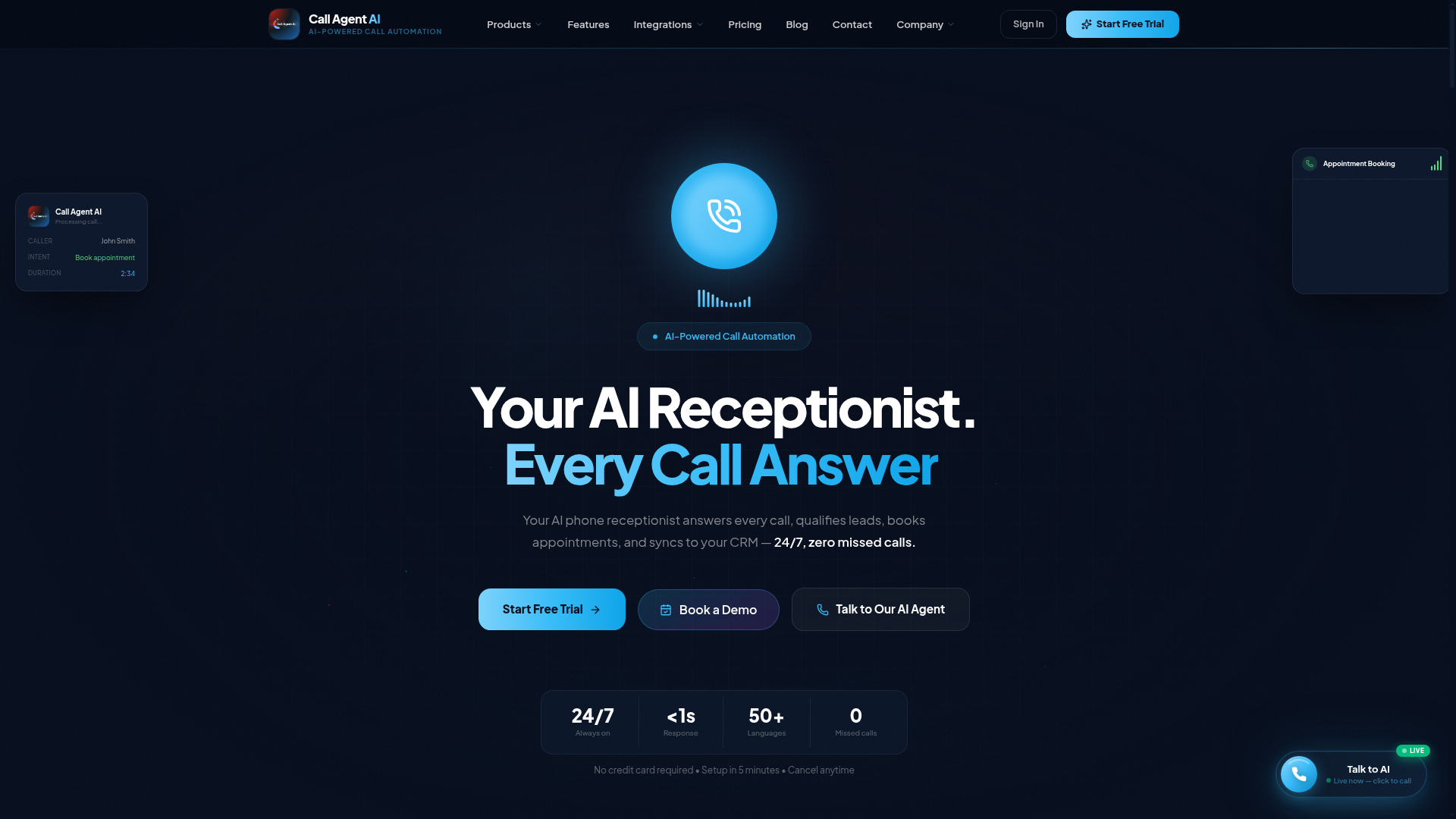
Example of an AI Call Automation Website
Example of an AI Call Assistant Mobile App Listing
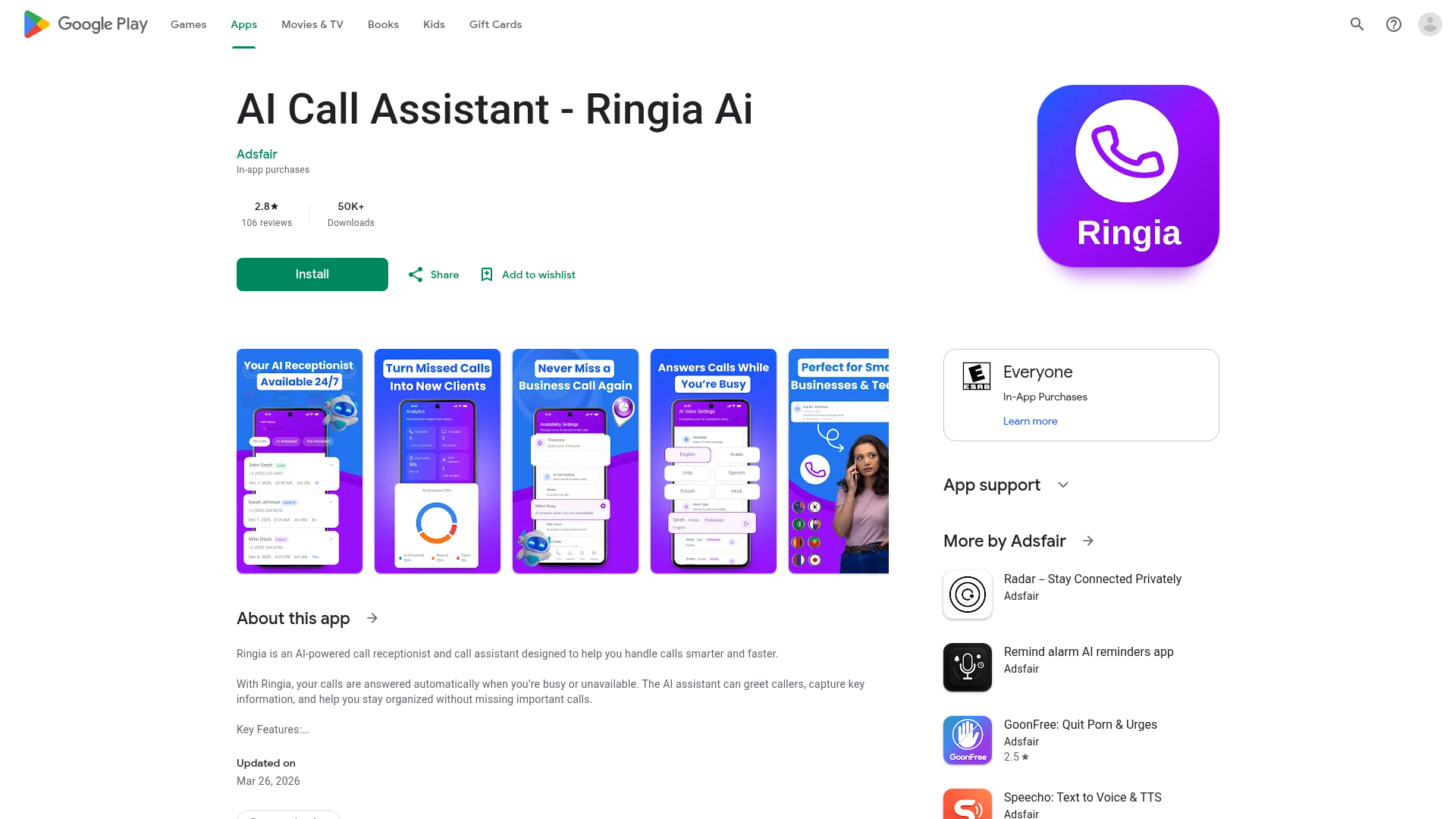
These examples show how broad the category has become, from app-based assistants to full business automation platforms. The gap, however, is still clear: many options promise AI answering, but fewer deliver fast deployment, grounded knowledge, integrated workflows, multilingual support, and production-ready business outcomes in one system.
How to Evaluate Whether Your Business Is Ready
You are likely ready for an AI call assistant if any of these are true:
your team misses inbound calls
staff spend too much time on repetitive phone conversations
appointment scheduling creates friction
you need after-hours coverage
leads go cold before follow-up happens
you want outbound reminders or qualification without more headcount
your phone, CRM, and messaging workflows are disconnected
If several of those sound familiar, the business case is already there.
Final Verdict
An AI call assistant is no longer a nice-to-have experiment. For many businesses, it is now the most practical way to answer more calls, qualify more leads, reduce repetitive workload, improve customer responsiveness, and keep service consistent around the clock.
The winners in this category will not be the tools with the longest feature lists. They will be the platforms that combine speed to launch, natural conversation quality, workflow automation, knowledge accuracy, and clean integration with the rest of the business stack.
That is why Trikon stands out. It gives modern teams a fast, no-code path to production-grade voice AI: live in under five minutes, grounded on your real business knowledge, available 24/7, multilingual, integration-ready, and built for both inbound and outbound calling at scale.
If your business depends on phone conversations and you want fewer missed opportunities with more efficient support and sales operations, Trikon is the smart next step.
FAQ
What is the best AI call assistant for business?
The best option is one that combines natural voice conversations, fast setup, workflow automation, and real business integrations. For many modern teams, Trikon stands out because it can go live in under 5 minutes, supports inbound and outbound calls, and connects with CRM, calendar, WhatsApp, and knowledge sources like websites and PDFs.
What is the best AI assistant for answering calls?
The best AI assistant for answering calls should provide sub-second response times, accurate answers, and seamless human transfer. A platform like Trikon is strong here because it answers 24/7, supports multilingual conversations, and can escalate calls with full context when needed.
What's the best AI assistant for business?
The best AI assistant for business depends on the workflow, but the strongest solutions are those that drive measurable outcomes such as lead capture, appointment booking, customer support efficiency, and follow-up automation. For voice-led communication, Trikon is especially effective because it is built for real business calls, not just generic AI conversations.
What are the top 5 AI assistants?
There is no single universal top 5 because the category includes chat assistants, coding tools, productivity copilots, and voice agents. For businesses focused on phone automation, prioritize tools with knowledge grounding, integrations, multilingual support, and fast deployment rather than broad consumer popularity.
Which AI is smarter than ChatGPT?
“Smarter” depends on the task. For business calling, a purpose-built platform can outperform general AI by offering phone-specific workflows, CRM actions, calendar booking, live transfer, and grounded answers from your business content, which is often more valuable than raw model capability alone.