

AI in Customer Experience: Top Trends for 2026
AI is no longer a side project in CX. In 2026, it is becoming the operating layer behind faster support, smarter personalization, proactive engagement, and more efficient service delivery.
For growing businesses, e-commerce teams, appointment-led service brands, enterprise support operations, and agencies, the real question is no longer whether to use AI in customer experience. It is where to use it first, how to make it measurable, and which channels actually improve customer outcomes instead of adding more tech complexity.
That matters because customers increasingly expect immediate answers, consistent context, and frictionless buying or support journeys across the channels they already use every day. And for many businesses, that channel is WhatsApp.
When AI is combined with conversational channels, businesses can do much more than deflect tickets. They can automate repetitive support, qualify leads, recover abandoned carts, send reminders, book appointments, process orders, and seamlessly hand customers from bot to human without losing context.
"According to Zendesk's 2026 Customer Experience Trends report, 85% of CX leaders state that a single unresolved issue is enough to lose a customer." - Source
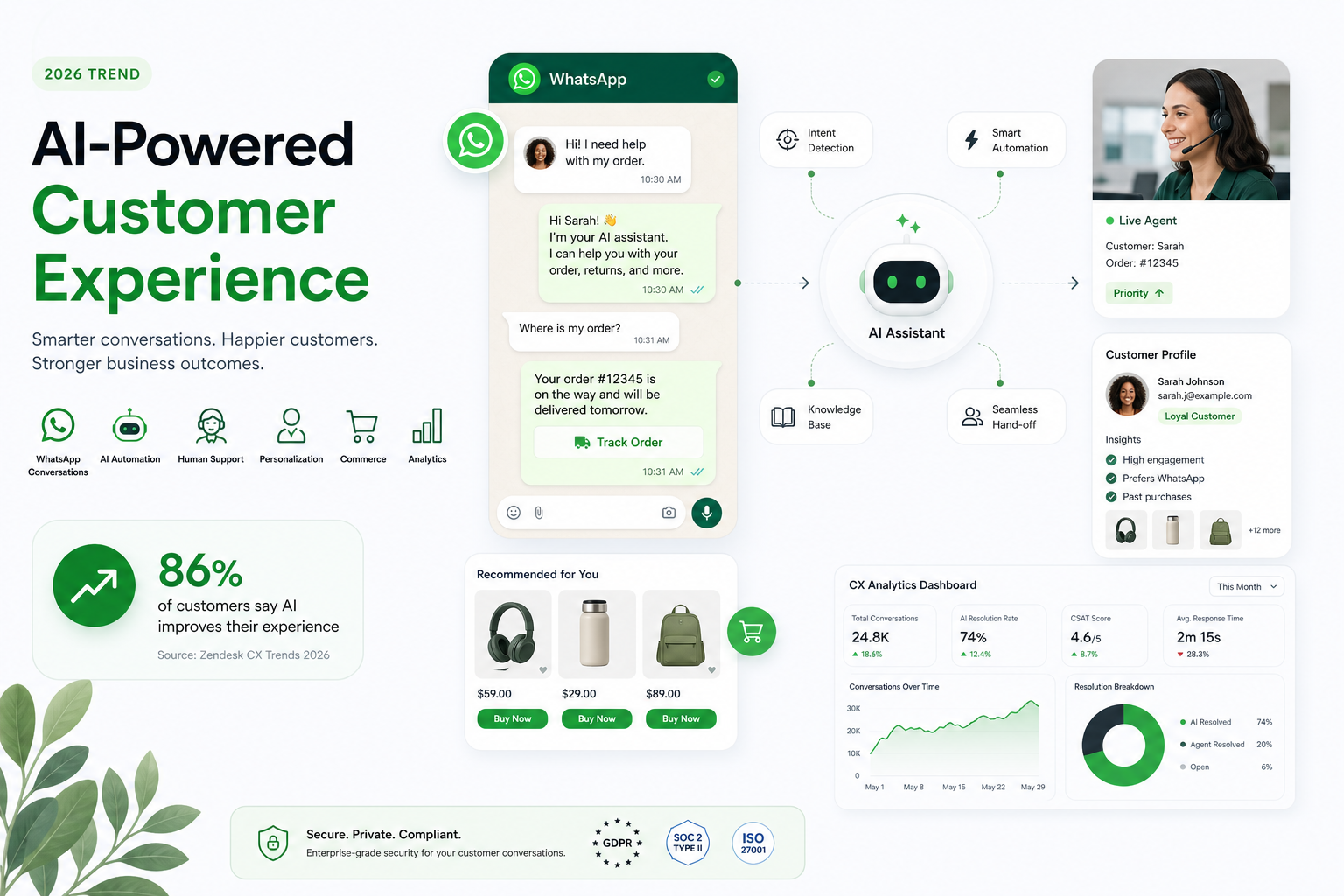
Why AI in customer experience matters more in 2026
Customer expectations have outpaced most support stacks.
Teams are under pressure to respond 24/7, personalize at scale, reduce support costs, improve conversion, and maintain service quality across chat, email, phone, and social messaging. But the old approach of adding more agents, more dashboards, and more disconnected tools is not sustainable.
What is changing in 2026 is that AI is becoming practical, operational, and channel-native.
Instead of just powering generic chatbots, AI is now being used to:
understand intent in real time
preserve context across conversations
automate routine support and sales tasks
guide human agents with next-best actions
trigger campaigns and follow-ups based on behavior
orchestrate bookings, reminders, and payments inside chat
turn messaging apps into full conversion channels
This is especially powerful on WhatsApp, where customers are already comfortable asking questions, confirming orders, receiving updates, and completing transactions.
For businesses that want one system for support, automation, commerce, and operations, Trikon brings these capabilities together in a single WhatsApp-first platform without requiring a large engineering team.
What the top competitor articles got right, and what they missed
Across the leading articles on AI in CX, a few themes are consistent:
AI is moving from simple automation to intelligent orchestration
customer expectations for speed and personalization are rising
human support still matters for high-empathy or complex situations
data, context, and integration are central to better CX
Those are all valid. But most competitor content leaves out a critical practical layer:
The biggest content gaps in existing AI in CX articles
Common Topic Covered | What Most Articles Miss | Why It Matters |
|---|---|---|
Personalization | How personalization actually happens in a conversational channel like WhatsApp | Customers do not experience “AI” in theory; they experience it in messages, offers, reminders, and support interactions |
Automation | The operational workflows AI can run beyond support | AI can power bookings, reminders, reservations, payments, order flows, and follow-ups |
Human + AI balance | The handoff mechanics between automation and agents | Seamless escalation is what makes automation feel helpful, not frustrating |
CX strategy | The need for a centralized inbox and SLA visibility | Enterprise and scaling teams need team assignment, accountability, and customer history |
Commerce | How AI directly influences conversion in chat | Broadcasts, drip flows, retargeting, abandoned cart recovery, and in-chat checkout all affect revenue |
Adoption | Minimal-engineering implementation paths | Mid-market brands and agencies need fast launch, no-code workflows, and scalability |
This is where a platform like Trikon stands out. It is not just a chatbot layer. It is an all-in-one WhatsApp Business API platform built to unify support, marketing, automation, bookings, and conversational commerce in one place.
The top AI in customer experience trends for 2026
1. Context-aware AI becomes the new baseline
In 2026, basic automation is no longer enough. Customers expect businesses to remember who they are, what they asked before, what they bought, and where they are in the journey.
Context-aware AI means a business can respond based on:
previous conversations
order history
support history
campaign engagement
appointment status
cart activity
lead stage or customer segment
Without this context, AI feels robotic. With it, AI becomes useful.
What this looks like in practice
A customer messages your brand on WhatsApp asking about delivery. Instead of getting a generic support menu, they receive a response tied to their actual order status. If they abandon a cart, the next conversation can reference the items left behind. If they previously booked an appointment, AI can offer a reschedule flow instead of a generic form.
Why it matters
Context lowers friction. It reduces repetition, speeds up resolution, and creates a more human-feeling experience even when automation is doing the heavy lifting.
For enterprise teams, it also helps agents work faster because every interaction starts with full customer history instead of guesswork.
2. Hybrid AI + human service wins over pure automation
The best customer experiences in 2026 will not be fully automated. They will be intelligently hybrid.
AI is ideal for repetitive, structured, high-volume tasks such as:
FAQs
order updates
lead qualification
appointment confirmations
payment reminders
return status checks
routing conversations to the right team
Humans are still better for:
complex support cases
escalations
emotional situations
high-value sales conversations
exception handling
negotiation or account-specific decisions
"A 2025 survey by Five9 revealed that 86% of consumers prioritize empathy and human connection over quick responses in customer service interactions." - Source
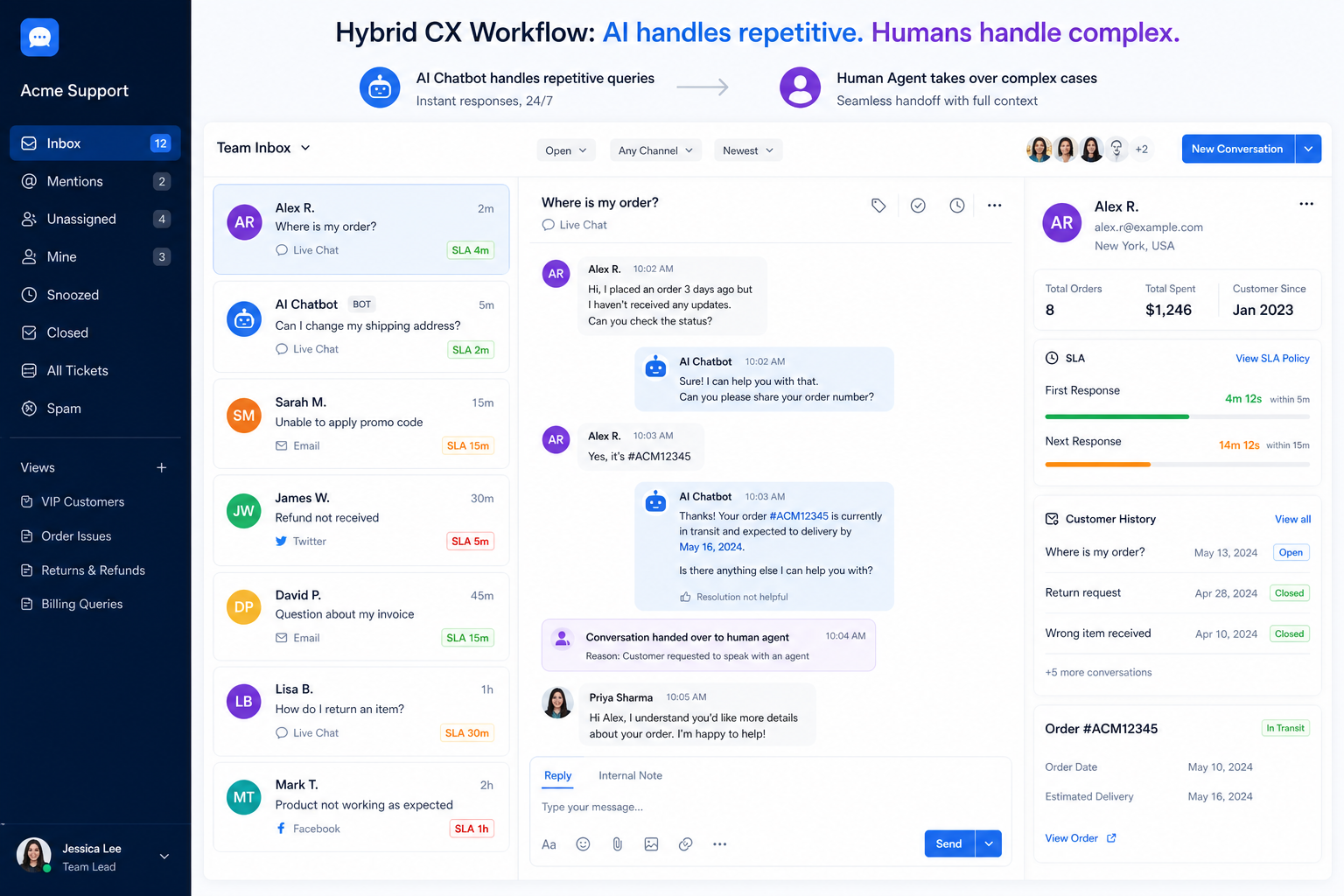
The real differentiator: seamless handoff
What separates good AI CX from bad AI CX is not the bot itself. It is the transition.
Customers should not have to restart the conversation when a human takes over. The agent should see the full chat history, customer profile, intent, and bot actions instantly.
This is exactly why a shared team inbox matters. Trikon’s Support Inbox gives businesses a centralized workspace with:
agent assignment
SLA tracking
full customer context
team collaboration
conversation ownership
That means automation can handle the first layer while human agents step in with complete visibility when needed.
3. AI-powered self-service gets faster, smarter, and more useful
Self-service used to mean static help centers and clunky menus. In 2026, it means real-time conversational resolution.
Customers increasingly want to message a business, ask a question naturally, and get an immediate useful answer without searching through documentation.
What modern self-service includes
natural language understanding
rule-based and AI-triggered replies
intent recognition
dynamic flows based on user response
guided troubleshooting
transaction support
escalation logic
For example, on WhatsApp, self-service can go far beyond answering “Where is my order?”
It can also:
collect lead details
recommend products
book an appointment
send a payment link
offer a catalog
update a reservation
recover an abandoned checkout
route VIP customers to priority agents
Why WhatsApp matters here
Customers already open WhatsApp multiple times a day. They prefer fast, familiar messaging over switching apps, waiting on hold, or navigating a website support tree.
That makes WhatsApp one of the most efficient channels for AI-driven customer experience.
As an official WhatsApp Business API partner, Trikon gives businesses a compliant and scalable way to deliver this kind of always-on service with no-code automation and fast launch times.
4. Conversational commerce becomes a serious revenue channel
One of the biggest shifts competitors mention only briefly is the link between AI in CX and direct revenue generation.
In 2026, support and sales are merging inside messaging channels.
Customers do not just want help. They want to discover, ask, compare, buy, confirm, and reorder in the same conversation thread.
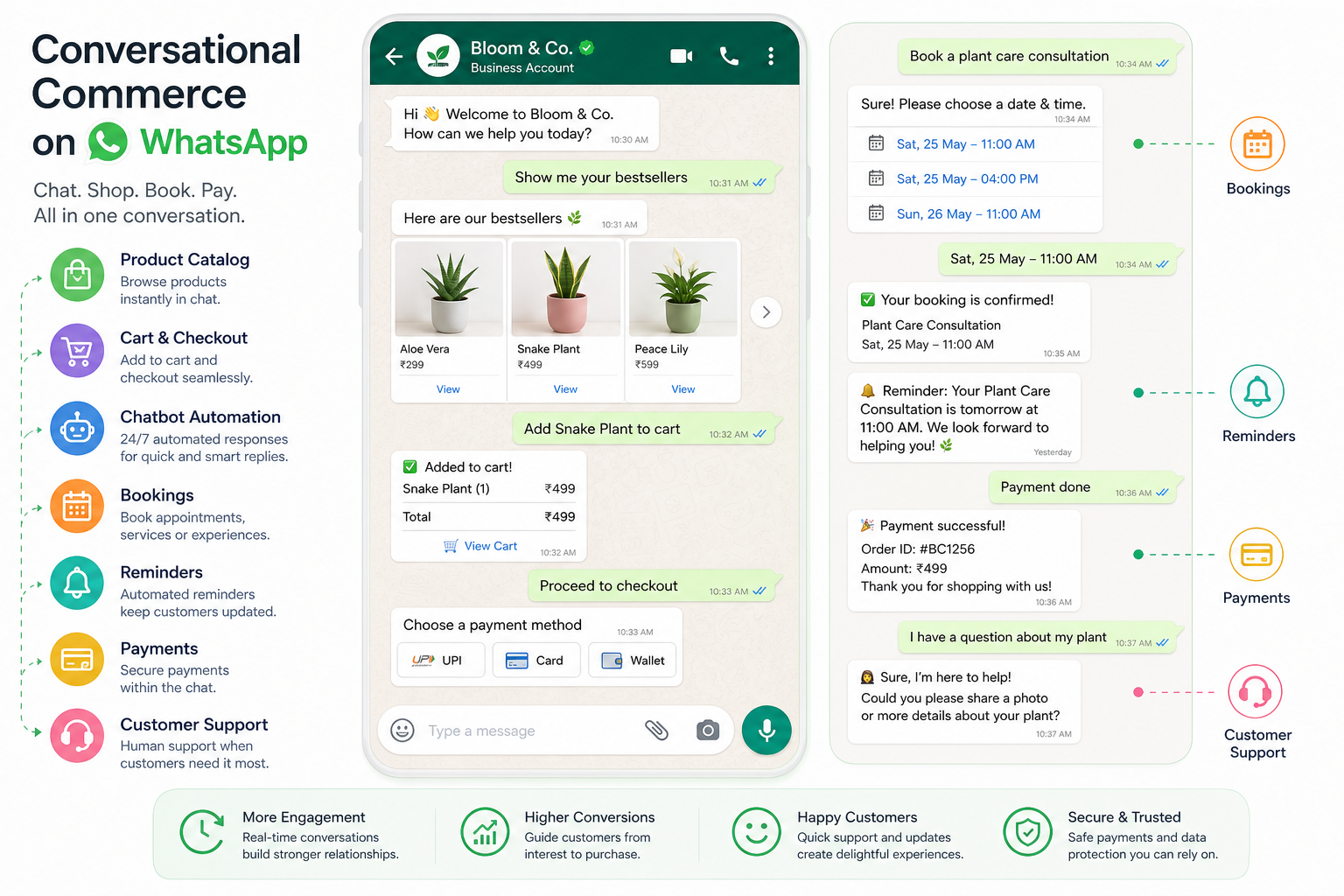
AI’s role in conversational commerce
AI helps brands sell better in chat by enabling:
instant product discovery
personalized recommendations
lead qualification
automated responses to buying questions
abandoned cart recovery
drip campaigns
retargeting flows
order confirmation and follow-up
The opportunity for D2C and e-commerce brands
For fast-moving brands, WhatsApp can function as a high-conversion channel for:
catalog browsing
cart creation
checkout prompts
order updates
upsells and cross-sells
repeat purchase campaigns
Trikon’s WhatsApp Storefront brings product catalogs, carts, orders, and website sync directly into the conversation, so businesses can sell where the customer is already engaged.
This turns CX from a cost center into a growth engine.
5. Operational workflows move into the conversation
A major blind spot in most AI in CX content is operations.
In many industries, great customer experience is not just about answering questions. It is about helping the customer complete a real-world task quickly.
That includes:
booking appointments
confirming reservations
sending reminders
rescheduling visits
collecting documents
processing payments
sharing instructions
completing post-service follow-up
Why this trend matters
For service businesses, healthcare-adjacent organizations, clinics, home services, salons, education providers, consultants, hospitality brands, and field teams, customer experience is deeply tied to operational reliability.
The fewer steps between “I need this” and “It is confirmed,” the better the experience.
AI + operations in WhatsApp
When AI is connected to these workflows, businesses can automate:
booking intake
confirmation messages
no-show reduction reminders
payment nudges
reschedule flows
after-service feedback prompts
Trikon supports these operational journeys inside WhatsApp, making it possible to run appointments, reminders, reservations, and payments in the same channel customers already use for support and updates.
6. Shared inboxes and SLA management become mission-critical for scaling CX
Many AI in CX articles focus on customer-facing innovation but ignore the internal operating model required to make it work.
As AI increases inbound message volume and enables more touchpoints, teams need structure behind the scenes.
That means:
shared visibility across agents
conversation routing
clear ownership
SLA management
escalation rules
collaboration history
full customer context
Why this matters for enterprise support teams
When customer conversations are scattered across personal devices or disconnected tools, response quality drops. Customers get duplicate answers, delayed follow-ups, or no clear resolution path.
A centralized team inbox solves this.
What Trikon adds
Trikon’s shared Support Inbox is built for scale, with:
team assignment and routing
SLA tracking
full conversation history
customer context visibility
support workflow management
For support leaders, that means better governance and faster service. For customers, it means a more consistent and accountable experience.
7. No-code AI adoption accelerates faster than custom-built stacks
In 2026, businesses do not just want AI capabilities. They want deployable AI.
One of the biggest barriers to progress has been implementation complexity. Many teams do not have large engineering resources, but they still need automation, segmentation, conversational flows, and measurable outcomes.
The new expectation
Businesses want to launch quickly with:
no-code bot builders
keyword triggers
AI-triggered workflows
campaign templates
integrations that do not require months of development
fast iteration by non-technical teams
Why this changes the market
This shift makes AI in customer experience more accessible to:
mid-market brands
lean D2C teams
appointment-based businesses
multi-location operators
agencies building solutions for clients
Trikon is built around this reality. Its minimal-setup, no-code approach helps teams launch support automations, marketing campaigns, chatbot journeys, and operational workflows without needing a complex custom stack.
That speed matters because the value of AI in CX is realized through execution, not strategy slides.
8. Marketing automation and CX are converging
Customer experience does not begin after the purchase. It begins with the first touchpoint and extends through every campaign, reminder, response, and follow-up.
That is why one of the biggest 2026 trends is the convergence of marketing automation and CX.
Where AI supports this convergence
AI helps brands send more relevant messages based on intent, timing, and behavior. On WhatsApp, that can include:
welcome sequences
lead nurturing
drip campaigns
retargeting
abandoned cart recovery
reorder reminders
loyalty prompts
win-back campaigns
Why this matters for growth
When marketing and CX are disconnected, customers get generic blasts that feel irrelevant. When they are unified, every outbound touchpoint can reflect customer context and business goals.
Trikon makes this practical by combining support and marketing automation inside the same WhatsApp platform. That means businesses can move from reactive service to proactive engagement without switching tools.
9. AI transparency and trust become competitive advantages
As automation takes on more visible customer interactions, trust becomes a real differentiator.
Customers may accept AI-generated service more readily when it is:
fast
accurate
clearly helpful
easy to escalate
respectful of privacy
consistent with brand promises
Trust in messaging channels matters even more
WhatsApp is personal. It is where people talk to family, friends, and close contacts. A business entering that space must earn trust through relevance and reliability.
That is why using an official WhatsApp Business API partner matters. It signals compliance, platform reliability, and a more professional operating model.
For businesses choosing infrastructure, this is not a minor detail. It affects deliverability, policy alignment, scalability, and long-term brand safety.
Trikon’s positioning as an official WhatsApp Business API partner supports this trust layer while enabling businesses to scale responsibly.
10. Agencies are becoming AI-powered CX operators
Another undercovered trend is the role of agencies.
In 2026, more agencies are moving beyond creative or paid media into lifecycle automation, chatbot deployment, lead flow optimization, and conversational commerce enablement.
Why agencies need different tooling
Agencies serving multiple clients need platforms that are:
fast to deploy
easy to manage
flexible across industries
scalable across accounts
friendly to white-label positioning
usable without heavy engineering support
Why this matters
WhatsApp automation is becoming a valuable client service, especially for:
e-commerce brands
clinics and appointment-led businesses
local multi-branch operators
education and service providers
support-heavy brands
Trikon’s agency-ready and scalable model makes it easier for partners to offer WhatsApp automation, chatbot services, shared inbox support workflows, and marketing automation under their own strategic delivery model.
Where businesses are seeing the biggest measurable CX gains
The impact of AI in customer experience is easiest to understand when mapped to business outcomes.
AI in CX Use Case | Customer Benefit | Business Benefit |
|---|---|---|
24/7 automated replies | Faster answers anytime | Lower manual support burden |
Shared inbox with assignment | Less repetition and fewer dropped conversations | Better team efficiency and SLA performance |
AI + human handoff | More helpful resolutions for complex cases | Higher CSAT and fewer escalations |
WhatsApp campaigns | More relevant updates and offers | Better conversion and retention |
Abandoned cart recovery | Convenient reminder in a familiar channel | More recovered revenue |
Appointment reminders | Reduced no-shows and missed follow-ups | Better operational efficiency |
In-chat commerce | Easier product discovery and purchase | Higher conversion in conversational journeys |
Customer history and context | More personalized service | Faster handling times and better agent performance |
A practical framework for adopting AI in customer experience in 2026
Many teams overcomplicate adoption. The most effective path is to start with workflows that are both high-volume and high-friction.
Phase 1: Automate repetitive conversations
Start with the tasks that consume team time every day:
FAQs
order updates
booking confirmations
lead capture
routing and triage
basic policy questions
Phase 2: Centralize support operations
Put conversations into a shared inbox with:
agent assignment
SLA rules
full history
customer context
escalation workflows
Phase 3: Add revenue and retention automation
Launch campaigns such as:
lead nurture sequences
abandoned cart recovery
retargeting
upsell prompts
repeat purchase reminders
Phase 4: Move key operations into chat
For businesses with appointments or transactions, bring in:
scheduling
reminders
payments
confirmations
post-service follow-up
Phase 5: Optimize the hybrid model
Use AI for speed and consistency, then continuously refine where humans step in for judgment, empathy, and high-value conversations.
This is where Trikon’s all-in-one approach is especially useful. Instead of stitching together separate tools for chatbot logic, inbox management, campaign sending, operations, and storefront functionality, teams can manage the customer journey in one system.
What to look for in an AI CX platform in 2026
If you are evaluating platforms, focus less on hype and more on operational fit.
Essential capabilities checklist
Capability | Why It Matters |
|---|---|
Official WhatsApp Business API access | Reliability, compliance, and scalable messaging |
Shared inbox | Team collaboration and centralized service |
Agent assignment and SLAs | Accountability and faster resolution |
No-code chatbot builder | Faster launch and easier iteration |
AI-triggered and rule-based automation | Flexibility across common and complex use cases |
Human handoff | Better experience for edge cases |
Marketing automation | Conversion, retention, and lifecycle messaging |
Bookings and payments | Operational efficiency inside chat |
Commerce tools | Catalog, cart, orders, and in-chat sales |
Minimal engineering setup | Faster adoption and lower implementation friction |
Agency scalability or white-label fit | Multi-client growth potential |
Trikon aligns strongly with this checklist because it is designed as a complete WhatsApp business channel, not a narrow single-use tool.
Why WhatsApp will be one of the most important AI CX channels in 2026
The future of AI in customer experience is not just smarter models. It is smarter delivery through channels customers already prefer.
WhatsApp stands out because it combines:
immediacy
familiarity
high engagement
conversational simplicity
support for sales, service, and operations in one thread
For growing businesses, it is often the shortest path to better CX without forcing customers into new behaviors.
For digital teams, it offers a direct route to combining support, automation, and conversion.
For enterprise operations, it provides a scalable messaging layer when paired with the right inbox, SLA, and workflow tools.
For agencies, it opens a valuable service category around chatbot deployment, lifecycle automation, and conversational commerce.
Final verdict: AI in customer experience in 2026 is about execution, not hype
The biggest AI in customer experience trends for 2026 are clear:
context-aware conversations
hybrid automation plus human support
conversational self-service
WhatsApp-led engagement
revenue-driving commerce flows
in-chat operational workflows
centralized support operations
no-code deployment
trust, transparency, and scalable infrastructure
The businesses that win will not necessarily be the ones with the most advanced AI models. They will be the ones that make customer journeys faster, simpler, more personal, and more actionable in the channels customers already use.
That is exactly where Trikon fits.
As an official WhatsApp Business API partner, Trikon gives businesses a simple but powerful way to turn WhatsApp into a complete customer channel for support, marketing, chatbots, bookings, payments, and commerce. With a shared team inbox, SLA management, no-code automation, 24/7 responses, and seamless human handoff, it helps teams improve CX while also driving efficiency and growth.

If you want to put AI in customer experience to work in a way that actually improves support, conversions, and operations, Trikon is one of the smartest places to start.