![Build Your MVP Without Code: 30-Day Launch Plan [2025]](https://blog.trikon.tech/rails/active_storage/blobs/redirect/eyJfcmFpbHMiOnsiZGF0YSI6NDk0LCJwdXIiOiJibG9iX2lkIn19--21468905b77438ad8588125294ee261cc5aed7f3/Build%20Your%20MVP%20Without%20Code-%2030-Day%20Launch%20Plan%20%5B2025%5D-cover.webp)
Why Build Your MVP Without Code in 30 Days (2025)
Shipping fast beats overbuilding. In 2025, the smartest path is to build your MVP without code, get it in front of real users, and learn what to double down on - without burning months or capital. A 30-day, no-code sprint keeps you focused on outcomes, not infrastructure, and sets up a clean build–measure–learn loop instead of a “build and build” trap.
The promise of a no-code MVP
Move from idea to user-tested product in one month. With modern platforms, you can build MVP without code and put a working version in users’ hands fast.
Focus on core value, not full-stack engineering. Your no code MVP centers on the one job-to-be-done that proves your hypothesis.
Validate with real users before investing heavily. Early signal beats perfect code - prioritize traction over tech.
"About 42% of startups fail because there’s no market need for their product." - CB Insights (2018)
How a 30-day sprint de-risks your idea
Time-boxing forces ruthless prioritization of one outcome. You’ll scope MVP builds to a single core result and cut everything else.
No-code platforms compress build time and cost. Tools like Bubble, Webflow, Glide, and automation stacks eliminate heavy engineering cycles so you can build your MVP quickly.
Early feedback loops drive better decisions. Ship, measure activation and first-task success, and iterate - this is the heart of mvp no code strategy.
Outcomes you can expect by Day 30
A working no-code MVP that delivers one core result. Build your MVP to complete a single, valuable workflow end-to-end.
Measurable traction: activation rate, first-task success, and waitlist signups. Replace opinions with data that validates demand.
A concise roadmap for the next 30–60 days, grounded in data. Your next MVP builds focus on what users actually did, not what they might do.
The No‑Code MVP Mindset: Lean, Agile, and Real Users
Adopt a mindset that prioritizes learning over shipping features. Your no-code MVP is a fast, focused experiment designed to validate real demand with minimal effort.
Lean Startup for 2025
Identify riskiest assumptions and test them with minimal effort. Start with the core hypothesis (problem, target user, willingness to pay) and design the smallest test to validate it.
Make the MVP a learning vehicle, not a feature bucket. Build only what’s needed to measure activation, first-task success, and retention.
"An MVP is that version of a new product which allows a team to collect the maximum amount of validated learning about customers with the least effort." - The Lean Startup, Eric Ries
Agile execution for a 30-day build
Time-boxed weekly goals and daily stand-ups (even solo). Define a single outcome per week - then cut anything that doesn’t serve it.
Continuous delivery to staging and quick user tests. Ship small, test daily, and iterate on signals, not opinions.
Wizard-of-Oz and concierge tests
Manually fulfill the core value to confirm demand before automating. If users still choose the solution when it’s partially manual, you’ve validated real value.
Define success criteria: e.g., 20 users complete the core task; 30% repeat within 7 days. Tie each criterion to a go/no-go decision for automation.
Add one learning channel early
Landing page with waitlist + one qualitative feedback loop (short interviews or an in-app micro-survey). This gives you both quantitative signal (signups, activation) and qualitative insight (why users did or didn’t succeed).
Your 30‑Day No‑Code MVP Plan at a Glance
Build momentum with a simple, outcome-driven roadmap. Here’s how to move from idea to live product in 30 days - lean, fast, and focused on real users.
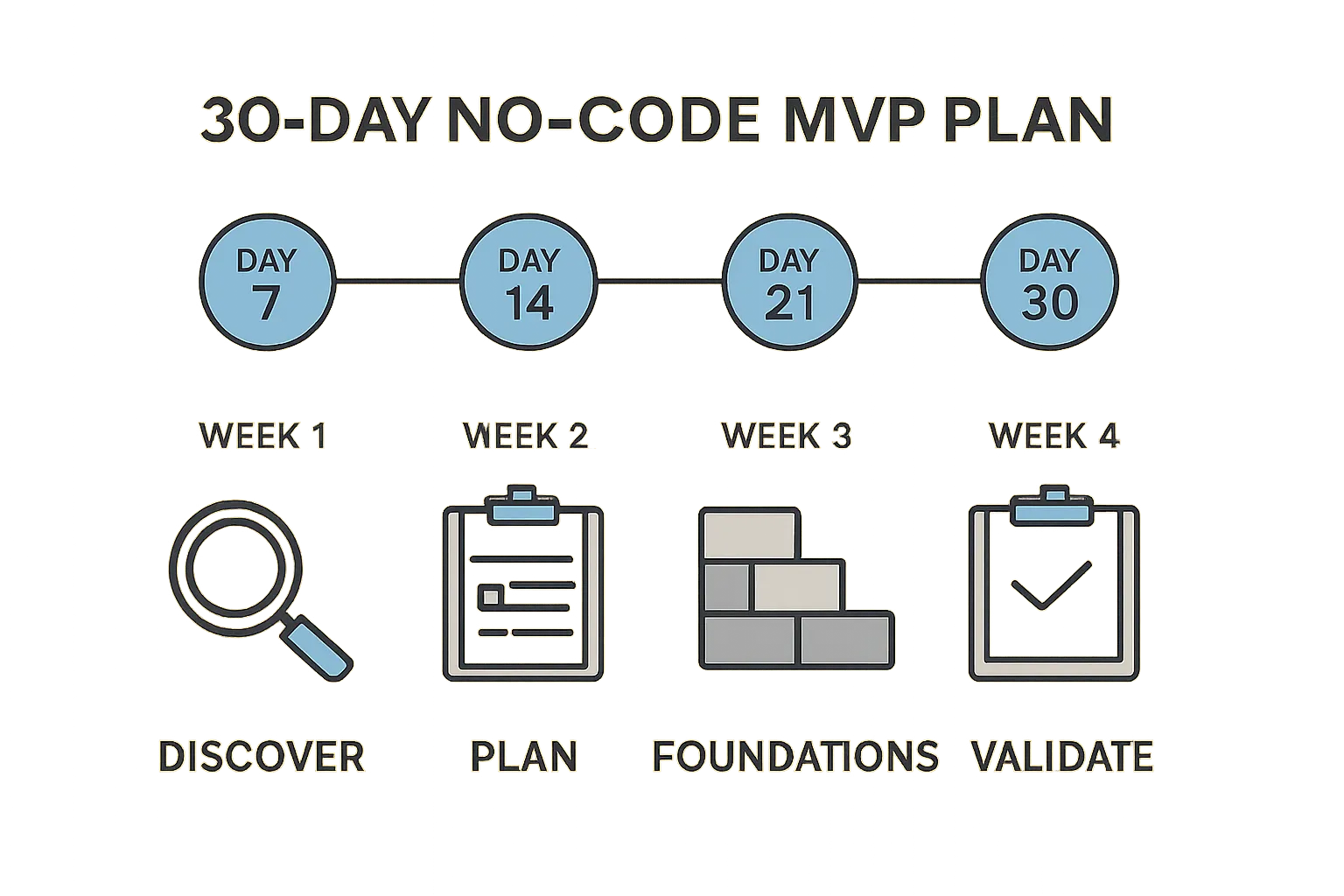
Four-week roadmap overview
Week 1 (Discover): Problem, persona, proof (landing page + interviews + Wizard-of-Oz test).
Week 2 (Plan): Scope lock (P1 features only), lo‑fi wireframes, clickable prototype, usability tests.
Week 2.5 (Foundations): Data model, no-code stack selection, automations, staging live.
Week 3 (Build): Ship the one core feature; versioned releases; QA checklist; pre-launch copy.
Week 4 (Validate): Soft launch, instrumentation, activation funnel, iterate, then public release.
Outcome checkpoints
Day 7: Validated problem-solution fit signals.
Day 14: Prototype + scope freeze; pass basic usability.
Day 21: Core feature working in staging with tracking.
Day 30: Live MVP, real users, measurable activation.
"By 2025, 70% of new applications developed by organizations will use low-code or no-code technologies (up from less than 25% in 2020)." - Gartner
30-day plan overview
Week | Primary Goals | Key Activities | Deliverables | Owner (founder/PM, design, build) |
|---|---|---|---|---|
Week 1 – Discover | Validate problem-solution fit | Interviews, survey, landing page with waitlist, Wizard-of-Oz/concierge test | Problem statement, target persona(s), early demand metrics | Founder/PM |
Week 2 – Plan | Freeze scope to P1 features | Lo‑fi wireframes, clickable prototype, 5–10 usability tests | Scope lock doc, prototype, test report | Design + Founder/PM |
Week 2.5 – Foundations | Set tech and data groundwork | Choose no-code stack (e.g., Webflow/Bubble/Glide + Airtable + Zapier/Make), define data model, staging setup | Data schema, integrations, staging URL | Build |
Week 3 – Build | Ship core value end-to-end | Implement core workflow, instrumentation (events), QA checklist, pre-launch copy | Working core feature in staging, tracked events, marketing copy | Build + Founder/PM |
Week 4 – Validate | Test with real users and iterate | Soft launch, activation funnel analysis, fix priority issues, public release | Live MVP, activation metrics, next-sprint roadmap | Founder/PM + Build |
Week 1 - Discover: Problem, Persona, and Proof (No Code Required)
Launch fast by validating the problem and value proposition before you build. Your goal this week is clarity: one audience, one painful problem, one way to prove demand.
Define one painful, valuable problem
Write a crisp problem statement for a specific user segment. Example: “Solo B2B consultants lose 5+ hours/week chasing unpaid invoices.”
Establish a measurable hypothesis (e.g., users will complete X in Y minutes). Tie it to a single primary action you can test manually.
Rapid validation methods
8–12 interviews to uncover jobs-to-be-done and current hacks. Ask about frequency, urgency, and existing workarounds.
Landing page + value proposition test (headline variants) capturing emails. A/B test headlines and track CTR to signup.
Wizard-of-Oz/concierge delivery of the core value. Manually fulfill the service to confirm willingness-to-pay and repeat use before automation.
Success criteria and kill/keep gates
Quantitative (CTR, signups, test completions) + qualitative (top 3 objections). Define thresholds (e.g., 3–5% LP conversion, 60% first-task completion).
Decide: persevere, pivot the segment, or refine the value prop. Use data to choose the narrowest path to clear signal.
Documentation
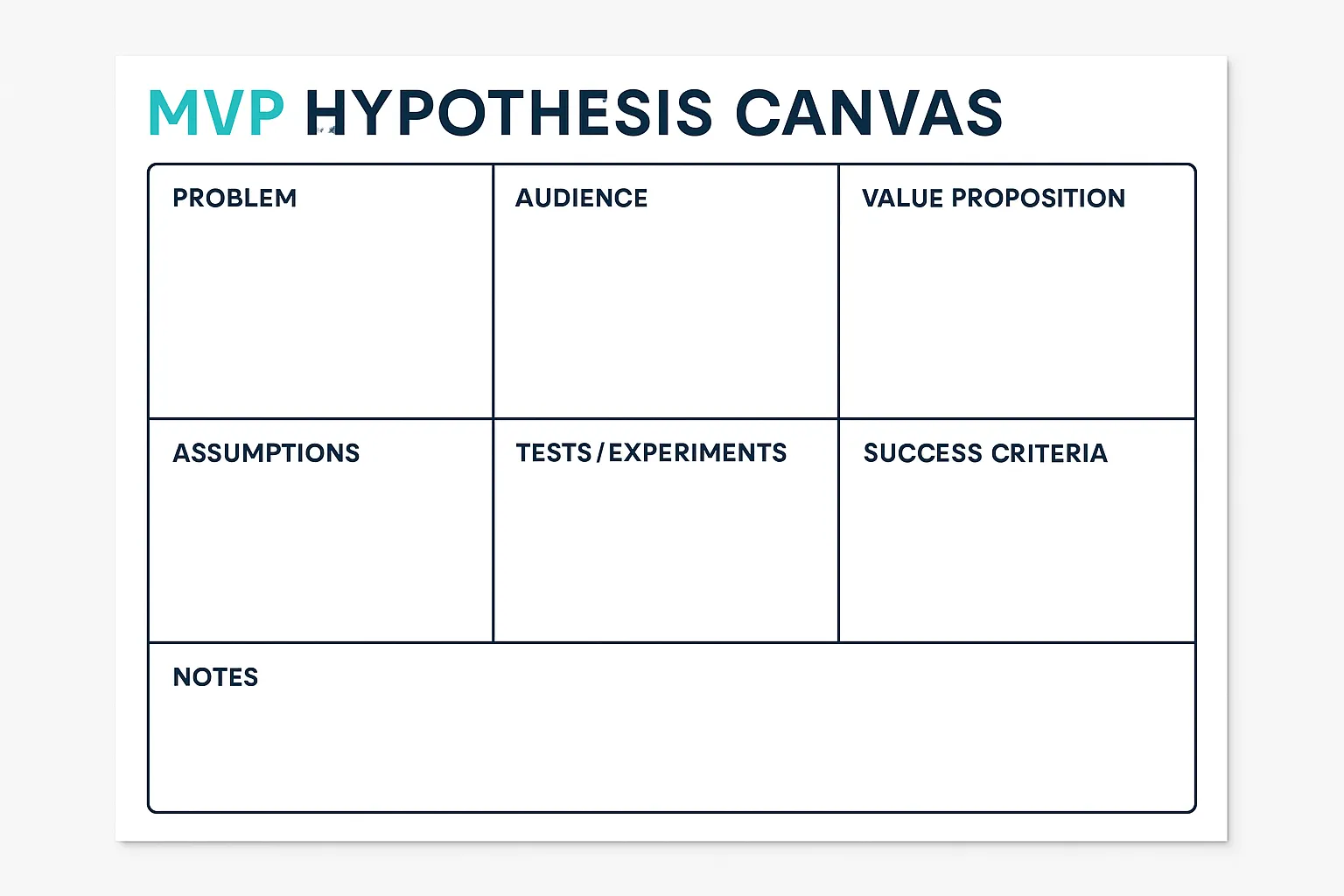
Create a one-page hypothesis canvas; log assumptions, signals, and decisions in Notion. Keep it living - update after each test and interview.
Week 2 - Plan: Scope, User Flows, and Clickable Prototype
Turn insights from Week 1 into a tight execution plan. Lock scope, map the happy path, and test a clickable prototype before build.
Lock scope with a P1-only mindset
Use MoSCoW; keep 1–3 must-have capabilities for the core user journey. Anything that doesn’t prove value gets parked for later.
Define out-of-scope items explicitly to prevent scope creep. Document a “Not Now” list to protect delivery.
Map the happy path
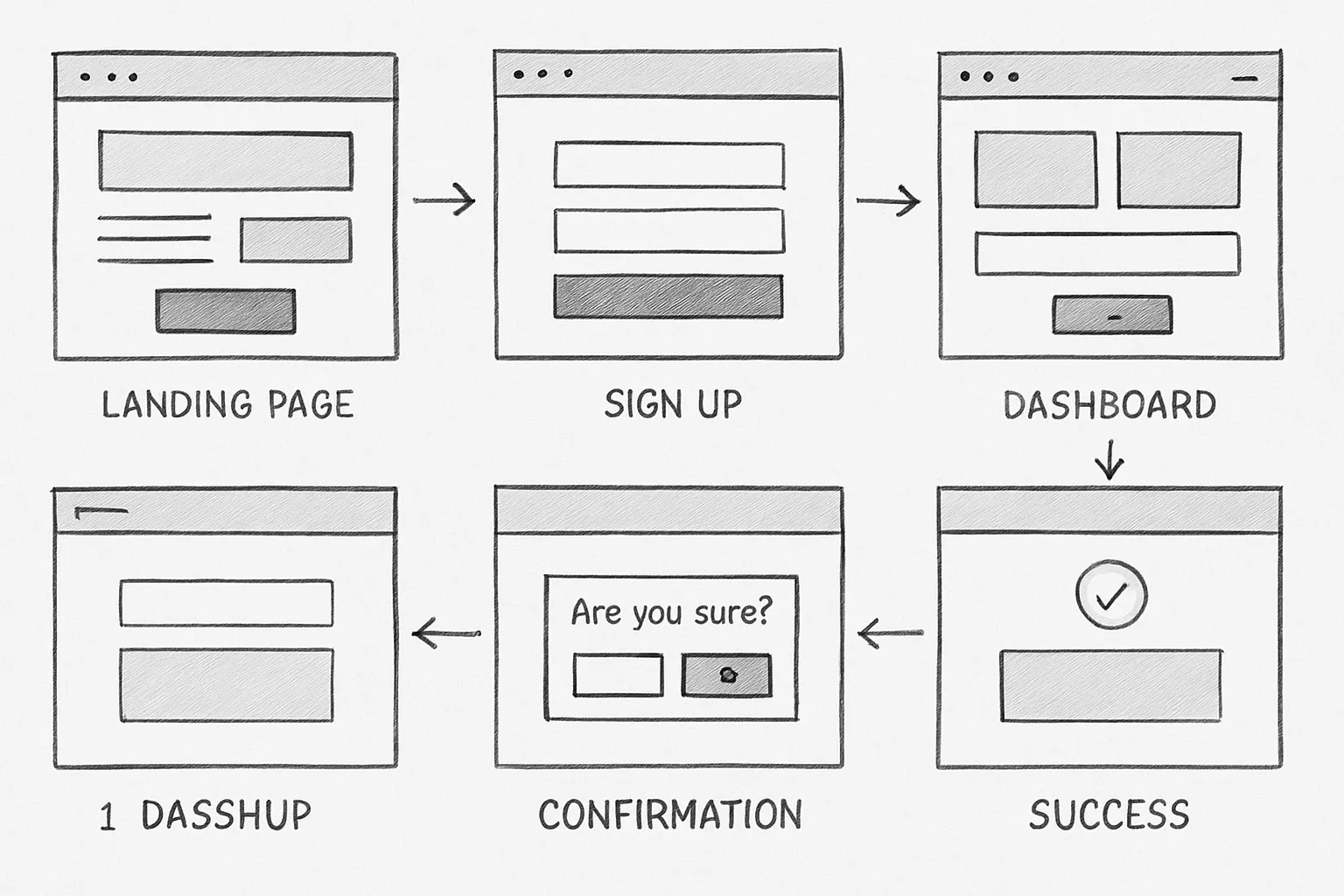
Draft end-to-end user flow for the single outcome; remove extra steps. Optimize for the shortest path to value (from entry to first success).
Prototype and test
Build lo‑fi to mid‑fi wireframes in Figma. Keep components simple to speed up iteration.
Run 5–7 usability tests; target ≥80% task completion; iterate twice quickly. Fix navigation clarity, copy friction, and button discoverability first.
Prep launch copy early
Draft headline, value bullets, and onboarding microcopy; align with test feedback. Mirror the language users use in interviews and tests for higher conversion.
Week 2.5 - Foundations: Data, No‑Code Stack, and Automation
Lay the groundwork that lets you ship fast now and scale smoothly later. Decide your stack, lock a lean data model, and set up observability so you learn from every user action.
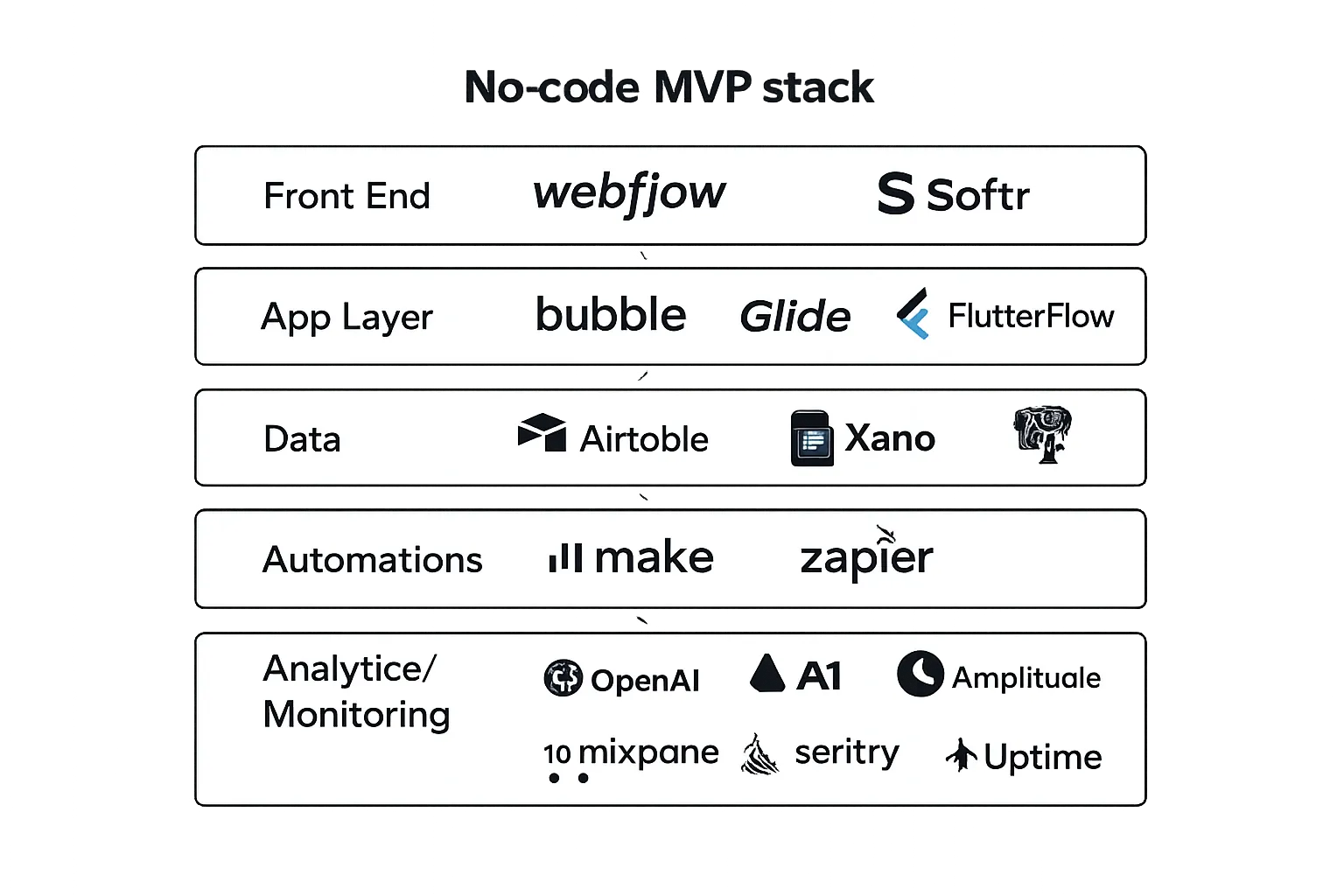
Choose a future-ready no-code stack
Front end: Webflow/Softr. Use for marketing site, docs, and lightweight portals.
Core app: Bubble/Glide/FlutterFlow (pick 1 based on complexity). Choose Bubble for web apps with complex logic, Glide for list/data-driven mobile, FlutterFlow for mobile-native performance.
Data: Airtable/Google Sheets (start) or Xano/Postgres (step-up). Start simple; plan a migration path to Xano/Postgres when you need scale or complex queries.
Automation: Make/Zapier; AI via OpenAI/Vertex for smart features. Use webhooks to orchestrate events across tools and enrich flows with AI prompts.
Minimal data model and security
Define 3–5 core tables/collections; role-based access; PII handling. Example: Users, Items, Transactions, Events, Settings.
Enforce least-privilege access, field-level privacy for PII, encrypted storage, and audit logs. Document data retention and deletion flows.
Observability from day one
Analytics (Plausible/GA4) + event tracking (Mixpanel/Amplitude). Track activation, first-task success, and core funnel drop-off.
Error monitoring (Sentry analogs), uptime checks. Add alerting for 4xx/5xx spikes and workflow failures in Make/Zapier.
Staging and versioning
Set a staging workspace/app; release notes; rollback plan. Use feature flags or duplicate apps for safe testing.
Versioned releases every 2–3 days with a change log tied to user impact and a “back-out” step if metrics or errors regress.
Week 3 - Build: Ship the One Core Feature, Fast
Focus on delivering one complete, valuable workflow. Keep scope microscopic, quality visible, and release cadence tight.
Build the core value end-to-end
Implement the single primary workflow (submission → processing → result). Ensure the path from “start” to “value” is uninterrupted.
Include essential guardrails: input validation, empty states, basic error handling. Protect the happy path and make recovery obvious.
"A Minimum Viable Product is the smallest thing you can build that delivers customer value (and as a bonus captures some of that value back)." - Ash Maurya, Running Lean
Keep the surface area tiny
No accounts if not essential; if needed, enable simple email sign-in or one social login. Reduce friction to first value.
Defer payments; if necessary, Stripe Checkout link-only. Don’t block validation with complex billing logic.
Quality quickly
Test daily against a checklist; log bugs in ClickUp/Notion; pair tests across devices. Prioritize fixes that unblock the core task.
Content control: set up CMS/collections so non-devs can iterate fast. Keep copy, FAQs, and UI text editable.
Prep go-live artifacts
Onboarding, empty-state tips, lightweight privacy/terms. Reduce confusion with clear microcopy and simple safeguards.
Soft-launch cohort identified and ready. Line up 20–30 target users for immediate feedback on the core flow.
Week 4 - Validate and Launch: Test, Metrics, and Growth Loops
Turn your no code MVP into real traction. This week is about learning from real usage, tightening the activation funnel, and shipping publicly with a clear next-sprint plan.
Soft launch and feedback capture
Invite 20–50 target users; aim for coverage across your primary persona.
Enable in-app feedback (Typeform/Featurebase) and session replay to observe friction in the core flow.
Tag feedback by severity and theme (navigation, copy clarity, performance) to speed triage.
Instrument the activation funnel
Define your activation event (the one outcome that proves value). Example: “Generated first report” or “Completed first booking.”
Measure sign-up → activation → retention D7. Create a simple dashboard to track daily.
Track time-to-value (TTV) and first-task success rate to see how quickly users reach the “aha.”
Iterate fast
Fix blockers first (navigation, clarity, broken steps). Prefer fast fixes over perfect refactors.
Ship small improvements daily; document impact on TTV, activation, and error rates.
Announce changes in-app (changelog or tooltip) to close the loop with early users.
Public release checklist
Production domain + SSL; feature flags for risky areas; monitoring and rollback plan live.
Founder story post on LinkedIn/Twitter explaining the problem, the journey to build your MVP without code, and a clear CTA.
Product Hunt if appropriate; share in targeted communities and niche forums where your users already hang out.
Plan the next 30 days
Turn insights into a prioritized backlog (RICE). Rank by reach, impact, confidence, and effort.
Schedule a two-week improvement sprint focused on activation lifts (onboarding copy, defaults, empty states) and retention (reminders, saved progress).
Define growth loops you can test quickly (referral prompt after activation, waitlist incentives, content-led acquisition).
Set explicit targets for the next sprint: activation %, D7 retention %, and support response SLAs.
By closing the loop fast on real user behavior and keeping MVP builds ruthlessly focused on one outcome, you’ll ship confidently - and learn exactly where to invest next.
Tool Stack and Costs: Best No‑Code Platforms, AI Add‑Ons, and Budget
Make smart choices once and move fast. Here’s the lean, proven stack we recommend to build your MVP without code in 30 days - plus realistic costs for a tight runway.
Platforms by use case
Landing/marketing: Webflow.
App builder: Bubble, Glide, Softr, FlutterFlow (mobile).
Data/back end: Airtable, Xano.
Automations: Make, Zapier.
Analytics: GA4, Plausible, Mixpanel.
AI: OpenAI APIs for generation/classification; embeddings for search.
No-code platforms comparison
Tool | Best For | Strengths | Limitations | Learning Curve | Pricing notes |
|---|---|---|---|---|---|
Webflow | Marketing sites, simple portals | Pixel-perfect control, CMS, fast hosting | App logic limited; needs integrations for auth | Moderate (designer-friendly) | Free to start; paid site plans ~$14–$39/mo |
Bubble | Complex web apps | Visual logic, database, plugins, robust auth | Performance tuning needed; mobile native via wrappers | Moderate–High | Free dev; paid app plans typically $29–$129+/mo |
Glide | Data-first mobile/web apps | Sheet-like builder, quick lists/forms, great for internal tools | Limited complex logic; branding constraints on lower tiers | Low–Moderate | Free tier; paid ~$25–$99+/mo |
Softr | Client portals, B2B workflows | Airtable integration, memberships, roles/permissions | Advanced logic requires workarounds | Low | Free; paid ~$49–$139+/mo |
FlutterFlow | Mobile-native (iOS/Android) | Exports Flutter code, animations, Firebase integration | Requires more app architecture thinking | Moderate–High (dev-inclined) | From ~$30–$70+/mo |
Airtable | Lightweight database | Views, automations, easy collaboration | Not ideal for heavy relational workloads | Low | Free; $20–$45/user/mo for advanced features |
Xano | Backend-as-a-service | Scalable APIs, auth, business logic | No front-end; needs pairing with UI tool | Moderate | Free to start; paid from ~$29+/mo |
Make | Visual automations | Powerful routing, APIs/webhooks, affordable | Complex scenarios can get messy | Low–Moderate | Free; paid from ~$10–$30+/mo |
Zapier | Quick integrations | Huge app ecosystem, easy to set up | Higher cost at scale; less flexible than Make | Low | Free; paid from ~$20–$50+/mo |
GA4 | Web/app analytics | Standard analytics, free, events-based | Learning curve, privacy/config complexity | Moderate | Free |
Plausible | Lightweight analytics | Privacy-first, simple dashboards | Less granular than GA4 | Low | ~$9–$29+/mo |
Mixpanel | Product analytics | Funnels, cohorts, retention | Requires event design upfront | Moderate | Generous free tier; paid scales with MTUs |
OpenAI APIs | Generation, classification, embeddings | State-of-the-art LLMs, embeddings for search | Ongoing token costs; prompt engineering needed | Moderate | Pay-as-you-go (usage-based) |
Lean budget ranges for a 30-day MVP
Builder + hosting: often free → low-cost tiers. Most no-code platforms let you prototype at $0 and go live on an entry plan.
Add-ons (auth, payments, email): pay-as-you-go. Stripe, Postmark/Resend, and OpenAI bill on usage, keeping early costs minimal.
Typical month-1 range: $0–$250 for most no code MVP builds; $250–$600 if you add product analytics, custom domains, and higher usage.
Selection tips
Choose what your team already knows. Familiarity accelerates your MVP builds and reduces rework.
Prefer ecosystems with strong templates and communities. Faster starts, easier answers, and fewer blockers when you need help.
Design for migration: start simple (Airtable/Glide) but map a path to step-up components (Xano/Postgres, FlutterFlow) if traction hits.
Simple starting stack examples
B2B workflow: Webflow + Softr + Airtable + Make + Stripe. Speed to value, role-based access, easy client portals.
Consumer tool: Webflow + Bubble + Xano + Plausible + OpenAI. Rich app logic, scalable backend, privacy-friendly analytics, AI features.
Need help selecting the right stack to build your MVP without code? Trikon Tech can assess complexity, recommend the best-fit platforms, and set up a lean, scalable foundation so you can launch and learn in 30 days.
Conclusion - Ship in Days, Not Months with Trikon Tech
A 30-day no-code MVP gives you an unfair edge: clarity on the core problem, speed-to-market, and real learning from real users. Instead of overbuilding, you build your MVP around one measurable outcome, validate demand fast, and invest with confidence. In 2025, the winners aren’t the biggest MVP builds - they’re the teams who build MVP without code, launch, learn, and iterate.
Why Trikon Tech
Our Discover → Plan → Build process maps directly to your 30‑day roadmap, keeping scope razor-sharp and momentum high.
Rapid build cycles: launch in days, not months
Reduced costs: avoid heavy dev overhead and long retainers
Founder control: manage content and updates without developers
Fast prototyping: test a no code MVP and iterate on real feedback
Scalable growth: choose platforms that grow with users and features
Data mastery: practical analytics, dashboards, and pipelines that inform every decision
Next step
Ready to ship a working MVP quickly and de‑risk your idea? Book a discovery call and start your no-code MVP in days.
CTA: Start your no-code MVP this month. Talk to Trikon Tech today.