

WA Chatbot: What Businesses Need to Know
If your customers already live in WhatsApp, your business needs to meet them there with speed, consistency, and context. A WA chatbot helps you do exactly that: automate replies, qualify leads, recover abandoned carts, book appointments, and support customers 24/7 without forcing your team to answer the same questions all day.
For growing brands, service businesses, enterprise support teams, and agencies, the challenge is not whether WhatsApp matters. It is how to turn it into a real business channel without creating operational chaos. That means more than sending messages. You need automation, a shared inbox, human handoff, campaign tools, and workflows that actually move revenue and reduce support load.
At Trikon Tech, we see WhatsApp as more than a messaging app. As an official WhatsApp Business API partner, Trikon gives businesses a unified platform to run support, marketing, bots, bookings, and conversational commerce from one place - with minimal setup and no large engineering team required.
"As of May 2025, WhatsApp reported over 3 billion monthly active users worldwide." - Source
"WhatsApp Business messages have about a 98% open rate, while average email open rates across industries are around 21.8%." - Source
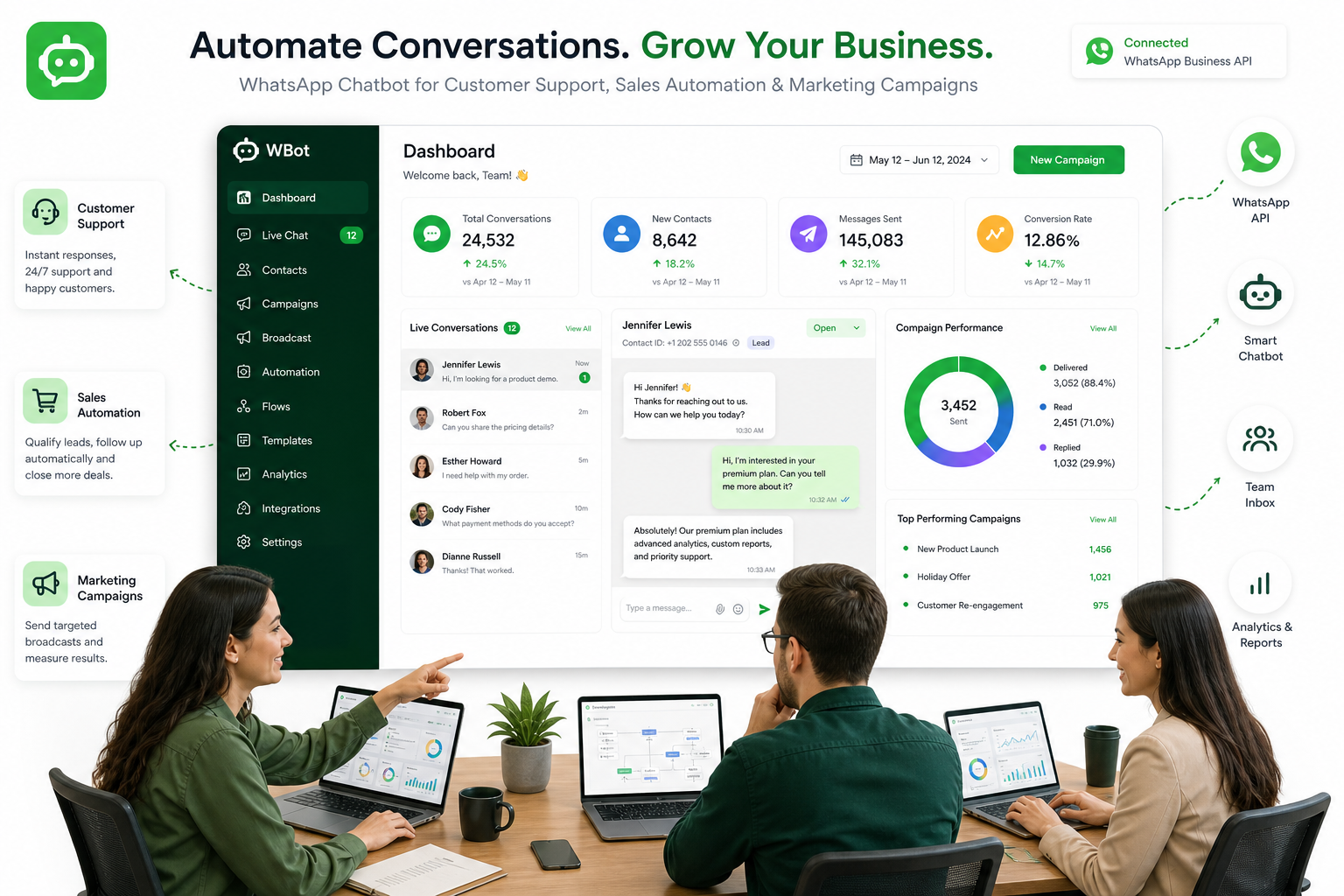
What is a WA chatbot?
A WA chatbot is a WhatsApp-based automated conversation system that interacts with customers inside WhatsApp. It can answer FAQs, collect leads, route conversations, share product information, confirm bookings, trigger reminders, and escalate complex issues to live agents.
The best WA chatbots are not just simple auto-repliers. They sit inside a broader customer communication workflow and connect to your support, sales, and operations stack.
In practical terms, a WA chatbot can:
greet new leads instantly
answer repetitive customer questions
capture names, intent, and contact details
recommend products or services
send payment or booking links
hand conversations to human agents with full context
follow up automatically when a user drops off
For most businesses, the real value is not automation alone. It is automation plus visibility plus human takeover when needed.
How a WA chatbot fits into the conversational marketing landscape
Many businesses think of chatbot software as a standalone feature. That is usually where competitor content stops. In reality, a WA chatbot performs best when it is part of a larger conversational marketing and CX system.
The bigger picture
A customer may:
click a WhatsApp ad
start chatting with your bot
browse your catalog
ask a question about delivery
get routed to a sales agent
place an order
receive follow-up messages
get post-purchase support in the same thread
That is not “just a bot.” That is a full conversational customer journey.
Where the ada chatbot discussion fits
The keyword ada chatbot often comes up when businesses research AI-powered customer service and automation tools. In the broader market, ADA-style chatbot experiences are associated with smart conversational flows, lead qualification, and support automation. But the key question is not just which bot brand or model to use. It is whether your chatbot is connected to the channel your customers actually prefer.
For many businesses, that preferred channel is WhatsApp.
So the more strategic question becomes:
Do you want a chatbot in isolation?
Or do you want a WhatsApp-first customer channel that blends AI automation, no-code workflows, agent collaboration, and conversion tools?
That is where Trikon stands out. Instead of treating chatbots as a disconnected tool, Trikon brings together:
shared support inbox
marketing automation
AI and rule-based chatbots
bookings and operational workflows
WhatsApp storefront and commerce
Why businesses are prioritizing WhatsApp over traditional channels
Email is crowded. Web forms create friction. Phone support is expensive. Live chat is often disconnected from mobile behavior. WhatsApp solves a different problem: it meets customers in a channel they already check constantly.
Why WhatsApp works so well
1. It is where customers already are
Customers do not need to download anything new or learn a new interface.
2. It feels personal and immediate
Messages arrive in a familiar environment, which improves open and response rates.
3. It supports the full customer lifecycle
From lead generation to support and repeat purchase, WhatsApp can carry the whole journey.
4. It is operationally efficient
A single team can manage large volumes through automation, routing, and a shared inbox.
5. It is stronger when tied to workflows
WhatsApp is not only for chatting. It can handle reminders, appointment confirmations, abandoned cart recovery, payments, and order updates.
The 4 main types of WA chatbots
Not every chatbot is built the same. Choosing the right type depends on your customer journey, support volume, and internal team capacity.
1. Rule-based WA chatbot
This type follows fixed logic. If a user selects an option or types a keyword, the chatbot sends a predefined response.
Best for:
FAQs
simple routing
business hours
appointment selection
order status prompts
Pros:
fast to launch
easy to control
predictable behavior
Cons:
limited flexibility
weaker at handling natural language variation
2. AI-powered WA chatbot
This type uses AI or NLP to understand user intent and respond more naturally.
Best for:
lead qualification
conversational support
product discovery
free-text questions
Pros:
more natural experience
handles broader inputs
reduces rigid menu dependence
Cons:
needs good setup and guardrails
must be monitored for accuracy
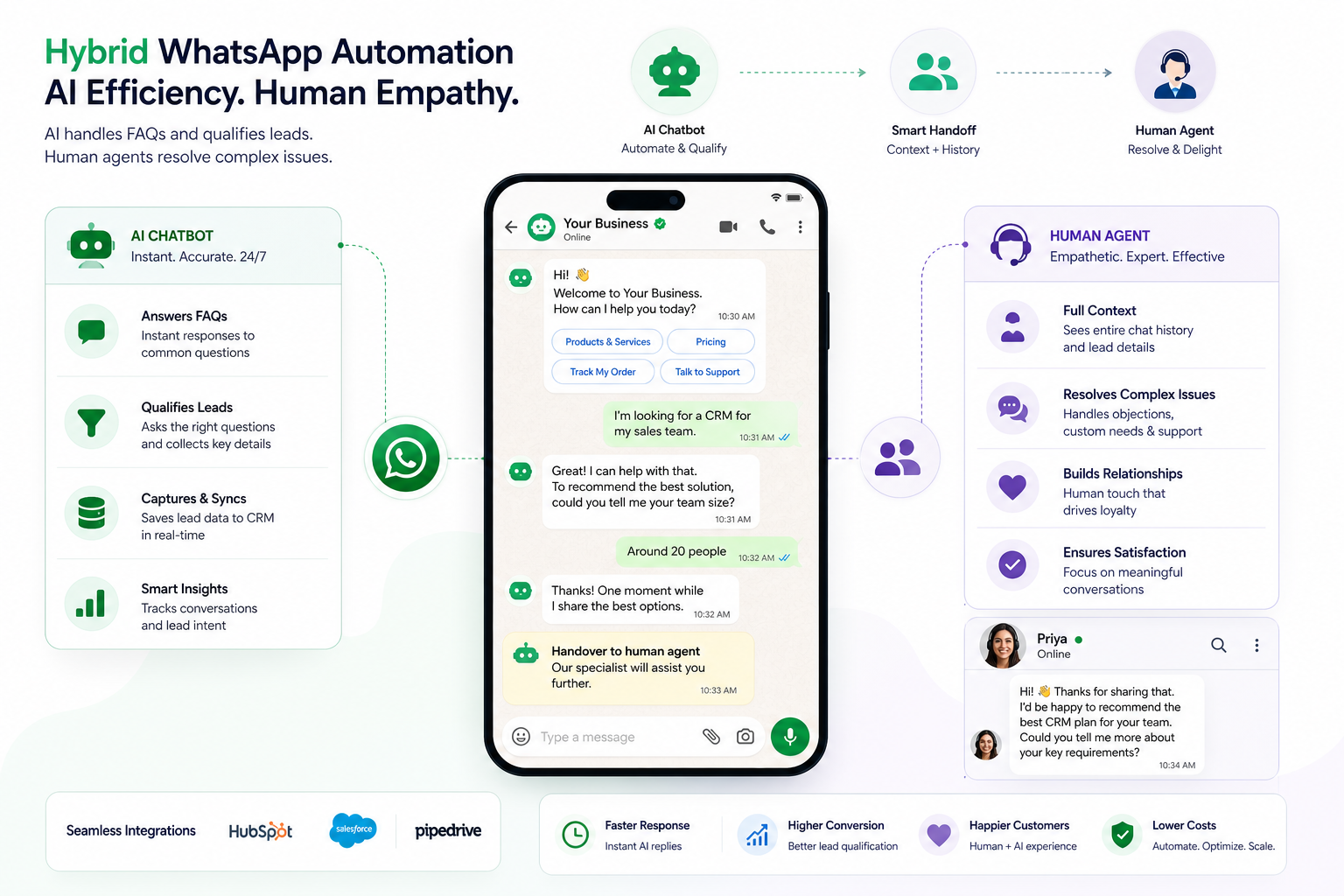
3. Hybrid chatbot with human handoff
This is often the best fit for real businesses. Automation handles repetitive queries, while agents step in for nuanced cases.
Best for:
customer support teams
D2C brands
service businesses
enterprise teams with SLA requirements
Pros:
balances efficiency and empathy
protects customer experience
scales better than human-only support
Cons:
requires a strong inbox and routing layer
4. Commerce-first WA chatbot
This type is designed to help users browse, ask, compare, and buy inside WhatsApp.
Best for:
e-commerce brands
catalog sales
repeat orders
upsell and cross-sell workflows
Pros:
strong conversion potential
shortens the buying path
keeps commerce in-chat
Cons:
works best when connected to inventory, orders, and cart logic
What a WA chatbot can actually do for your business
Competitor articles often stay too generic here. Let’s get concrete.
Customer service automation
A WA chatbot can instantly handle high-volume repetitive requests like:
order tracking
shipping questions
return policies
pricing queries
basic troubleshooting
store hours
appointment confirmation
This reduces pressure on your support team and gives customers fast answers at any hour.
With Trikon’s shared team inbox, agents can jump in when needed with access to full conversation history, customer context, assignment logic, and SLA tracking.
Lead generation and qualification
A WA chatbot can capture and qualify leads before a salesperson gets involved.
It can ask:
what service do you need?
what is your budget?
what location are you in?
when do you want to start?
what product category interests you?
That means your sales team does not waste time on unqualified inbound messages.
Sales automation
A WA chatbot can help prospects move faster through the buying journey by:
recommending products
answering objections
sharing catalogs
triggering discount reminders
recovering abandoned carts
sending checkout or payment links
For D2C and e-commerce brands, this can turn WhatsApp into a high-conversion revenue channel rather than a support-only tool.
Bookings and operations
For clinics, salons, consultants, restaurants, events, and field service businesses, a WA chatbot can streamline:
appointment booking
reservation confirmations
reminders
rescheduling
deposit collection
follow-up messaging
This is one of the most overlooked use cases in competitor content, and one of the highest ROI applications in practice.
Post-purchase engagement
The conversation should not end after a sale. A WA chatbot can:
send delivery updates
collect feedback
request reviews
suggest repeat purchases
reactivate dormant customers
That makes WhatsApp a retention channel, not just an acquisition tool.
WA chatbot vs WhatsApp Business App vs WhatsApp Business API
A lot of business confusion starts here.
Option | Best For | Automation | Multi-Agent Support | Integrations | Scalability |
|---|---|---|---|---|---|
WhatsApp Business App | Small businesses with very low volume | Limited | No | Minimal | Low |
WA Chatbot on API | Businesses wanting automation and workflows | High | Yes | Strong | High |
Trikon on WhatsApp Business API | Teams needing support, marketing, commerce, and automation in one platform | Very High | Yes | Strong | Very High |
Key takeaway
If you want a real WA chatbot that supports business growth, you need the WhatsApp Business API, not just the free app.
As an official API partner, Trikon helps businesses launch faster while staying compliant, scalable, and operationally efficient.
What most competitor articles miss
After reviewing competitor themes, a few gaps stand out clearly.
Gap 1: They talk about chatbots, but not inbox operations
A chatbot alone does not solve customer communication. Teams also need:
agent assignment
ownership visibility
conversation history
SLA management
internal accountability
Trikon solves this with a shared support inbox built for teams, not just bots.
Gap 2: They underplay the hybrid model
The highest-performing setups are not bot-only. They combine automation for repetitive questions with human handoff for complex issues.
That hybrid approach protects CX while still reducing manual workload.
Gap 3: They separate support, marketing, and commerce
In reality, these functions overlap constantly inside WhatsApp. A customer can move from question to offer to purchase in one thread.
Trikon brings these journeys together in one system.
Gap 4: They ignore agency and white-label opportunities
Agencies increasingly want to offer WhatsApp automation to clients without building a custom stack from scratch. A scalable, no-code, agency-ready platform is a major market need.
Gap 5: They gloss over setup practicality
Many articles imply businesses need heavy engineering resources. That is not true. Platforms like Trikon are designed for minimal setup, faster deployment, and no-code automation.
How Trikon turns WhatsApp into a real business channel
Trikon is built for businesses that want more than isolated messaging. It gives you a single platform to run WhatsApp as a primary channel across support, marketing, operations, and sales.
1. Shared support inbox
Trikon’s support inbox helps teams manage customer conversations professionally.
Key capabilities:
multi-agent collaboration
conversation assignment
SLA tracking
customer history
smoother escalations
better accountability
This is especially valuable for enterprise support teams that need structure, reporting, and speed.
2. No-code chatbot and automation builder
Build flows without heavy engineering. You can automate:
FAQs
welcome sequences
lead capture
qualification flows
routing logic
support triage
AI-triggered responses
keyword-triggered actions
This is ideal for lean teams that need to launch fast.
3. Marketing automation inside WhatsApp
Trikon supports conversion-focused campaigns such as:
drip sequences
broadcasts
audience segmentation
retargeting
abandoned cart recovery
re-engagement campaigns
That makes WhatsApp a serious performance marketing channel, not just a communication utility.
4. Bookings and operational workflows
Use WhatsApp to run workflows like:
appointments
reservations
reminders
confirmations
follow-ups
payment requests
This reduces no-shows, increases convenience, and centralizes operations in a channel customers already use.
5. WhatsApp storefront and conversational commerce
Trikon helps businesses sell directly in chat with:
product catalogs
carts
orders
website sync
conversational purchase journeys
For e-commerce and D2C brands, this shortens the gap between browsing and buying.
6. Agency-ready scalability
If you are an agency offering WhatsApp chatbot or automation services, Trikon offers a scalable path with white-label positioning and minimal technical overhead.
Best WA chatbot use cases by business type
D2C and e-commerce brands
Top use cases:
product discovery
FAQs
abandoned cart recovery
order updates
post-purchase upsell
repeat order reminders
Why it works: Shoppers want fast answers and low-friction buying. WhatsApp gives both.
Appointment-based service businesses
Top use cases:
appointment booking
reminders
rescheduling
lead capture
payment collection
review requests
Why it works: It reduces manual admin and increases attendance.
Enterprise support teams
Top use cases:
first-line support automation
ticket triage
agent routing
SLA-based follow-up
conversation ownership
escalations with context
Why it works: It centralizes support while keeping service quality controlled.
Agencies
Top use cases:
client chatbot deployment
campaign execution
lead funnels
automation packages
white-label WhatsApp services
Why it works: It opens a recurring-service revenue stream without custom-building every deployment.
How to build an effective WA chatbot strategy
Start with a high-friction use case
Do not automate everything at once. Begin with a pain point that is repetitive and measurable, such as lead qualification, order tracking, or booking confirmations.
Map the conversation journey
Think through:
how users arrive
what they want
what objections they have
where they drop off
when a human should take over
Design for speed, not complexity
A good WA chatbot should feel simple. Offer clear options, short prompts, and fast resolution paths.
Use automation where it helps most
Automate repetitive, high-volume tasks. Do not over-automate emotional or complex cases.
Keep human handoff easy
The fastest way to ruin a chatbot experience is trapping users inside it. Always make escalation easy.
Connect the bot to real business outcomes
Track:
response time
resolution rate
lead conversion
booking completion
cart recovery
agent workload reduction
WA chatbot implementation checklist
Use this checklist before launch:
Checklist Item | Why It Matters |
|---|---|
WhatsApp Business API access | Required for scalable automation |
Clear use case definition | Prevents vague bot design |
Customer journey map | Improves conversation flow |
FAQ and support logic | Reduces repetitive support workload |
Human handoff rules | Protects CX on complex cases |
Shared inbox setup | Enables team collaboration |
Campaign and retargeting flows | Supports conversion and re-engagement |
Booking/payment workflow setup | Unlocks operational ROI |
Catalog or storefront sync | Enables conversational commerce |
Reporting dashboard | Proves business impact |
Common mistakes businesses make with WA chatbots
Treating the chatbot like a gimmick
If your bot does not solve a real problem, users will abandon it.
Overcomplicating the flow
Long trees and too many steps create drop-off.
No handoff path
Customers need a way to reach a human when needed.
No team workflow behind the bot
Without assignment, SLAs, and visibility, support quality breaks down.
Ignoring commerce and retention opportunities
Many brands stop at support. The real upside includes marketing automation and sales conversion too.
What to look for in a WA chatbot platform
When comparing vendors or evaluating an ada chatbot alternative for WhatsApp, focus on the full operating model, not just the bot engine.
Look for:
official WhatsApp Business API partnership
no-code setup
AI and rule-based automation
shared team inbox
agent routing and SLAs
broadcast and drip campaign support
retargeting and abandoned cart recovery
booking and payment workflows
commerce features like catalog and cart
reliable human handoff
scalability for teams and agencies
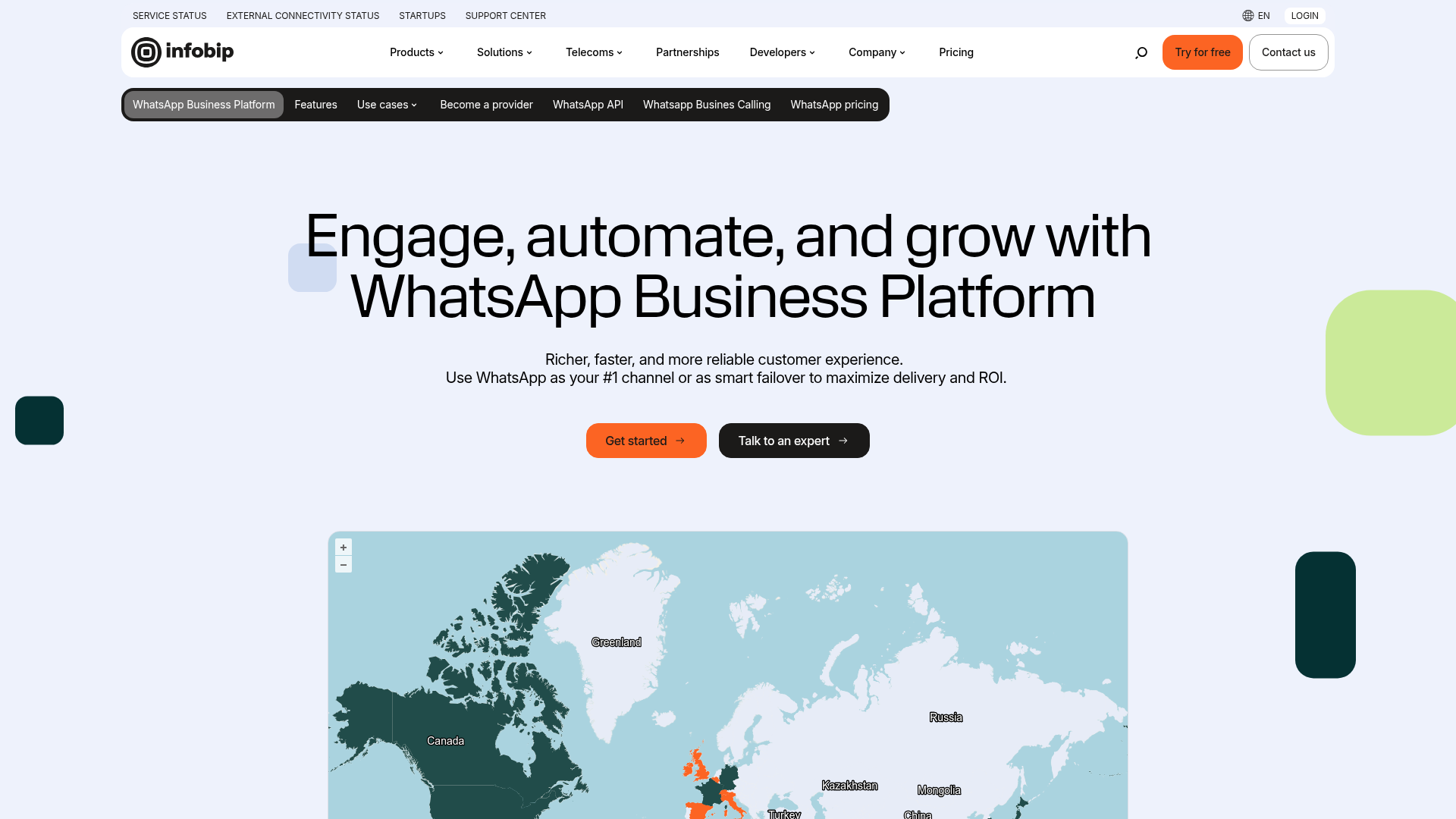
Screenshots: the platform ecosystem behind WhatsApp automation
The future of the WA chatbot: from support tool to revenue engine
The WA chatbot is evolving from a simple FAQ responder into a central layer of modern customer operations.
The businesses that win will use WhatsApp to unify:
support
sales
remarketing
appointment workflows
payments
customer retention
That is why the old “bot vs human” debate is the wrong framing. The future is automation plus agent collaboration plus commerce enablement.
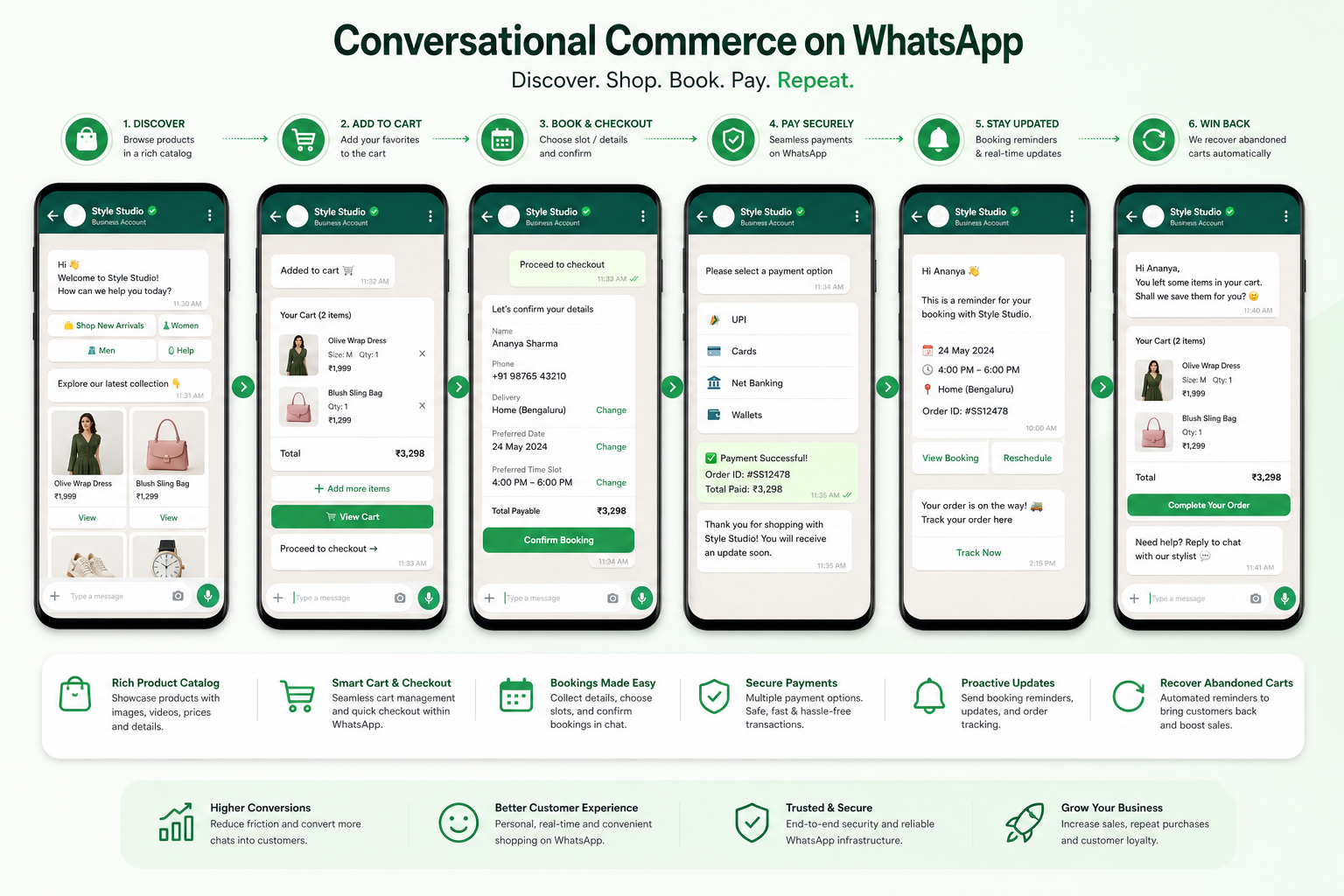
Final verdict: what businesses need to know
A WA chatbot is not just a support add-on. It is a growth tool.
Used well, it helps businesses:
respond instantly
reduce manual support load
qualify leads automatically
increase conversion
run bookings and reminders
recover carts
sell directly in chat
create a better customer experience at scale
If you are evaluating an ada chatbot style solution or researching how WhatsApp automation fits your business, the most important takeaway is this: the best results come from a platform that combines automation, inbox management, campaigns, operations, and commerce in one place.
That is what Trikon Tech is built for.
As an official WhatsApp Business API partner, Trikon gives growing teams, enterprise support operations, and agencies a simple but powerful way to turn WhatsApp into a fully operational business channel. You can launch quickly, automate intelligently, keep human support available when it matters, and scale without a massive engineering investment.
If your business wants to turn WhatsApp into a real CX and revenue engine, Trikon is the smart place to start.
FAQ
What businesses need AI chatbots?
D2C brands, e-commerce stores, service businesses, enterprise support teams, and agencies benefit most from AI chatbots because they handle repetitive conversations at scale. If your team deals with frequent inquiries, lead qualification, bookings, or sales follow-ups, an AI chatbot can reduce workload and improve response speed.
How to use WhatsApp bot for business?
Use a WhatsApp bot to automate customer support, lead capture, bookings, reminders, cart recovery, and sales conversations. The best setup combines no-code automation with a shared team inbox so human agents can step in for complex cases.
What should I know about WhatsApp Business?
WhatsApp Business App is suitable for basic small-business messaging, but serious automation and multi-agent workflows require the WhatsApp Business API. With the API, businesses can run chatbots, campaigns, support operations, and conversational commerce at scale.
What do I need to know about chatbots?
Chatbots work best when they solve clear, repetitive problems such as FAQs, lead qualification, or booking confirmations. The strongest chatbot strategy uses a hybrid model: automation for routine interactions and human handoff for nuanced support.
Which 3 jobs will survive AI?
Jobs centered on strategy, relationship-building, and complex decision-making will remain highly valuable. In the context of WhatsApp automation, that includes sales consultants, customer success managers, and support specialists handling sensitive or high-context cases.
What are the 5 big ideas in AI?
Five practical AI ideas for business are automation, prediction, personalization, natural language understanding, and decision support. In WhatsApp, these appear through chatbots that answer questions, qualify leads, tailor responses, and route users to the right next step.