

Executive overview: Why WhatsApp API trends 2026 matter for Sales & Support
WhatsApp has crossed from “useful messaging channel” to mission‑critical infrastructure for revenue and customer experience. In 2026, winning sales and support teams run their entire engagement playbook inside WhatsApp - prospecting, nurturing, ordering, support, and loyalty - powered by automation, AI, and tight CRM loops. For leaders evaluating WhatsApp API trends 2026, the message is clear: embrace chat‑first, automate what’s repeatable, and measure everything.
"WhatsApp is used by 54% of online adults globally." - Source
With Trikon, brands move beyond isolated replies to orchestrated journeys: AI assists agents, bots resolve routine questions 24×7, carts and bookings convert in chat, and a shared inbox with SLAs and analytics keeps teams accountable. This is the future of WhatsApp API - fast, contextual, and revenue‑centric.
WhatsApp’s shift from channel to core system of engagement
From one-off messaging to orchestrating end-to-end journeys
Replace fragmented touchpoints with continuous, automated flows - from lead capture and qualification to purchase, delivery, and re‑engagement - inside WhatsApp.
Trikon’s hybrid automation routes FAQs to bots and complex cases to humans with full conversation history.
Chat-first expectations: instant responses, personalized flows, in-chat transactions
Buyers expect sub‑minute replies, tailored recommendations, and no redirects. AI in WhatsApp support and WhatsApp sales automation meet this standard.
Storefronts, carts, appointments, payments, and operations can now live natively in chat - reducing drop‑offs and shortening cycles.
What’s new in 2026 for go-to-market and CX teams
AI in WhatsApp support: from FAQ bots to agent co-pilots
Beyond simple FAQs, agent co‑pilots surface next‑best actions, draft answers from policies/KBs, and escalate with context - improving first‑contact resolution and CSAT.
WhatsApp sales automation powering storefronts, carts, and bookings
In‑chat catalogs, guided product discovery, dynamic offers, and abandoned‑cart recovery drive conversions without leaving WhatsApp. Service brands fill calendars via automated bookings and reminders.
CRM-centric operations: shared inboxes, SLAs, analytics
A centralized inbox with assignment, priorities, and SLA timers keeps teams accountable; CRM data enriches conversations; dashboards expose reply times, conversion influence, and agent productivity.
Privacy-by-design operator tools and compliance-by-default templates
Role‑based visibility, redaction, consent capture, and approved templates reduce risk while maintaining speed. Trikon’s compliance‑first approach supports regulated workflows at scale.
How to read this guide
Each trend explained with use cases for Sales & Support
See practical plays: lead nurturing, order updates, returns, renewals, service triage, and proactive retention.
What it means for businesses + adoption for small/medium teams
Clear “so what” takeaways and phased rollouts - how SMB teams can start fast with high‑ROI WhatsApp automation trends.
KPIs to track impact and scale with confidence
Measure time‑to‑first‑response, resolution time, opt‑in growth, conversion rate, revenue from WhatsApp, cart recovery rate, CSAT, and SLA adherence to prove value and guide scale.
The big picture: Future of WhatsApp API - 7 forces reshaping revenue and CX
WhatsApp is no longer a side channel - it’s the core engagement fabric where customers browse, buy, and get support. The future of WhatsApp API is defined by seven forces that compress response times, automate repetitive work, and make revenue influence measurable across sales and support. If you’re tracking WhatsApp API trends 2026, these are the shifts that will decide who converts faster and retains longer.
"Conversational commerce channels will facilitate over $290 billion in spending globally by 2025." - Source
The 7 forces
AI assistants embedded in WhatsApp support and guided selling
AI in WhatsApp support evolves from simple FAQ bots to intent-aware assistants and agent co-pilots that draft answers, suggest next-best-actions, and hand off contextually.Lifecycle automation and lead nurturing flows with silent triggers
Behavioral and “silent” triggers (e.g., product view, cart idle, SLA risk) kick off drip sequences, nudges, and re-engagement without human intervention.Multi-channel CRM integration and a centralized, SLA-driven inbox
A shared inbox with assignment rules, SLAs, and omnichannel history creates one source of truth - and closes the loop between marketing, sales, and support.Privacy, consent, and template governance at scale
Consent capture, role-limited views, and Meta-approved templates become operational guardrails so teams can move fast without compliance risk.Conversational commerce: catalogs, carts, payments, and order ops
End-to-end commerce happens in chat - catalogs, carts, offers, payments, confirmations, returns, and reorder flows.Cloud API reliability and simpler onboarding at scale
The Cloud API standardizes setup, improves delivery, and reduces infrastructure overhead - accelerating go-live across regions and brands.Data-driven optimization with end-to-end attribution
Tight attribution links WhatsApp touches to pipeline and revenue; leaders optimize by FRT, CSAT, cart recovery, and rep productivity, not message volume.
What this means for Sales and Support
Sales: shorter cycles, higher conversion, measurable revenue influence
Guided selling, in-chat checkout, and automated nurturing reduce drop-offs and make WhatsApp sales automation directly accountable to pipeline and bookings.
Support: lower handle times, 24×7 coverage, better CSAT and retention
AI deflects repetitive tickets, co-pilots accelerate resolution, and SLA-driven routing keeps promises visible and met.
Force-to-impact matrix
Force | What changes in the API/experience | Impact on Sales | Impact on Support | Team/process implications |
|---|---|---|---|---|
1) AI assistants in support and guided selling | AI suggestions, intent detection, co-pilot drafting; smarter handoffs with full context | Faster discovery, tailored offers, higher win rates | Higher FCR, faster AHT, consistent quality | Train on KB/FAQs; define escalation rules; monitor AI responses and outcomes |
2) Lifecycle automation with silent triggers | Event-based drips (viewed, clicked, abandoned, delivered, SLA risk) | Fewer no-shows, better nurture → conversion lift | Proactive updates reduce inbound load | Map journey events; set throttle/consent; align content to each trigger |
3) Multi-channel CRM + SLA inbox | Shared inbox, assignment, priorities, omnichannel history, SLA timers | Clear ownership → faster follow-up and velocity | Reduced rework; continuity across channels | Define routing/ownership; standardize notes/tags; SLA policy and reporting |
4) Privacy, consent, template governance | Built-in opt-in capture, role-based visibility, Meta template controls | Higher deliverability; less churn from spammy sends | Trust and compliance in regulated flows | Centralize consent; template QA; periodic policy reviews |
5) Conversational commerce (catalogs, carts, payments, ops) | In-chat catalogs, carts, offers, order updates/returns | More checkouts, better AOV via cross/upsell | Fewer “where is my order” tickets; smoother returns | Sync product/inventory; standardize policies; connect OMS/PSP |
6) Cloud API reliability + onboarding | Faster setup, better uptime, scalable throughput | Launch campaigns faster; handle peaks smoothly | Stable service windows; predictable delivery | Document onboarding; sandbox-to-prod checklists; capacity planning |
7) Data-driven optimization + attribution | FRT, CSAT, cart recovery, pipeline/revenue attribution | Spend to impact clarity; optimize per segment | Resource to impact clarity; deflection vs. CX balance | Unify dashboards; QA event tracking; monthly optimization rituals |
Where Trikon fits
Official WhatsApp Business API + unified engagement: support, marketing, chatbots, bookings, commerce - minimal setup, fast time-to-value
Trikon operationalizes these seven forces in one platform: AI/keyword bots with human handoff, broadcast and drip automations, a centralized SLA-driven inbox, privacy-by-design controls, in-chat storefront and bookings, Cloud API reliability, and revenue-grade analytics to prove impact.
Trend 1 - AI in WhatsApp support: from simple bots to agent co‑pilots
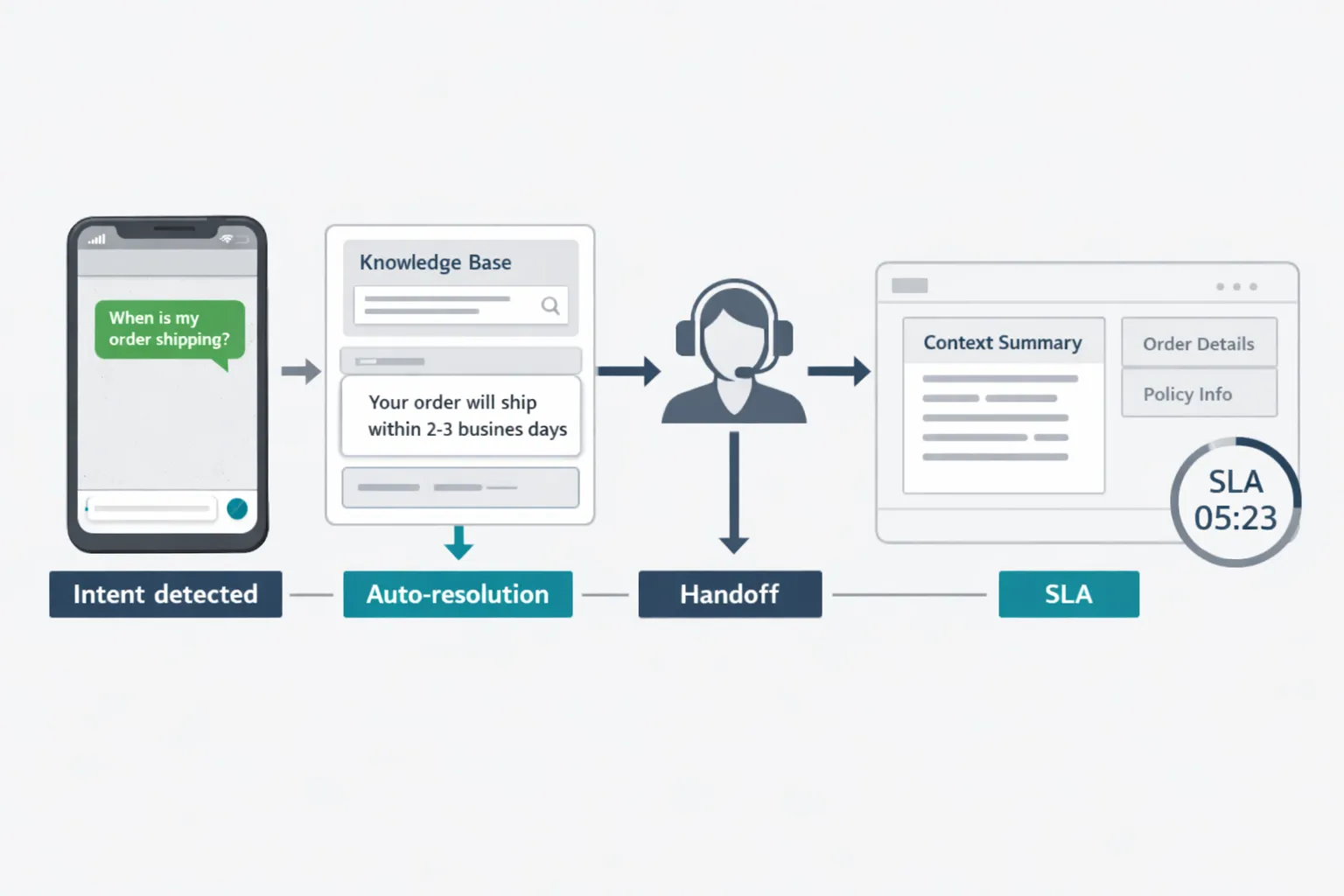
AI has matured from scripted responders to smart assistants that understand intent, retrieve answers from your knowledge base, and coach agents in real time. In 2026, the winning pattern is hybrid: automation handles high-volume, repetitive work while agent co‑pilots accelerate complex resolutions with context, compliance, and empathy.
What changed since 2024–2025
From rigid FAQs to intent-aware assistants with context memory
Models now recognize intents, entities, and sentiment; they remember prior turns to sustain coherent conversations.
AI surfaces relevant help center content, order data, and policies
Retrieval-augmented generation (RAG) pulls vetted answers from KBs, order systems, and policy docs - minimizing hallucinations.
Hybrid model: automation resolves repetitive queries; humans handle complex cases
Bots deflect routine requests (status, returns, invoices), while co‑pilots prep humans with summaries and next‑best actions.
Design patterns that work
Retrieval-augmented responses tied to your knowledge base
Connect WhatsApp to a curated KB; cite sources in replies for trust and auditability.
Smart routing: AI classifies issue, assigns owner, sets SLA
Auto‑tag by intent and priority; route VIPs to senior queues; start SLA timers immediately.
Suggested replies and summary notes for faster first-time resolution (FTR)
Draft empathetic responses; generate conversation and policy summaries to cut handle time.
Guardrails and compliance
Human override, escalation keywords, and audit trails
Always offer “agent,” “help,” or similar keywords; maintain message logs with model prompts and citations.
Clear disclosures and consent; template governance for outbound
Identify automated messages; use Meta‑approved templates for proactive outreach; respect opt‑ins and quiet hours.
Trikon advantage
No-code AI + keyword logic, seamless handoff, full history and SLAs in a shared inbox
Trikon blends AI deflection with human expertise: unified history, SLA tracking, agent assignment, and compliant templates - so teams scale support without sacrificing CX.
Trend 2 - Lead nurturing flows and silent customer triggers
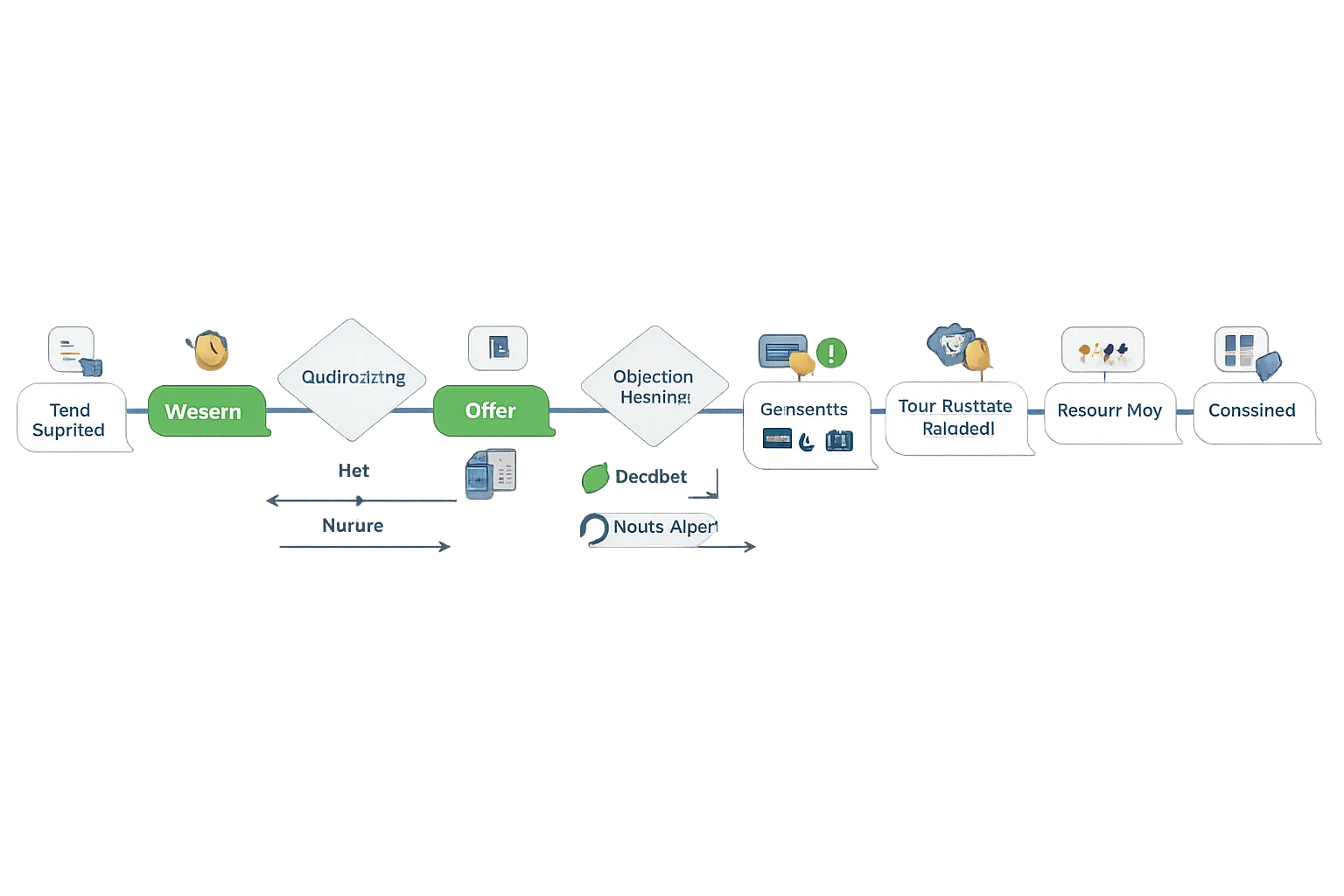
Silent triggers turn WhatsApp into a persistent yet unobtrusive guide across the customer lifecycle. Instead of waiting for a user to ask, your system reacts to key events - nudging buyers forward, rescuing stalled intents, and keeping support promises visible without noise.
What are silent triggers?
Event-based automation without explicit prompts (e.g., catalog view, payment started, invoice issued, SLA threshold reached)
When a user browses a catalog, starts checkout, or hits a renewal date, WhatsApp flows activate automatically with timely, helpful messages.
Behavioral scoring to prioritize hot leads and re-engage quietly
Score actions (opens, replies, link clicks, cart depth) and escalate only when intent is high; otherwise, nurture with light-touch check‑ins.
Sales nurture in WhatsApp
Post-click journeys from Click-to-WhatsApp ads
Instantly greet, capture preferences, and route to the right product or rep. Use quick replies and lists to keep momentum.
Drip sequences: educate, qualify, and offer right-time CTAs
Micro‑lessons, social proof, and comparison cards build trust; surface context-aware CTAs (reserve, add to cart, book a demo).
Support lifecycle in WhatsApp
Proactive updates: appointment reminders, service windows, warranty renewals
Reduce no‑shows and missed deadlines with timely nudges and self-serve links.
Recovery flows: missed-delivery rescheduling, NPS follow-ups
Turn problems into loyalty moments - automate rescheduling, share guides, and trigger human outreach on low NPS.
Trikon playbook
Visual-free, minimal-setup flows triggered from your CRM/commerce/booking events; retargeting and abandoned cart recovery baked in
Trikon listens to product, payment, and ticket events to fire the next best message - no complex visual builders - so small teams launch high-ROI nurture and recovery in days, not months.
Trend 3 - Multi‑channel CRM integration and a centralized inbox with SLAs
When WhatsApp becomes your primary system of engagement, fragmented tools slow teams down and degrade CX. The future of WhatsApp API is multi‑channel by design - Sales and Support need a single source of truth, SLA discipline, and automation that spans CRM, commerce, payments, and logistics.
Why integration is now non‑negotiable
Unify WhatsApp, email, web chat, Instagram, and voice context
One engagement layer across channels ensures consistent messaging and fewer handoffs.
One timeline per customer: no duplicate outreach, better continuity
Every touch - ad click, catalog view, order, ticket - lives in a single record so reps see the full story before replying.
Shared inbox for Sales & Support
Assignment rules, collision detection, internal notes, and @mentions
Clear ownership, no double replies, and fast internal collaboration to resolve issues or close deals.
SLA policies by priority and channel; real-time breach alerts
Timers and alerts keep teams accountable; VIP and high‑risk cases surface automatically.
Data layer and automation
Bi-directional sync: contacts, segments, orders, tickets, tags
Keep WhatsApp conversations enriched with CRM attributes and recent transactions.
Trigger webhooks to kick off journeys in CRM, billing, or logistics
Drive lead nurture, invoice reminders, shipment updates, and returns with event-based workflows.
Trikon in practice
Centralized WhatsApp inbox with conversation history, segmentation, drip, retargeting, and bookings - fast go-live, no engineering
Trikon connects to your CRM, e‑commerce, and help desk in minutes; run SLA-driven operations and revenue plays from one place.
What to integrate and why
System | Key data synced (→ from/to WhatsApp) | Example automations it enables | Impact |
|---|---|---|---|
CRM | → Lead/contact fields, segments, deal stages; ← Conversation transcripts, opt-ins, intent tags | Auto-assign owner on new WhatsApp lead; trigger stage-based drips; update deal when customer confirms in chat | Higher conversion, cleaner pipeline, no duplicate outreach |
E‑commerce/OMS | → Catalog, stock, orders, returns; ← Cart events, reorder requests | In‑chat cart recovery, back‑in‑stock alerts, return labels via WhatsApp | More revenue per session, fewer WISMO tickets |
Payment gateway | → Invoice links, payment status; ← Payment confirmations/failures | Auto-remind unpaid invoices; confirm receipts; retry failed payments with secure links | Faster cash collection, fewer manual follow-ups |
Booking/appointments | → Slots, confirmations; ← Reschedules, cancellations, no‑show flags | One‑tap confirm/reschedule; send pre‑visit checklists; recover no‑shows | Higher attendance, reduced ops friction |
Help desk/ITSM | → Ticket IDs, priorities, SLAs; ← Notes, resolution codes, CSAT | Open/update tickets from chat; SLA breach alerts; post‑resolution CSAT prompts | Lower handle time, better FCR/CSAT |
Data warehouse/BI | → Events, campaign IDs, revenue; ← Audience cohorts, LTV tiers | Revenue attribution for WhatsApp touches; push high‑LTV segments back for VIP routing | Smarter targeting, provable ROI |
Ads platforms (CTWA) | → UTM/ad ID, audience lists; ← Lead outcomes, ROAS | Sync CTWA leads to WhatsApp instantly; feed outcomes back for lookalikes | Shorter lead-to-response, improved ROAS |
ERP/logistics | → Inventory, shipment status, RMA; ← Address confirms, delivery prefs | Proactive delivery updates; missed-delivery rescheduling; RMA initiation | Fewer delivery failures, lower support load |
By integrating the right systems and operating from a centralized, SLA-driven inbox, Sales shortens cycles with measurable revenue influence, and Support drives faster resolutions with higher CSAT - exactly what WhatsApp automation trends demand in 2026.
Trend 4 - Operator privacy, governance, and compliance-by-default
Privacy and governance have shifted from “nice to have” to core operational requirements. In 2026, teams expect privacy-by-design features that protect customer data, control operator access, and codify compliance without slowing down sales or support velocity.
Privacy features teams expect in 2026
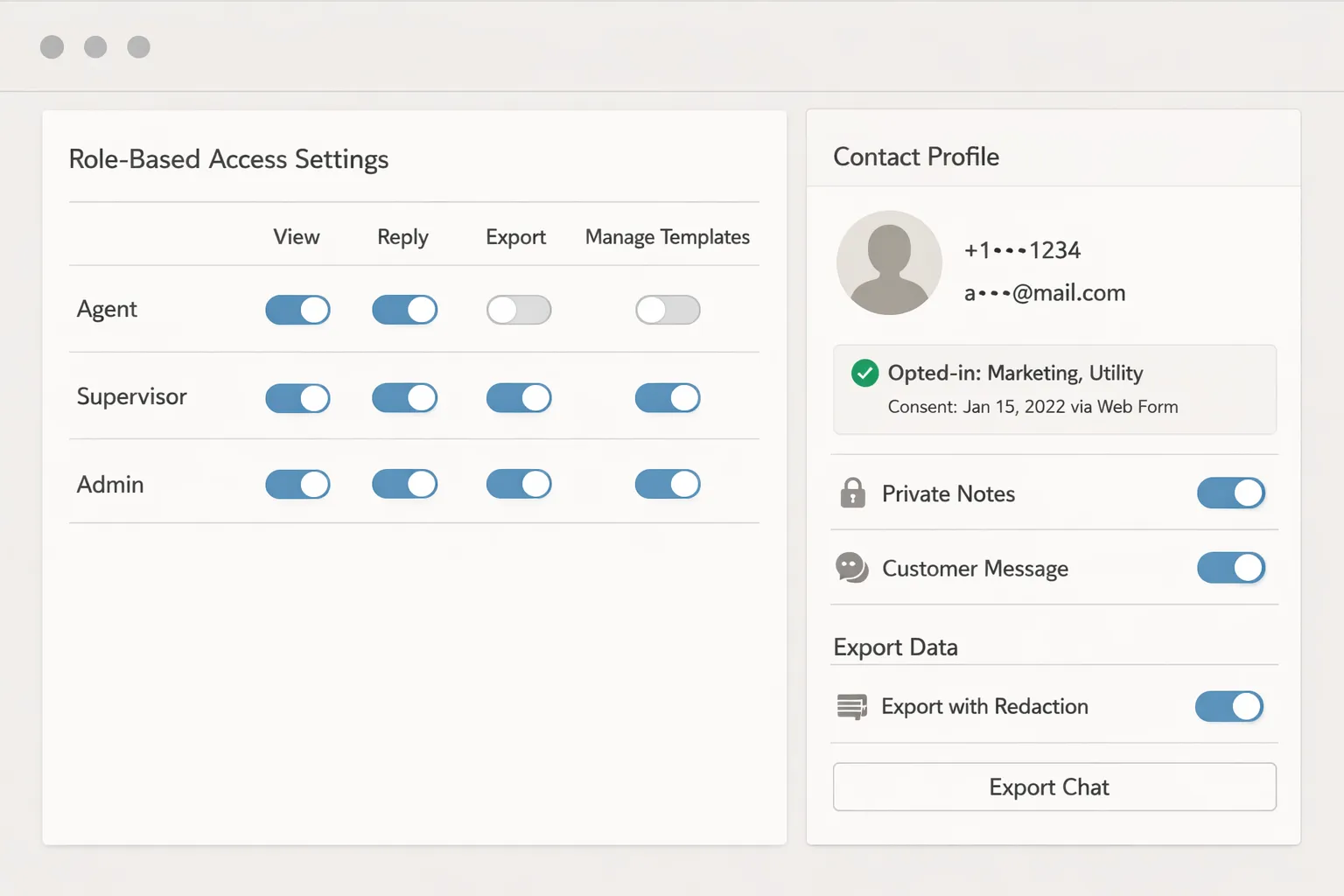
Role-based access (RBAC), least-privilege controls, and masked PII
Limit who can view, export, or bulk-message; obfuscate phone/email by default to reduce exposure risk.
Private notes vs. customer-visible messages; redaction on export
Keep internal context separate from customer threads; auto‑redact sensitive fields in exports and audits.
Template and consent governance
Opt-in capture and preference centers across entry points
Store source, timestamp, and scopes (marketing, utility, authentication) for policy‑grade records.
Template libraries with approval status, testing, and change logs
Centralize Meta-approved templates; version, test, and monitor performance to reduce rejections and blocks.
Audit and risk controls
Conversation archives, immutable logs, and export for compliance
Preserve end‑to‑end trails for regulatory or client audits, with search and role‑based retrieval.
Anomaly detection: spikes in blocks/opt-outs, off-hours spikes
Flag risky sends and enforce throttles/pauses before brand reputation is harmed.
Trikon’s stance
Official WhatsApp Business API partner; reliability, compliance, and scalable governance built-in
Trikon ships RBAC, masked PII, consent tracking, template governance, and audit trails out of the box - so teams move fast while staying compliant.
Trend 5 - WhatsApp sales automation and in‑chat commerce
WhatsApp is now a full funnel - from discovery to checkout to support - without forcing customers to switch channels. By automating key revenue plays and embedding operations in chat, teams reduce drop‑offs and turn intent into purchases in minutes.
From discovery to purchase without drop-offs
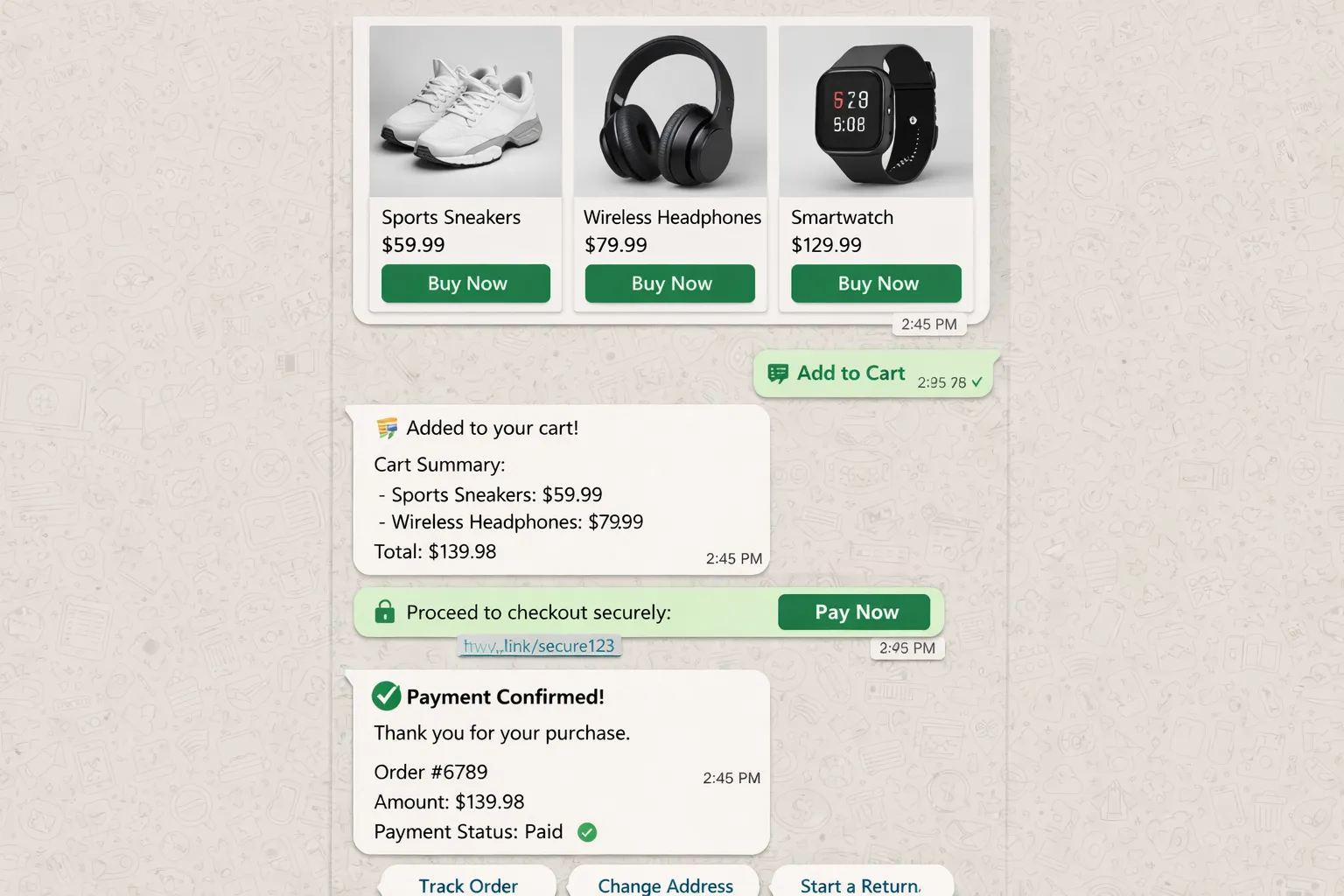
Catalogs, carts, and inventory in chat; in-line product Q&A
Shoppers browse carousels, check variants, and ask questions - all inside WhatsApp.
Payment links and confirmations; refunds/exchanges updates
Secure links complete checkout; automated receipts, refunds, and exchange notifications maintain trust.
Proven revenue plays
Abandoned cart recovery with incentives and smart timing
Layer urgency, social proof, and limited perks to lift completion rates.
Back-in-stock and price-drop triggers; preorder flows
Convert interest into orders the moment availability or pricing changes.
Bookings and reservations with reminders and change windows
Fill calendars and reduce no‑shows with one‑tap confirmations and reschedule options.
Support + operations synergy
Proactive order status, delivery scheduling, service tickets
Reduce “where is my order?” by pushing updates and self-serve tools proactively.
Smooth handoff between bot and agent during checkout blockers
If payment fails or verification is needed, route to an agent with full context.
Trikon commerce toolkit
WhatsApp storefront, retargeting flows, and operations in one place; no complex builders required
Trikon unifies catalogs, carts, payments, abandoned‑cart recovery, and post‑purchase support - so small teams launch revenue programs fast and scale confidently.
What it means for businesses: adoption playbooks for small/medium teams
Small and medium teams can operationalize WhatsApp API trends 2026 in weeks - not months - by focusing on core building blocks: compliant opt-ins, SLA-driven inbox, lifecycle automation, and clear KPIs. Here’s a pragmatic, product-led path to value.
Quick-start blueprint (30/60/90 days)
30 days: connect WhatsApp API, import contacts with consent, ship 3 approved templates (welcome, order update, NPS), launch basic bot + human handoff
60 days: build nurture flows with silent triggers, set SLAs, launch abandoned cart + back-in-stock, enable shared inbox and tagging
90 days: integrate CRM and payments, roll out segmentation + drip, add bookings/operations, build KPI dashboards and QA reviews
Phase | Objectives | Key tasks | Trikon features to use | Success metrics |
|---|---|---|---|---|
30 days | Go live fast with compliant messaging and basic automation | Verify business, connect WhatsApp API; import consented contacts; create 3 Meta-approved templates (welcome, order update, NPS); enable basic FAQ bot + human handoff | Official WhatsApp API, Template manager, No‑code bot + keyword logic, Shared inbox (basic), Consent capture | Time-to-first-message, Template approval rate, First response time (FRT), Opt-in growth, CSAT (NPS prompt) |
60 days | Add lifecycle nurture and SLA discipline | Build silent triggers (catalog view, cart started, invoice issued); configure SLAs and priority queues; launch abandoned cart + back‑in‑stock; roll out tagging and internal notes | Event-based automations, SLA timers/alerts, Abandoned cart + back‑in‑stock flows, Inbox tagging/notes, Segmentation | Cart recovery rate, Reply rate, SLA adherence, Collision incidents (↓), Lead-to-first-call time |
90 days | Scale with integrations, segmentation, and visibility | Integrate CRM and payments; deploy drip campaigns by segment; add bookings/operations flows; publish dashboards; institute weekly QA reviews | CRM sync (bi‑directional), Payment links + confirmations, Bookings/appointments, Drip automation, Analytics dashboards | Conversion rate, Revenue influenced by WhatsApp, Show-up rate (bookings), AHT/FCR, Opt‑out and block rate (stable/↓) |
Team enablement
Roles: channel owner (governance + KPIs), bot content editor (FAQs, templates), inbox supervisors (SLAs, QA), agents (resolution + upsell)
Playbooks: response tone and style guide; escalation matrix (bot → tiered queues); template hygiene (naming, variables, testing cadence); quiet hours and consent rules
Risk checklist
Consent enforcement, opt-out clarity, send-cadence guardrails
Template approvals, PII access controls, audit exports
Channel health monitoring: delivery/read rates, block/opt-out trends, compliance alerts
Trikon fast track
Minimal setup; prebuilt flows for marketing, support, bookings, and commerce; white-label friendly for agencies
Trikon compresses time-to-value with official WhatsApp Business API, a centralized SLA-driven inbox, no‑code chatbots, retargeting and abandoned-cart recovery, bookings and payments in chat, and revenue-grade analytics - so lean teams adopt WhatsApp automation trends confidently and scale with control.
Metrics that matter: proving ROI from WhatsApp automation trends
To scale WhatsApp API trends 2026 with confidence, you need a measurement system that connects every conversation to revenue, efficiency, and CX. The goal: prove what works, cut what doesn’t, and continuously optimize automation, SLAs, and agent workflows.
Channel health
Delivery, read, response, block, and opt-out rates by template and segment
Delivery rate = delivered / attempted, sliced by template, audience, and entry point.
Read and response rates by time band (within 1, 5, 30 minutes) to detect friction.
Block and opt-out rates monitored per template and campaign to protect sender reputation.
First response time, SLA attainment, backlog and reopens
FRT (median and p90) across priorities/channels; SLA attainment by queue and agent.
Backlog aging, reopens per ticket, and collision incidents (double replies) show operational strain.
Template rejection rate and quiet-hours violations as compliance health checks.
Revenue and efficiency
Assisted conversion rate, AOV uplift, cart recovery rate
Assisted conversion: % of orders with a WhatsApp touch within your lookback window (e.g., 7/30 days).
AOV uplift: (AOV with WhatsApp touch − AOV baseline) / AOV baseline.
Cart recovery: recovered orders / total abandoned carts reached via WhatsApp.
Containment (bot-resolution) rate, cost-per-contact, time-to-resolution
Containment: cases fully resolved by automation / total cases started.
Cost per contact: (WhatsApp + platform + agent cost) / unique conversations.
Time to resolution (median, p90), plus FCR (first contact resolution) for quality and speed.
Agent productivity: resolved per hour and revenue per conversation for sales-assisted chats.
Experimentation and QA
A/B testing templates and send windows; human QA of AI responses
Test subject lines, media vs. text, CTA phrasing, and send windows by segment and geography.
Guardrails: adequate sample sizes, fixed windows, pre-registered hypotheses, and holdouts.
Weekly trend reviews with corrective actions
Review funnel drop-offs (view → reply → intent → order), SLA breaches, and containment leakage.
Corrective actions: template rewrites, throttling high-block sequences, re-routing VIP queues, and updating bot intents/FAQs.
How Trikon reports it
Prebuilt dashboards tying conversations to opportunities, orders, and CSAT; export to BI
Channel Health: delivery/read/response, FRT, SLA attainment, blocks/opt-outs by template.
Revenue Influence: assisted conversions, cart recovery, AOV uplift, revenue per conversation.
Automation: containment by intent, deflection impact, human handoff quality.
Team Performance: handle time, backlog aging, reopens, collision detection.
Compliance & Governance: template approval/rejection, quiet-hours adherence, consent growth.
Data portability: export events to your data warehouse/BI for end-to-end attribution across campaigns and channels.
By operationalizing these metrics, small and medium teams can quantify ROI from WhatsApp automation trends, optimize spend, and scale confidently - turning chat-first engagement into predictable revenue and best-in-class support.
Conclusion - Move fast on WhatsApp API trends with Trikon
Why act now
Customers expect instant, personalized, and conversational experiences
In a chat‑first world, the future of WhatsApp API is about orchestrating journeys, not blasting messages. Brands that deliver AI in WhatsApp support, smart nurturing, and in‑chat commerce win attention and loyalty.
Early movers lock in higher conversions, lower support costs, and stronger loyalty
Adopting WhatsApp automation trends in 2026 - guided selling, silent triggers, SLA‑driven inboxes - shortens sales cycles, raises CSAT, and creates measurable revenue influence.
Why Trikon
All-in-one WhatsApp platform: support inbox, marketing automation, chatbots, bookings/operations, and storefront - live fast, scale securely
Trikon unifies WhatsApp sales automation, AI‑powered support, broadcasts and drips, bookings, and commerce with minimal setup and no complex builders.
Hybrid automation + human handoff, SLA tracking, and full history
Let bots resolve the repetitive 24×7 while agents handle complex cases with context, SLAs, and complete conversation history.
Official WhatsApp Business API partner for reliability and compliance
Built for scale and governance: template approvals, consent tracking, RBAC, masked PII, and audit trails - so you move fast without risk.
Next step
See how Trikon can operationalize these WhatsApp API trends for your team - marketing, sales, and support - in weeks, not months
From lead nurturing flows and silent triggers to in‑chat storefronts and agent co‑pilots, Trikon turns WhatsApp into a revenue and CX engine.
Call to action: Book a demo at https://whatsapp.trikon.tech/