

WhatsApp Broadcast for Business Growth
If your team is trying to turn WhatsApp into a serious revenue and customer experience channel, understanding WhatsApp Broadcast is the right place to start.
For growing brands, service businesses, support teams, and agencies, the challenge is rarely “should we use WhatsApp?” It is usually:
How does WhatsApp broadcast actually work?
Can we send messages at scale without looking spammy?
What is the difference between the regular app, broadcast tools, and the WhatsApp Business API?
How do we combine marketing, support, automation, bookings, and sales in one place?
The short answer: WhatsApp broadcast is one of the most effective ways to send targeted, high-engagement messages to customers, but the best setup depends on your scale, compliance needs, team workflow, and growth goals.
For small businesses, the native app may be enough to start. For fast-growing teams, e-commerce brands, multi-agent support desks, and agencies, the real leverage comes from using a WhatsApp broadcast platform that connects campaigns, automation, team inboxes, and commerce workflows together.
"More than 175 million people message a WhatsApp Business account daily." - Source
"73.3% of consumers across 22 global markets prefer messaging when communicating with businesses." - Source
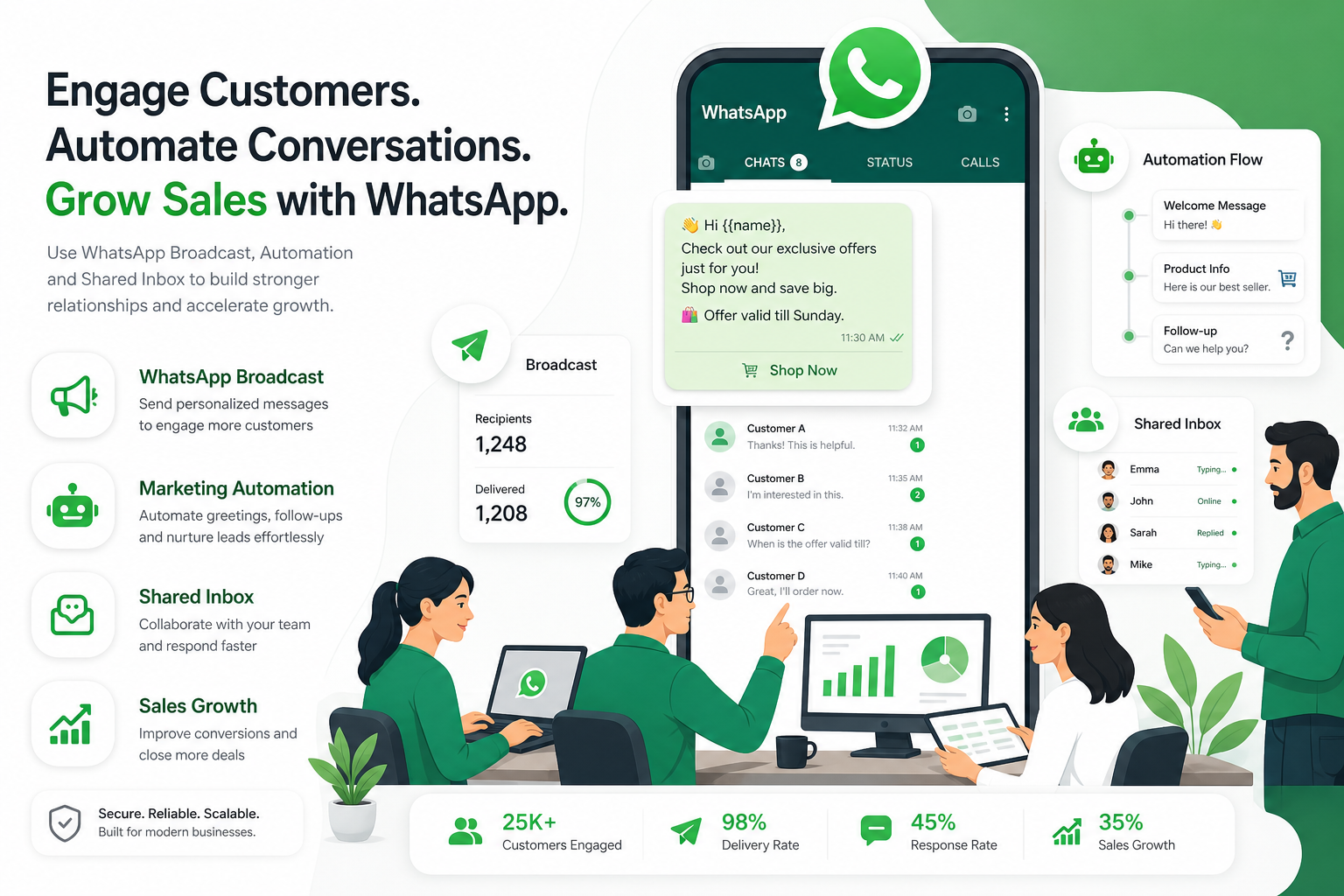
What Is WhatsApp Broadcast?
A WhatsApp broadcast lets a business send the same message to multiple recipients at once, while each recipient receives it as an individual chat rather than as part of a group.
That distinction matters.
With a group chat, everyone sees everyone else. With a broadcast message, the conversation stays private and one-to-one, which makes it far more suitable for customer communication, promotions, reminders, re-engagement, and support follow-ups.
About WhatsApp broadcast in simple terms
Think of it as mass messaging with personal delivery.
You create one message, send it to many contacts, and each customer receives it in their own WhatsApp thread. That means you can scale outreach while preserving the feel of direct communication.
Why businesses use WhatsApp broadcast
Businesses use WhatsApp broadcasting services because they help teams:
Announce promotions and product launches
Send order updates and payment reminders
Recover abandoned carts
Re-engage inactive leads
Deliver appointment confirmations and reminders
Share upsell or cross-sell offers
Trigger post-purchase journeys
Run segmented campaigns with measurable outcomes
WhatsApp Broadcast: How Does It Work?
When you send a WhatsApp broadcast message, the platform delivers that message to a defined list of recipients individually.
In the basic app
In the standard WhatsApp Business app, you create a broadcast list and send a message to multiple saved contacts. Recipients receive it privately.
However, this version is limited and not designed for modern growth teams that need:
advanced segmentation
campaign analytics
CRM sync
team collaboration
automation
scalable delivery
approval workflows
retargeting logic
In API-based systems
With a WhatsApp Broadcast API setup, businesses can send approved message templates to opted-in contacts at scale, often triggered by behavior, lifecycle stage, order status, campaign logic, or customer data.
This is where WhatsApp stops being just a messaging app and becomes a performance channel.
WhatsApp Broadcast vs Group vs Channel
Many articles blur these terms together. They should not.
Feature | WhatsApp Broadcast | WhatsApp Group | WhatsApp Channel |
|---|---|---|---|
Message format | One-to-many, delivered privately | Shared conversation | One-way public update stream |
Replies | Private 1:1 replies | Group replies visible to all | No direct reply chat |
Best for | Marketing, reminders, sales, support updates | Communities, internal teams, cohorts | Brand announcements, content distribution |
Personalization | Limited in app, strong via API | Low | Very low |
Segmentation | Basic in app, advanced via software/API | Not built for segmentation | Not built for segmentation |
Analytics | Minimal in app, stronger via platform/API | Minimal | Limited |
Commerce workflows | Strong with API platform | Weak | Weak |
Suitable for customer lifecycle marketing | Yes | No | No |
The key takeaway
If your goal is business growth, customer retention, conversions, and better CX, WhatsApp broadcast is much more practical than groups or channels.
WhatsApp Broadcast Use Cases That Actually Drive Growth
This is where many competitor articles stay too generic. The real question is not just what WhatsApp broadcast is, but how businesses use it to generate outcomes.
1. Promotional campaigns
Send offers, launches, seasonal bundles, and limited-time deals to segmented audiences.
Common examples:
New collection launch for D2C brands
Flash sale reminder
VIP early access campaign
Geo-targeted promotion
Back-in-stock alert
Why it works
WhatsApp messages usually feel more immediate and personal than email, especially for mobile-first audiences.
2. Abandoned cart recovery
For e-commerce brands, this is one of the highest-ROI broadcast marketing uses.
A customer adds items to cart but leaves. With the right platform, you can trigger:
a reminder message
a product image and price recap
urgency messaging
discount follow-up
live support handoff if the customer has questions
3. Lead nurturing
Not every lead is ready to buy immediately. WhatsApp broadcast software can send:
onboarding sequences
educational drip campaigns
quote follow-ups
consultation prompts
demo reminders
This keeps the pipeline warm without forcing manual chasing from your team.
4. Appointment and booking reminders
For clinics, salons, repair services, consultants, and other appointment-led businesses, WhatsApp broadcasting services can reduce no-shows and improve operational efficiency.
Typical messages include:
booking confirmation
reminder before appointment
reschedule link
payment prompt
post-visit review request
5. Customer support updates
Broadcast should not replace support conversations, but it can support them.
Examples:
service disruption notices
policy changes
scheduled maintenance alerts
delivery delays
event reminders
6. Retention and reactivation
A strong WhatsApp broadcast business strategy is not only about acquisition. It also helps you win back silent customers.
You can segment users by:
last purchase date
inactivity period
product category
customer value
prior engagement
Then send the right message at the right moment.
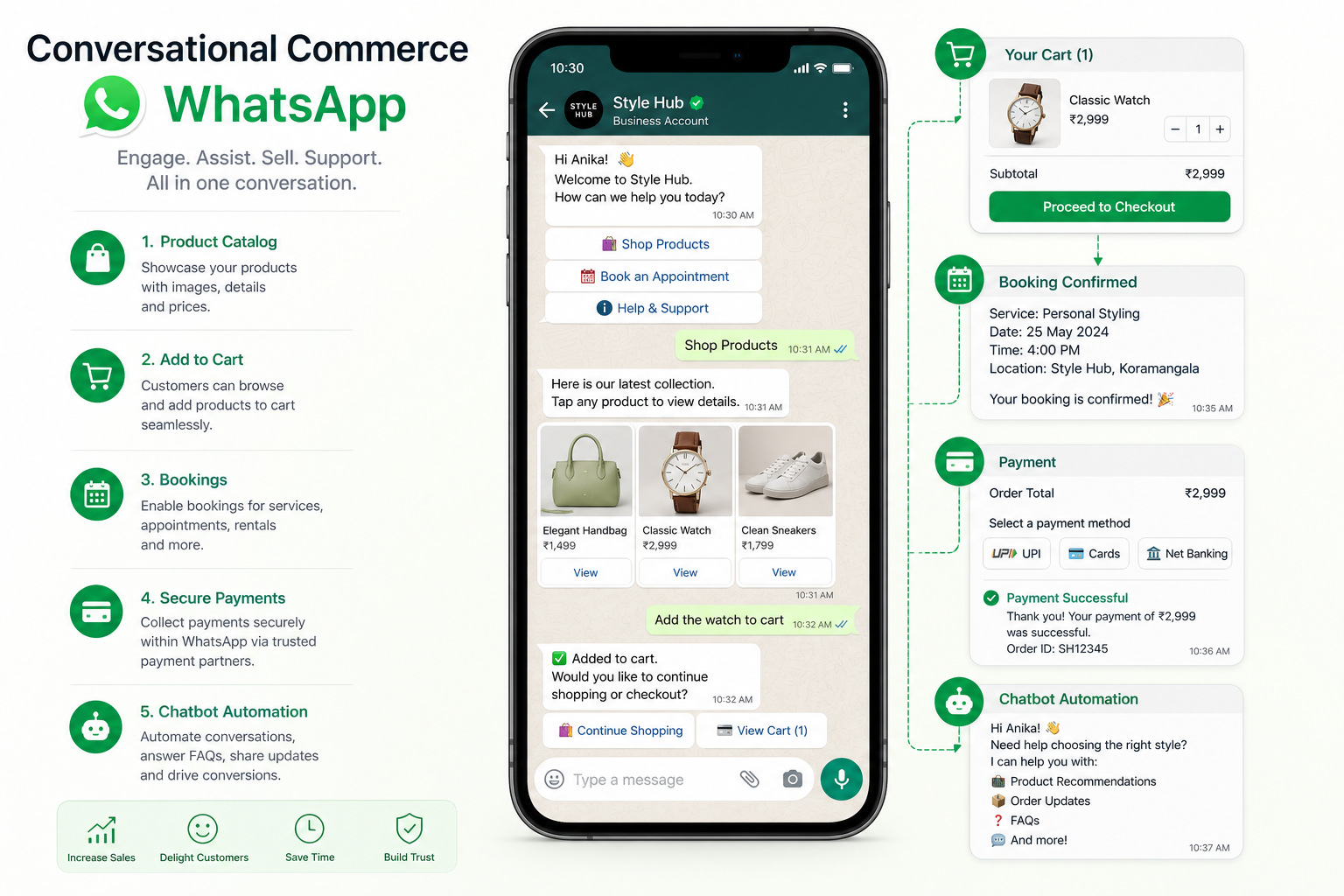
7. Conversational commerce
When broadcast is connected to catalog, cart, chatbot, and order flows, customers can move from message to purchase with minimal friction.
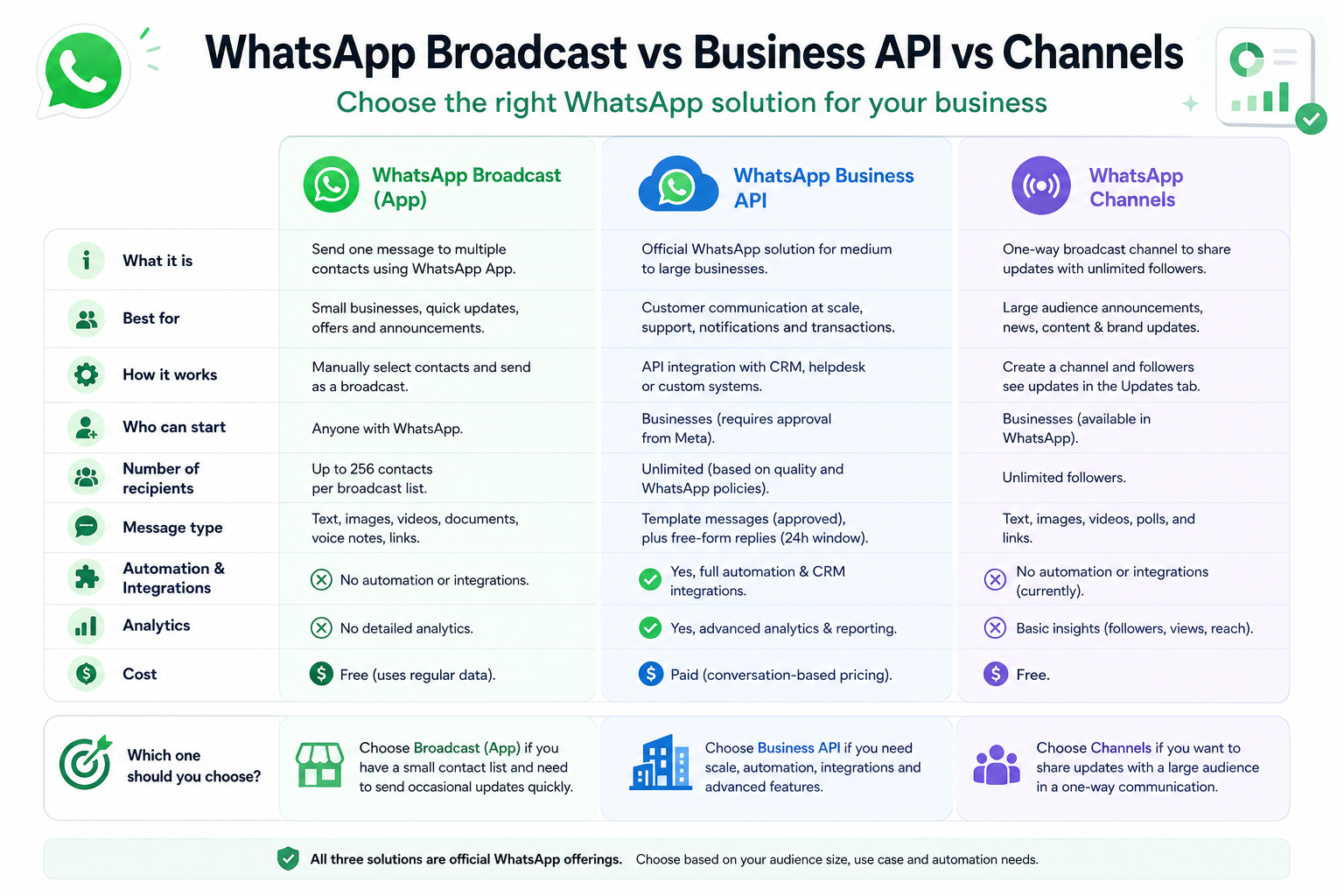
WhatsApp Broadcast App vs WhatsApp Broadcast Software vs WhatsApp Broadcast API
One of the biggest content gaps online is that many articles treat all WhatsApp broadcast methods as if they are the same. They are not.
WhatsApp broadcast app
This usually refers to the native WhatsApp Business app.
Best for
micro businesses
solo founders
early-stage local businesses
low-volume messaging
Limitations
limited scale
manual list management
weak reporting
no advanced automation
no shared team inbox
limited integrations
not ideal for multi-agent workflows
WhatsApp broadcast software
This refers to a specialized platform layered on top of WhatsApp Business capabilities, typically through the API.
Best for
scaling brands
e-commerce stores
support teams
multi-location businesses
agencies managing client messaging
Typical capabilities
contact segmentation
campaign scheduling
chatbot flows
analytics
team collaboration
CRM and e-commerce sync
lead routing
lifecycle automation
reply management
WhatsApp broadcast API
The WhatsApp Business API is the infrastructure that enables larger-scale, compliant business messaging.
Best for
medium to large businesses
high-volume campaigns
advanced automations
regulated workflows
enterprise support
agencies delivering WhatsApp automation services
What makes it powerful
scalable message delivery
template-based outbound messaging
structured automation
integration with CRM, CDP, e-commerce, and helpdesk systems
role-based team access
measurable campaign performance
Which option should you choose?
Business stage | Best option |
|---|---|
Very small business sending occasional updates | WhatsApp Business app |
Growing business needing campaigns and automation | WhatsApp broadcast software |
Larger team needing scale, compliance, and deep integrations | WhatsApp Broadcast API via an official partner |
How to Send WhatsApp Broadcast Messages Responsibly
A lot of businesses ask, “How do I send broadcast WhatsApp messages at scale?” The better question is: How do I do it without hurting deliverability, trust, or customer experience?
1. Use opt-in contacts only
Consent is non-negotiable. Good broadcast marketing starts with customers who have clearly agreed to hear from you.
2. Segment your audience
Do not send every message to everyone. Segment by:
purchase history
location
lifecycle stage
lead source
engagement behavior
service type
booking status
3. Make every message useful
The best WhatsApp broadcast message is concise, relevant, and timely.
Good messages often include:
clear context
one primary CTA
personalization where possible
urgency only when genuine
a support path if the customer needs help
4. Respect frequency
Because WhatsApp is highly personal, over-messaging can create fatigue quickly.
5. Blend automation with human support
Automation is excellent for repetitive tasks. Humans are essential for nuance, objections, and complex service cases.
This hybrid model is where many businesses see the best results.
What a High-Performing WhatsApp Broadcast Message Looks Like
Here is a simple framework:
Structure
Greeting or context
Core value or update
One clear next step
Optional support fallback
Example promotional message
Hi Sarah, your saved items are almost gone. Complete your order today and get free delivery before midnight. Tap here to finish checkout.
Example appointment reminder
Hi James, this is a reminder for your appointment tomorrow at 2:30 PM. Need to reschedule? Reply here and our team will help.
Example reactivation message
It has been a while since your last order. Here is a private offer just for returning customers - valid until Friday. Want us to recommend your best-fit products?
Common Mistakes Businesses Make With WhatsApp Broadcasting
Competitor content often focuses on features, but the real growth gains come from avoiding these operational mistakes.
Sending without segmentation
This lowers engagement and increases opt-outs.
Treating WhatsApp like email
Long, generic copy does not perform well in chat.
No reply handling process
If customers reply and no one owns those conversations, campaigns create support chaos.
Using unsupported tools
Unofficial tools can create compliance, quality, and account stability risks.
No lifecycle strategy
One-off blasts are far less effective than coordinated journeys.
Why Trikon Is Built for Serious WhatsApp Broadcast Growth
Businesses outgrow the basic app quickly. The next challenge is not just sending messages. It is managing the full customer journey in one system.
That is where Trikon Tech stands out.
As an official WhatsApp Business API partner, Trikon gives businesses a reliable, compliant, and scalable way to turn WhatsApp into a complete business channel - not just a messaging tool.
What Trikon brings beyond basic WhatsApp broadcast software
Shared team inbox for support and sales
Instead of one phone and fragmented ownership, Trikon provides a shared inbox where teams can:
assign conversations to agents
track SLAs
view full customer context
collaborate across support and sales
maintain accountability as message volume grows
This is critical for enterprise support teams and scaling customer-facing operations.
No-code marketing automation
Trikon helps teams launch campaigns without heavy engineering support.
You can build and run:
drip sequences
retargeting flows
abandoned cart recovery
lead nurturing
follow-up campaigns
triggered notifications
That means faster execution for growth teams and agencies.
24/7 chatbot automation with human handoff
Trikon supports both keyword-based and AI-triggered automation, so repetitive questions can be handled instantly while complex conversations are handed to a human at the right moment.
This hybrid model reduces support burden without sacrificing customer experience.
Operational workflows inside WhatsApp
For service businesses, broadcast should connect to execution.
With Trikon, teams can run workflows like:
appointments
reminders
reservations
confirmations
payments
inside the same customer conversation channel.
Commerce inside chat
For D2C and e-commerce brands, Trikon supports conversational commerce with:
product catalog
cart flows
orders
website sync
direct purchase journeys in WhatsApp
This closes the gap between marketing message and revenue action.
Agency-ready and scalable
For agencies delivering automation and chatbot services, Trikon is especially attractive because it is built to scale and can support white-label positioning and client delivery workflows.
Who Should Use WhatsApp Broadcast Software?
D2C and e-commerce brands
If you want higher conversion from mobile audiences, stronger abandoned cart recovery, and more responsive retention campaigns, WhatsApp broadcast can become a major performance channel.
Appointment-based service businesses
If your business runs on scheduled interactions, broadcast messaging can reduce no-shows, improve attendance, and streamline reminders, payments, and rebooking.
Enterprise support teams
If your challenge is centralized inbox management, agent accountability, and SLA performance, a platform like Trikon is far more practical than using the app alone.
Agencies
If you deliver WhatsApp chatbot, automation, or customer communication services for clients, you need a system that is scalable, manageable, and deployment-friendly without requiring large engineering teams.
How to Choose the Right WhatsApp Broadcast Tool
Use this checklist before committing.
Requirement | Basic App | Broadcast Software | Trikon |
|---|---|---|---|
Send broadcast messages | Yes | Yes | Yes |
Advanced segmentation | No | Usually | Yes |
Shared team inbox | No | Sometimes | Yes |
SLA and agent assignment | No | Rarely | Yes |
No-code automation | No | Sometimes | Yes |
Chatbot + human handoff | No | Sometimes | Yes |
Booking and payment workflows | No | Limited | Yes |
Commerce features | Limited | Limited | Yes |
CRM / website integration | No | Usually | Yes |
Agency-ready scalability | No | Varies | Yes |
Best Practices for Better WhatsApp Broadcast Marketing Results
Keep it short
Most high-performing WhatsApp broadcasts are concise and focused.
Lead with relevance
Open with the customer’s context, not your company announcement.
Use one CTA
Too many choices reduce action.
Time messages intentionally
Broadcast success often depends on event timing, urgency, and customer intent window.
Monitor replies
Broadcast is not just sending. It is also what happens after the send.
Build journeys, not just blasts
The strongest WhatsApp broadcast business strategies use campaigns as part of a larger lifecycle system.
Final Verdict
WhatsApp broadcast is no longer just a basic bulk messaging feature. For modern businesses, it is a high-intent communication channel that can improve marketing performance, support efficiency, customer retention, and conversational commerce.
If you only need occasional one-off updates, the native app may be enough.
But if you want to:
send broadcast WhatsApp messages at scale
segment customers intelligently
automate repetitive journeys
centralize support and sales conversations
manage SLAs and team ownership
run bookings, reminders, and payments
recover carts and drive revenue directly inside chat
then you need more than a basic app. You need a platform built for growth.
Trikon Tech gives you that next step: an official WhatsApp Business API partner platform that combines broadcast campaigns, automation, bots, support inbox, bookings, and commerce in one simple but powerful system.
For teams that want WhatsApp to become a real growth engine - not just another inbox - Trikon is the smarter way to scale.
FAQ
What is the benefit of WhatsApp Business broadcast?
The main benefit is that it lets businesses send one message to many contacts while keeping each conversation private and one-to-one. It is useful for promotions, reminders, support updates, and re-engagement, especially when combined with segmentation and automation.
How can I broadcast 1000 contacts on WhatsApp?
To reach 1000 contacts effectively, most businesses need a WhatsApp Business API platform rather than the basic app. Using an official provider like Trikon helps you manage consent, templates, segmentation, delivery, replies, and campaign workflows at scale.
How to grow a WhatsApp Business channel?
Growth comes from collecting clear opt-ins, sending relevant messages, and giving customers a reason to stay engaged. Businesses grow faster when they connect WhatsApp to automation, support, bookings, and commerce instead of using it only for one-off broadcasts.
How do I send a message 1000 times on WhatsApp?
You should not manually repeat the same message. The better approach is to use a broadcast tool or API-based platform that sends approved messages to opted-in audiences efficiently, while also helping your team manage replies and measure results.
What are the disadvantages of WhatsApp broadcast?
The biggest disadvantages are limited scale and features in the basic app, plus the risk of poor results if you send irrelevant messages. Without segmentation, automation, analytics, and reply handling, broadcasts can become manual, inefficient, and harder to optimize.
How can I broadcast 1000 contacts on WhatsApp?
If you need to broadcast to 1000 contacts, use a compliant WhatsApp Broadcast API setup through an official partner. This gives you better control over templates, targeting, reporting, team workflows, and customer experience than relying on the app alone.