

Executive summary: What is WhatsApp SIM‑binding and why it matters in India (2026)
"India remains WhatsApp’s largest market with approximately 535.8 million users." - Source
Definition and context
SIM‑binding, in practical terms, means a WhatsApp account’s access is explicitly tied to the active SIM card (and custody of the mobile number) present in a physical device. If the SIM is swapped out, becomes inactive, or the number changes hands (due to telco recycling), WhatsApp can trigger re‑verification or restrict access until ownership is reconfirmed via OTP and device checks.
Why this policy is surfacing now in India:
Spam and fraud containment: India’s massive WhatsApp user base makes it a prime target for unsolicited marketing, impersonation, and account takeovers. SIM‑binding raises the friction for bad actors by requiring ongoing proof of number custody.
Number recycling risks: Indian telcos frequently recycle inactive numbers. Without periodic re‑verification, a recycled number could unintentionally grant a new holder access to a prior user’s chat identity. SIM‑binding helps force a clean handover.
OTT compliance pressure: With evolving Indian regulatory expectations for OTT messaging, stronger identity, traceability, and consent signals are increasingly important. SIM‑binding aligns WhatsApp account continuity with the mobile operator’s verified number lifecycle.
For leaders operating WhatsApp in India (marketing, support, commerce), this shifts program design from “any device, any time” to “active SIM custody plus predictable verification.”
Who is affected
Affected: WhatsApp App and Business App users on physical devices
Single or rotating devices that rely on an inserted SIM for access.
SMB teams that share one phone/SIM across multiple staff.
Field operations that frequently hot‑swap SIMs or rotate handsets.
Largely unaffected: Official WhatsApp Business API (Cloud/API via BSP) numbers
API‑connected numbers (like those used with Trikon) are provisioned via Meta’s official Business API and managed in the cloud. They are not reliant on a SIM in a device, enable multi‑agent access, and support compliant automation at scale.
This is the recommended pathway for enterprise‑grade WhatsApp in India across support, marketing automation, chatbots, and commerce.
What changes operationally
Device rotation and number sharing
Expect tighter controls when moving a WhatsApp account between devices. Frequent device rotation, SIM swaps, or sharing a single SIM‑backed number across multiple people can trigger re‑verification friction or temporary access limits.
For teams using the WhatsApp Business App as a shared inbox, policies may need to shift to a centralized, API‑first workspace instead of shared devices.
OTP, re‑verification, and account recovery flows
More frequent OTP prompts: If WhatsApp detects a SIM change, inactivity, or a suspicious environment, it can demand OTP re‑verification.
Recovery tied to number custody: If a number is recycled or deactivated, recovery can become complex or impossible without telco assistance. Maintaining custody of numbers (and avoiding churn) becomes mission‑critical.
Stronger access hygiene: Clear ownership records, secure device management, and documented SOPs for number changes will reduce downtime and support escalations.
Bottom‑line for enterprises
To scale WhatsApp in India responsibly - across support, marketing, and commerce - enterprises should prioritize API‑first, SIM‑less architectures:
Reliability and compliance: API numbers avoid SIM rotation risks, align to OTT compliance expectations, and maintain clean audit trails across templates, opt‑ins, and message logs.
Operational efficiency: A centralized inbox, multi‑agent access, SLA tracking, and full conversation history are easier to maintain with an API platform than with shared phones.
Scale with automation: AI/keyword chatbots, broadcasts, segmentation, drip campaigns, and abandoned cart recovery are built for Cloud/API - not for SIM‑tethered devices.
Lower fraud exposure: Clear identity and governed template flows reduce spoofing and policy violations common with informal device sharing.
How Trikon helps
API‑first, SIM‑less foundation: As an official WhatsApp Business API partner, Trikon provisions cloud numbers, removing SIM custody risks while enabling omnichannel scale.
Unified engagement stack: Support Inbox with SLAs and full history; Marketing Automation with broadcasts, segmentation, retargeting; no‑code Chatbots with human handoff; Bookings & Operations; and a WhatsApp Storefront for catalogs, carts, and orders.
Faster go‑live: Minimal setup, no engineering required - ideal for enterprise teams migrating off shared devices.
Built for India: Designed for WhatsApp in India - from multilingual support expectations to compliant template governance - so you can run WhatsApp chat, WhatsApp support, and even WhatsApp advertising follow‑ups within a governed, high‑conversion workflow.
If your growth or CX strategy depends on WhatsApp in India, the move is clear: adopt a SIM‑less, API‑first model now to protect continuity, reduce risk, and unlock scale. Trikon makes that transition fast and future‑proof.
The rule, decoded: Technical implications for App vs Business App vs Business API
How SIM‑binding works at the account level
At its core, SIM‑binding ties account continuity to active number custody on a physical device. Practically, that affects how registration, session tokens, and recovery behave when the SIM or number state changes.
Registration and token refresh
Initial registration uses OTP sent to the number. Ongoing session validity is reinforced by periodic checks that can prompt OTP re‑verification when WhatsApp detects SIM state changes, suspicious device posture, or abnormal network conditions.
Device signals (e.g., SIM ICCID, carrier, roaming state) can trigger heightened verification and token refresh.
Re‑verification when SIM/number state changes
SIM swap or deactivation: If the SIM is removed, swapped, or suspended, WhatsApp can require OTP re‑verification before allowing continued access.
Number porting: Porting to another operator may produce brief periods where re‑verification is required as network state transitions.
Number recycling scenarios and device mismatch prompts
Telco recycling: Inactive numbers in India are often recycled. If not re‑verified, a recycled number could create identity conflicts; SIM‑binding enforcement forces a clean re‑registration.
Device mismatch: Frequent device rotation or restoring chats on a new device without a stable SIM can prompt “Confirm it’s you” challenges or temporary restrictions until OTP is validated.
"Enable two-step verification to add a PIN that’s required when registering your phone number with WhatsApp again." - Source
Impact by product tier
WhatsApp App/Business App: single‑device custody under SIM‑binding
Designed for one primary device (with optional linked devices). SIM custody must remain consistent; frequent SIM swaps or rotating handsets elevate OTP prompts and risk lockouts.
Operational constraints:
Shared phone workflows (one SIM/phone passed among staff) are brittle - expect more re‑verification prompts and downtime.
High‑movement teams (field reps) may hit device mismatch warnings when changing devices too often.
Account recovery depends on ongoing access to the phone number; if the number is lost or recycled, recovery becomes difficult.
WhatsApp Business API (Cloud/API via BSP): SIM‑less, token‑based, built for scale
No SIM required; numbers can be landline or VoIP. Authentication is handled via API credentials and Meta verification - not device/SIM checks.
Conversation service windows and templates remain unchanged:
Marketing, Utility, and Authentication templates continue to govern outbound messaging.
The 24‑hour customer service window and template rules still apply.
Operational benefits:
Multi‑agent, multi‑location access via a centralized inbox.
Stable, auditable messaging (opt‑ins, templates, logs) without device churn.
Consistent performance for WhatsApp India campaigns (broadcasts, WhatsApp chat India support, and commerce flows) without SIM‑related disruptions.
India‑specific nuances
KYC/number ownership proofing
Indian telcos enforce KYC at SIM activation to ensure traceability; strict SIM‑binding aligns WhatsApp identity to the verified subscriber lifecycle.
Enterprises should maintain clear custody records of business numbers (ownership, renewal dates, and porting history) to avoid unplanned re‑verification events.
"All mobile connections in India must be activated only after successful Know Your Customer (KYC) verification by the Telecom Service Provider." - Source
Roaming and travel edge cases
International roaming with intermittent carrier data can increase verification prompts.
Data‑only devices or eSIM transitions can lead to unexpected OTP checks; plan for predictable number custody and documented device policies.
Enterprise MDM considerations
Lock down SIM swaps on corporate devices; mandate OS‑level security (PIN/biometric) and app‑level protections.
Centralize number lifecycle management (procurement, KYC renewals, porting) in IT/Network Ops to avoid service interruptions during critical campaigns (e.g., WhatsApp advertising India activations or festival sales).
What “good” looks like
API‑first architecture: Move from device‑bound accounts to the WhatsApp Business API to eliminate SIM custody risks and enable scale across support, marketing, chatbots, bookings, and commerce.
Agent‑agnostic operations: Use a centralized inbox with role‑based access, SLA tracking, and conversation history for every agent and team.
Automation with governance: Verified templates, consent management, and compliant broadcast segmentation for high‑deliverability messaging at volume.
Resilience by design: No dependency on a physical SIM or single device; high uptime for WhatsApp support India operations and campaign spikes.
How Trikon accelerates the shift
Cloud/API via BSP: Provision SIM‑less WhatsApp numbers (including landline/VoIP) with token‑based auth and enterprise‑grade reliability.
Unified platform: Shared Support Inbox, Marketing Automation (broadcasts, segmentation, drip, retargeting), no‑code AI/keyword chatbots with human handoff, Bookings/Operations, and a WhatsApp Storefront.
Compliance and scale: Opt‑in governance, template QA, audit logs, and multi‑language support tuned for the realities of WhatsApp of India at national scale.
Operational impact by use case: D2C, support centers, field teams, and retail
D2C and eCommerce
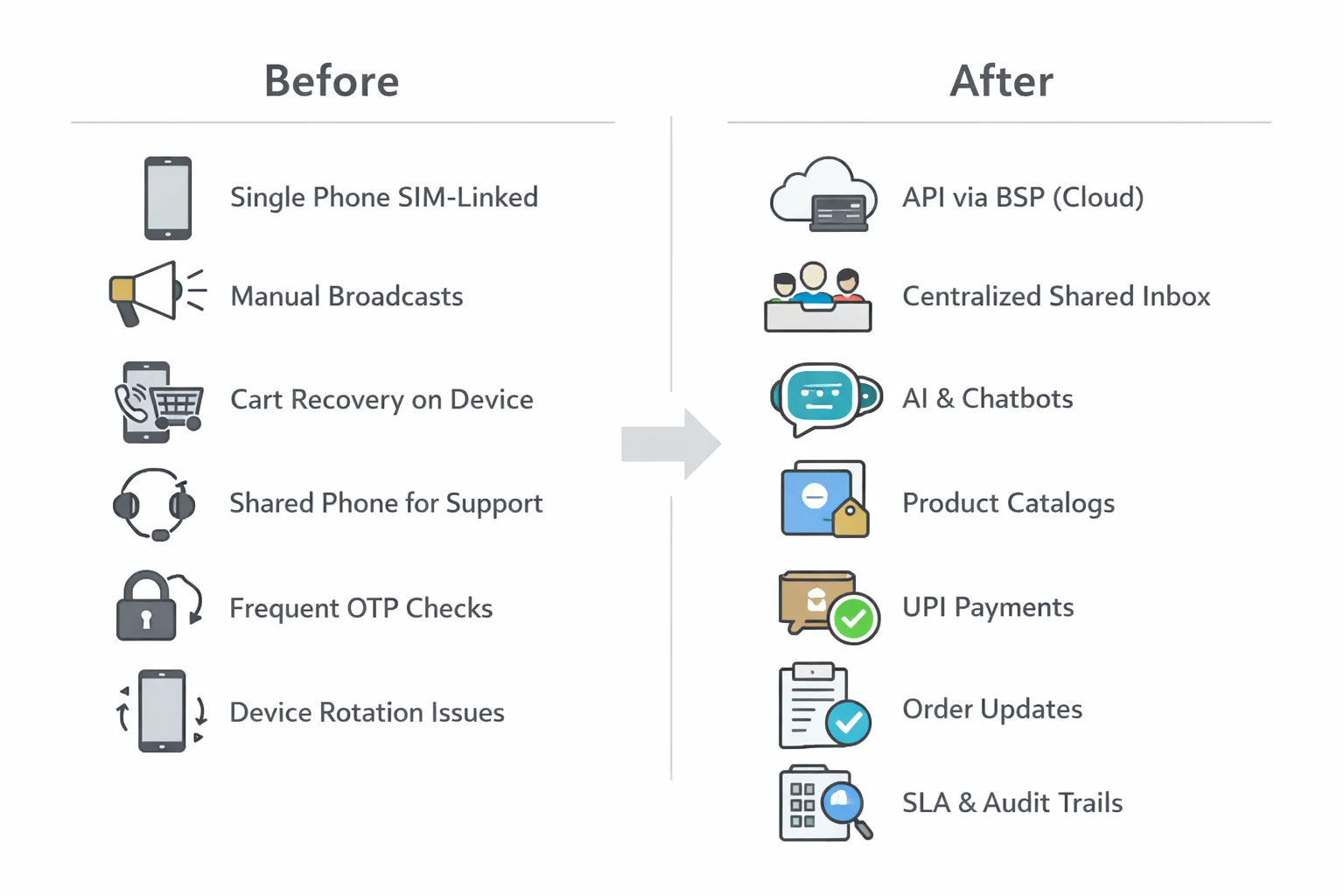
Marketing broadcasts and cart recovery: device vs API
Device-bound (App/Business App): Broadcasts depend on a single SIM‑tied phone. Frequent OTP re‑verification interrupts campaigns, and sender reputation suffers when devices rotate. Cart recovery from a handset is slow, manual, and hard to measure.
API‑first (Business API): Schedule compliant marketing templates, segment audiences, and trigger cart recovery automatically based on events. No SIM dependency means uninterrupted delivery, with funnel‑level analytics and retargeting at scale.
Catalog, payments, and order updates under SIM‑binding
Device-bound: Sharing catalogs and collecting UPI links from a phone is error‑prone; order status messages pause when re‑verification is triggered, creating CX gaps.
API‑first: Sync product catalogs, push UPI deep links, and send real‑time order updates via utility templates. Automation and SLA alerts prevent missed notifications during peak sales.
Customer support and shared inbox teams
Why device rotation breaks under SIM‑binding; SLA risks during re‑verification
Shared phones/SIMs invite OTP prompts, lockouts, and lost context. During re‑verification, open tickets stall and SLA breaches rise.
API‑based shared inbox with agent assignment and full history
Centralized, agent‑agnostic workspaces maintain full conversation history with assignments, tags, and macros. Automation handles FAQs; human agents resolve complex cases with seamless handoff. SLA timers and collision detection keep response times tight.
Field sales and in‑store teams
Multi‑agent challenges with SIM‑tied numbers on shared phones/kiosks
Rotating staff on a single SIM‑tethered device triggers device mismatch prompts, breaks continuity, and exposes audit gaps.
Using role‑based workspaces and audit trails via API platforms
Provision teams as users, not device holders. Role‑based access, region routing, and timestamped logs ensure compliance. Integrate appointment bookings, reservations, and payments in chat without swapping devices.
Agencies and multi‑brand operators
Governance, template management, and brand separation at scale
Avoid cross‑brand contamination from shared devices. With API, manage multiple brands in isolated workspaces, enforce template governance and opt‑in compliance, and run broadcasts with fine‑grained approvals. Centralize reporting by brand, campaign, and channel.
What still works vs what breaks under SIM‑binding
Task / User Type | WhatsApp App (consumer) | WhatsApp Business App | WhatsApp Business API (Cloud/API via BSP) |
|---|---|---|---|
Marketing broadcast | Limited lists; manual sends; prone to OTP disruptions when SIM/device changes. | Basic broadcast lists; device‑bound, interruptions during re‑verification. | Template‑based campaigns with segmentation, scheduling, and analytics; unaffected by SIM state. |
Shared support (multi‑agent) | Not designed for teams; chat context tied to one device. | Multi‑device linking is fragile; rotation triggers re‑verification and context loss. | Centralized inbox with agent assignment, SLAs, tags, collision control; stable across teams. |
OTP (authentication to customers) | Possible but manual; risks delays if device is locked/re‑verifying. | Possible but device‑dependent; disruptions during SIM checks. | Authentication templates, high deliverability, event‑triggered; independent of SIM custody. |
Payment notifications | Manual sharing; pauses if device locked or SIM swapped. | Basic updates from device; interruptions under SIM‑binding. | Utility templates triggered from ERP/OMS; reliable at scale with full audit logs. |
Cart recovery | Manual nudge; inconsistent follow‑ups. | Rudimentary reminders; limited measurement. | Automated drip and retargeting flows with A/B testing, ROAS tracking. |
Catalog sharing | Manual attachments; error‑prone. | Basic catalog sharing; tied to device availability. | Synced WhatsApp Storefront, dynamic recommendations, and structured replies. |
Column descriptions:
WhatsApp App (consumer): Individual use, single device, minimal team capability.
WhatsApp Business App: Small business device‑centric operations with basic broadcast and labels; sensitive to SIM‑binding events.
WhatsApp Business API (Cloud/API via BSP): SIM‑less, token‑based architecture enabling centralized inboxes, automation, templates, and compliance at scale.
How Trikon makes this easy
API‑first, SIM‑less: Run broadcasts, cart recovery, support SLAs, and post‑purchase flows without device dependency.
Unified platform: Shared Support Inbox, Marketing Automation, AI/keyword chatbots with human handoff, Bookings/Operations, and WhatsApp Storefront.
Built for Indian scale: Multilingual templates, UPI flows, and audit‑ready logs to meet India’s compliance and performance expectations.
Risk scenarios to plan for in India
Number recycling and loss of custody
Reassignment windows and unintended access if re‑verification is missed
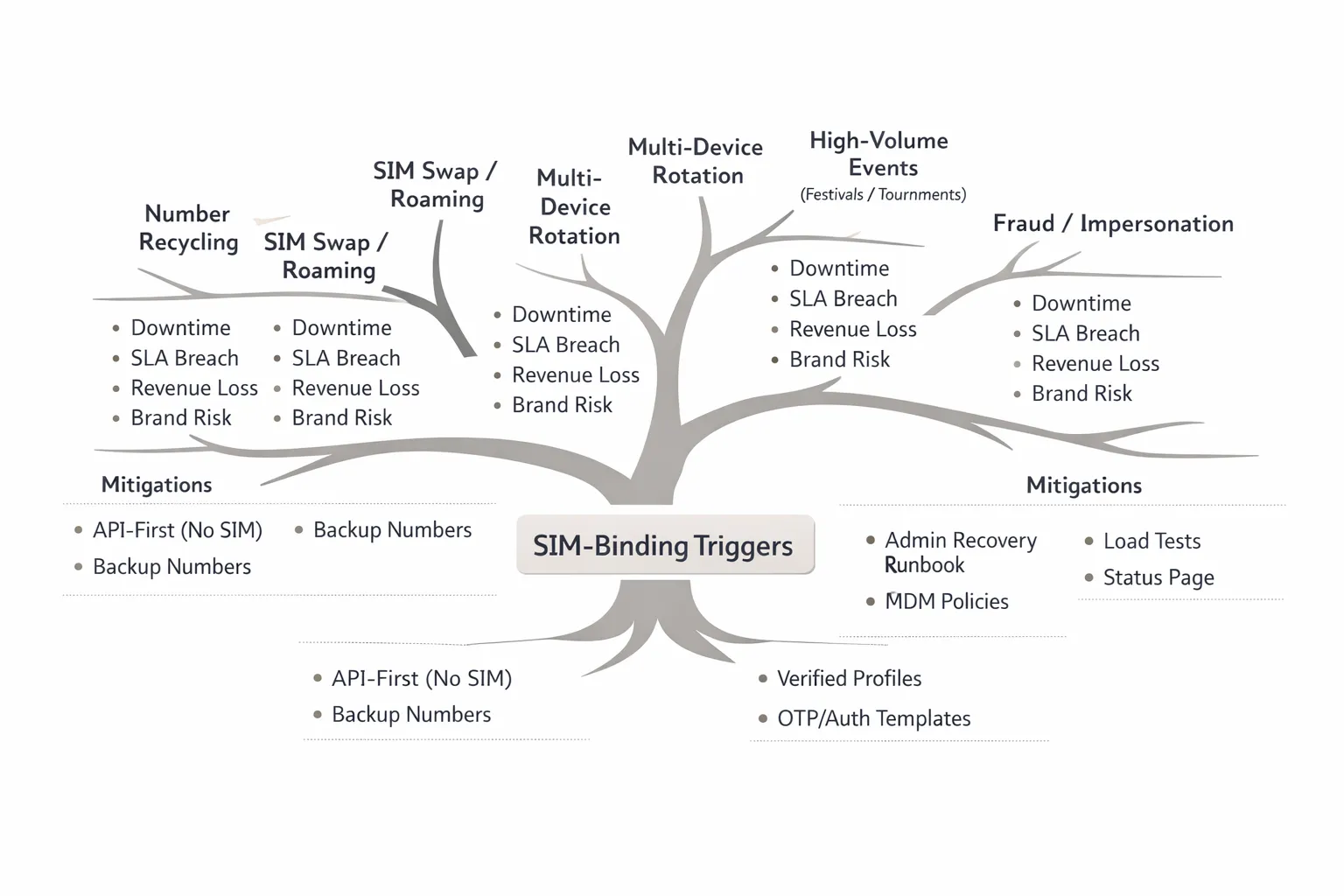
Indian telcos recycle inactive numbers; if custody is lost (non‑renewal, churn) and re‑verification prompts are ignored, you risk losing control of the WhatsApp identity tied to that number.
Business impact: Downtime for marketing and support, broken order updates, and potential privacy exposure if a recycled number is registered by a new user.
Mitigations:
Migrate critical use cases to the WhatsApp Business API (SIM‑less).
Maintain an inventory and renewal calendar for all business numbers with KYC details.
Configure admin alerts for inactivity and auto‑initiate recovery workflows.
Travel, roaming, and multi‑device use
SIM swap triggers; device mismatch prompts during international travel
Frequent device rotation, eSIM moves, or roaming changes can trigger OTP re‑verification and “confirm it’s you” prompts that stall operations.
Business impact: Agent lockouts during peak hours, SLA breaches, and dropped conversations.
Mitigations:
Standardize on API‑first shared inboxes for frontline teams; avoid shared phones.
Enforce MDM policies to limit SIM swaps and unapproved device changes.
Provide documented re‑verification steps and backup admin contacts for fast unlock.
Fraud and impersonation during high‑volume events
Tournament/festive spikes; verified profile and authentication best practices
Spikes attract scammers using look‑alike numbers or spoofed accounts; customers may fall for fraudulent offers during limited‑time sales.
Business impact: Chargebacks, customer distrust, and brand damage.
Mitigations:
Use verified business profiles, authentication templates (OTP), and consistent domain alignment.
Pre‑approve high‑volume campaign templates and maintain strict opt‑in records.
Publish safety tips and anti‑fraud education in utility updates ahead of sales.
Continuity playbook
Backup numbers, admin recovery, and automated status pages
Establish a failover framework so customer messaging continues even if one number is disrupted.
Components:
Backup numbers: Provision dormant API lines for emergency cutover; restrict use to verified templates and utility updates.
Admin recovery: Maintain a secure runbook with super‑admin contacts, telco KYC documents, and WhatsApp Business API console steps for number reassignment.
Status page: Automate an external status page (and in‑app banner) for incident updates, expected resolution times, and alternate contact options.
Load and chaos tests: Simulate holiday/tournament traffic and forced re‑verification scenarios to validate incident response times.
How Trikon reduces risk
API‑first, SIM‑less numbers remove SIM‑binding failure points.
Centralized inbox, SLAs, and audit logs preserve continuity during spikes.
Verified template governance, consent management, and multilingual safety messages strengthen trust across India’s biggest sales moments.
Compliance and governance: India‑ready checklist for 2026
"WhatsApp OTP delivery success rates typically exceed 95% globally." - Source
Core obligations
Consent/opt‑in capture and storage
Use explicit, documented opt‑in across entry points (website forms, CTWA ads, QR codes, POS, IVR).
Store consent metadata: user identifier (MSISDN), source channel, timestamp, consent wording/version, language, IP/device, and campaign context.
Provide easy opt‑out in every marketing message ("STOP" or button) and honor immediately.
Template policies and approvals
Use approved Marketing, Utility, and Authentication templates; maintain version control with change logs and rationale.
Localize templates for Indian languages; align tone with cultural context and avoid prohibited categories (e.g., financial claims without disclosures).
Audit logs and reporting
Maintain immutable logs for: template approvals, send events, delivery/engagement results, agent actions, and policy exceptions.
Enable on‑demand exports for internal audit and regulator queries (CSV/JSON + evidence packets).
DoT/TRAI KYC alignment for number ownership and record‑keeping
Maintain a central registry of WhatsApp numbers with KYC documentation, activation/port dates, and custodianship history.
Enforce “no personal SIMs for business messaging.” Prefer API‑provisioned (SIM‑less) numbers; if using SIMs, ensure KYC documents are in the enterprise’s name and are current.
Track number lifecycle (renewals, ports, deactivations) and implement proactive re‑verification procedures.
Template and frequency governance
Quality scores and deliverability
Monitor template performance (blocks, spam reports, conversation opens). Retire or iterate low‑performers quickly.
Run A/B tests on hooks, media, and CTAs; gate new sends until quality stabilizes.
Language/localization at scale
Pre‑approve variants in Hindi, Hinglish, and key regional languages; verify translations and script rendering (Devanagari/other).
Include accessibility cues (alt text/captions) for media templates.
Festival/event sensitivity
Use festival‑aware calendars (Diwali, Eid, Onam, cricket/football tournaments) with frequency caps and quiet hours.
Add fraud‑safety inserts for high‑volume periods; avoid urgency tactics that resemble phishing.
Authentication and utility best practices
OTP and account alerts
Use WhatsApp Authentication templates for logins, password resets, and high‑risk actions; set TTL and attempt limits.
Add device/IP context lines (e.g., “Attempt from Bengaluru on Android”) and a “Not you?” support CTA.
Signed links and deep‑linking
Deliver signed, single‑use links (HMAC/nonce) for payments and profile updates; expire on click or timeout.
Prefer UPI deep links and verified domains; never expose raw identifiers in query strings.
Fraud education in‑chat
Pin “safety tips” mini‑templates during spikes; mark official handles with a verified business profile and consistent brand assets.
Promote two‑step verification and educate users to avoid sharing OTPs with anyone, including supposed “support agents.”
Evidence and retention
What to log
Consent ledger: opt‑ins/opt‑outs with full metadata and template copy in effect at time of consent.
Messaging ledger: template ID/version, audience segment criteria, send time, delivery status, read/interaction signals, failure codes.
Security and auth: OTP attempts, device/IP fingerprint, success/failure outcomes, escalations, and abuse reports.
Agent operations: assignments, internal notes, macros used, resolution timestamps, and SLA outcomes.
How long to retain
Set tiered retention aligned to business and regulatory needs (e.g., 24–36 months for marketing logs, 36–60 months for financial/utility messages, per internal policy and counsel).
Apply WORM storage for critical audit artifacts; ensure tamper‑evident hashing for integrity.
Who can access
Role‑based access control (RBAC) with least privilege; segregate brand workspaces for agencies/multi‑brand operators.
Enforce data‑access approvals, session timeouts, and periodic entitlement reviews; maintain access audit trails.
How Trikon helps you stay compliant in India
Consent and template governance: Central consent ledger, localized template libraries, versioning, and automated quality scoring.
Secure authentication and utility: Built‑in Authentication templates, signed link orchestration, and abuse‑signal monitoring.
Evidence‑ready operations: Immutable logs, SLA tracking, role‑based workspaces, and exportable audit packs for internal review or regulator requests.
API‑first architecture: SIM‑less provisioning aligned with KYC best practices, ensuring reliability and continuity for WhatsApp India at scale.
Cost, risk, and ROI: App vs API under SIM‑binding
The hidden costs of device‑bound operations
Agent downtime during re‑verification
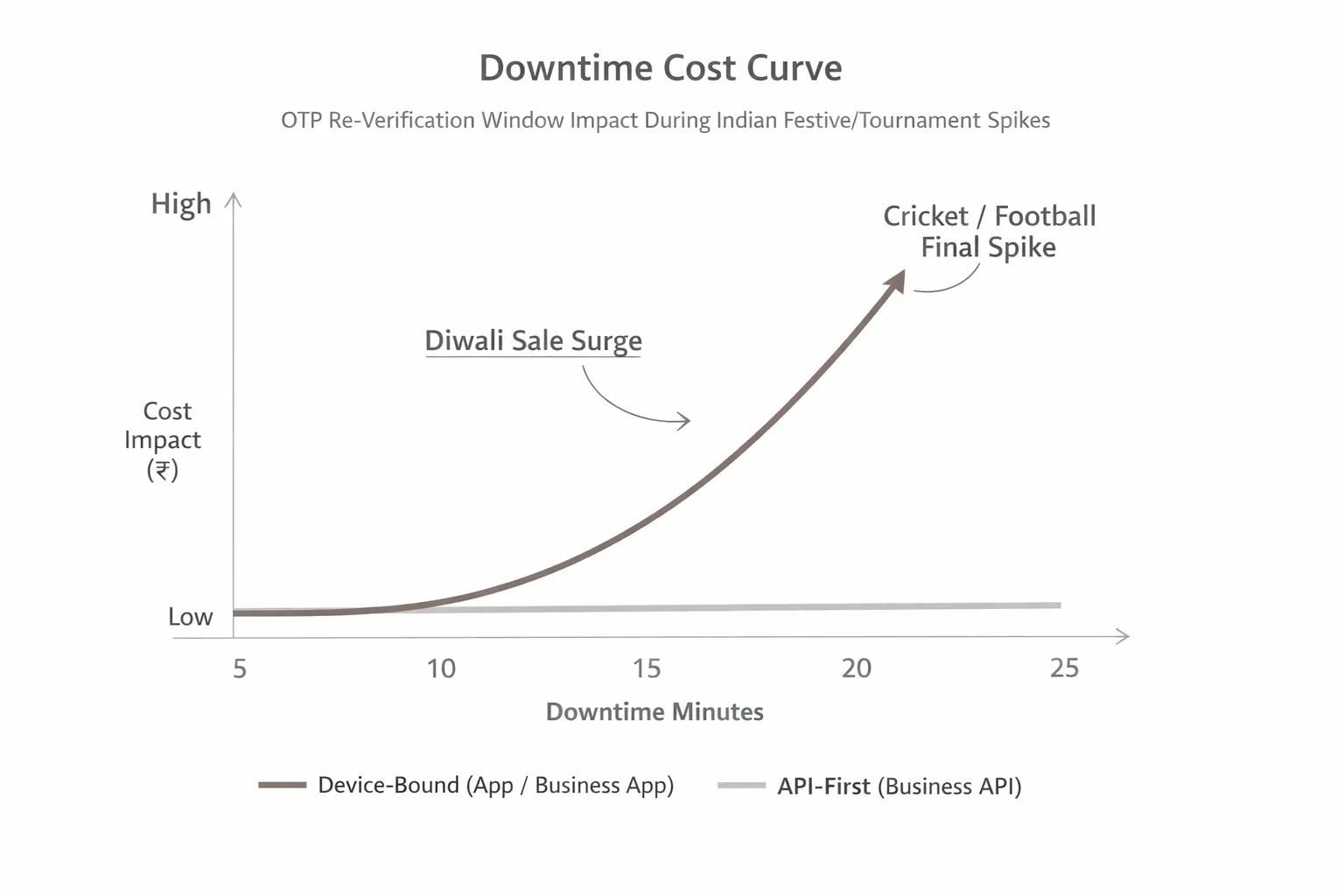
OTP prompts and device mismatch checks pause access for minutes to hours, especially after SIM swaps, roaming, or device rotation. Every minute compounds queue backlogs and SLA penalties.
Missed SLAs and escalations
Shared phones mean stalled conversations, lost context, and longer resolution times. This raises make‑good credits, refunds, and negative CSAT.
Lost campaigns and revenue
Re‑verification mid‑campaign halts broadcasts, cart recovery, and order updates, eroding peak‑period revenue (festivals, tournament finals) and damaging sender reputation.
API economics
Higher deliverability and segmentation
Template governance plus event‑driven triggers keep quality scores high; granular segments lift conversion for WhatsApp advertising India follow‑ups and D2C retargeting.
Triggered journeys and automation
Abandoned cart, reorder, and post‑purchase flows run reliably without SIM custody; AI/keyword bots deflect FAQs 24×7 with human handoff.
Shared inbox productivity
Multi‑agent workspaces with SLA timers, tags, macros, and collision control compress average handle time while maintaining full conversation history and auditability.
India examples
BFSI
Authentication, statements, EMI reminders, and KYC nudges via Utility/Authentication templates. API eliminates device/SIM bottlenecks, ensuring regulated logs and customer trust at scale.
Healthcare
Appointment reminders, pre‑op instructions, report delivery, and follow‑ups with multilingual templates and verified profiles - no risk of missed critical updates due to SIM re‑verification.
Retail
Flash sales, stock‑drop alerts, UPI deep links, and order tracking run uninterrupted during Diwali or tournament spikes; API‑first ensures campaign continuity and real‑time analytics.
How to model it
Inputs for a basic ROI and risk‑adjusted cost model
Volume metrics: monthly conversations, broadcast recipients, orders influenced.
Performance: delivery/read rates, CTR, cart‑to‑paid, average order value, deflection rate.
Operations: agents, shifts, AHT, SLA targets, re‑verification downtime minutes/month for device‑bound ops.
Risk costs: SLA penalties, refunds, churn rate from missed updates, fraud/impersonation exposure during spikes.
Platform costs: API conversation pricing by category, BSP fees, and tooling licenses vs device costs (handsets, SIMs, MDM).
Calculations
Revenue lift = (API conversions – device conversions) × AOV.
Downtime cost = downtime minutes × (orders/minute × AOV + SLA penalty/minute).
Productivity delta = agents saved via shared inbox/automation × fully loaded cost.
Net ROI = (revenue lift + downtime savings + productivity gains – platform costs).
App/Business App vs Business API: comparison matrix
Dimension | App/Business App (device‑bound) | Business API (Cloud/API via BSP) |
|---|---|---|
Reliability | Prone to OTP/re‑verification lockouts; device rotation risk. | SIM‑less; stable token auth; high uptime across teams. |
Staffing | Shared phones; context loss; inconsistent AHT; manual routing. | Role‑based access; assignments, SLAs, macros; lower AHT. |
Compliance | Weak audit trails; personal SIM KYC; higher policy risk. | Central logs, consent ledger, verified templates, RBAC. |
Campaign velocity | Manual sends; limited segmentation; pauses on re‑verification. | Event‑driven automation, segmentation, A/B tests, analytics. |
Auditability | Fragmented exports; difficult evidence assembly. | Immutable logs, exportable evidence packs, template/version control. |
Total cost of ownership (TCO) | Hidden costs: downtime, SLA penalties, device churn, fraud risk. | Predictable platform fees offset by higher conversions and productivity. |
Column descriptions:
App/Business App (device‑bound): Single/SIM‑tied device operations suited for micro‑teams; vulnerable under SIM‑binding.
Business API (Cloud/API via BSP): SIM‑less, centralized, and automation‑ready for Indian scale and compliance.
Migration plan: 30‑60‑90 day roadmap to an API‑first WhatsApp stack
Day 0–30: Stabilize and prove value
Objectives: exit SIM‑bound risk, establish an API‑first baseline, and validate fast wins for WhatsApp India.
Number strategy (porting/new)
Decide port vs new: Port high‑equity numbers to WhatsApp Business API via BSP, or provision new landline/VoIP API numbers to avoid SIM custody.
Complete display name and business verification; prepare KYC docs and ownership proofs.
Stand up a branded, verified business profile; align domain and link hygiene for trust.
Baseline automations (FAQs, order updates)
Launch a no‑code FAQ bot (English + Hindi/regional) for top 20 intents; enable seamless human handoff.
Connect OMS/CRM to trigger Utility templates for order confirmation, shipping, delivery, COD confirmation, and returns.
Add Authentication templates for login/OTP and high‑risk actions; enable “Not you?” safeguards.
Enable a centralized Support Inbox: agent assignment, tagging, macros, and SLA timers.
Essential templates
Welcome + opt‑in confirmation, cart recovery, reorder reminders, appointment/reservation reminders, payment success/failure, NPS post‑resolution.
Localize for key regional languages; pre‑approve festival‑safe variants.
Measurement and proof points
Targets: first response time < 2 minutes (support), 24‑hour resolution rate > 85%, delivery rate > 95%, template quality stable/green, opt‑in growth baseline set.
Risks to mitigate: limit device usage to avoid SIM re‑verification, maintain a backup API number, enable agent SSO/RBAC.
How Trikon helps: instant Cloud/API provisioning, shared inbox with SLAs, no‑code chatbots, utility/auth templates, and catalog/order sync to prove value in weeks.
Day 31–60: Scale campaigns and support
Objectives: expand revenue programs and operational scale across WhatsApp chat India use cases.
Segmentation and triggered journeys
Build RFM, city, and language segments; layer festival calendars (Diwali/Eid/Onam/cricket/football).
Activate abandoned cart, browse‑abandon, reorder/refill, win‑back, and cross‑sell drips.
Set frequency caps and quiet hours; auto‑pause templates on negative quality signals.
Cart recovery and commerce
Sync catalog to a WhatsApp Storefront; use structured replies and smart recommendations.
Attach UPI deep links for one‑tap pay; confirm payment via webhooks and send receipts via Utility templates.
SLA tracking and CX excellence
Route by skill/region; apply macros and collision control.
Deflect repetitive queries to the bot; escalate complex ones with full context and history.
Add proactive status updates for high‑priority tickets (delivery delays, refunds, reschedules).
Analytics and optimization
Funnel dashboards: delivered→read, read→reply, click→cart, cart→paid.
A/B test hooks, creatives, CTAs, time‑of‑day, and language variants.
Integrate CTWA ads and QR entry points; attribute revenue lift vs control.
How Trikon helps: broadcasts, segmentation, drip flows, A/B testing, storefront + payments in chat, SLA analytics, and agent productivity tooling to scale WhatsApp support India and commerce.
Day 61–90: Harden governance and resiliency
Objectives: make the stack audit‑ready, resilient, and India‑compliant.
Backups and failover
Provision backup API numbers; define cutover rules for incidents.
Publish an external status page and in‑app banners; document incident severities and SLAs.
Admin policies and access security
RBAC with least privilege, SSO, and session controls; periodic access reviews.
Enforce template governance (versioning, reviewers, localizations) and consent ledgers.
Lock device‑bound usage; codify a “no shared phones” policy.
Audit logs and evidence
Immutable logs for opt‑ins/opt‑outs, template sends, delivery/failure codes, agent actions, and escalations.
Retention policies by category (marketing vs utility/auth); exportable evidence packs for audits.
Playbooks for SIM‑related events
Number lifecycle SOPs (renewals, ports, deactivations).
Re‑verification escalation steps with owners and SLAs.
Festival/tournament surge runbook: capacity planning, frequency caps, fraud education inserts.
How Trikon helps: consent and template governance, immutable logging, backup numbers, verified templates, multilingual safety messaging, and DR playbooks built for WhatsApp of India at national scale.
Change management
Training
Marketing: segmentation, template QA, campaign analytics, festival sensitivity.
CX: shared inbox operations, SLA discipline, bot‑to‑human handoff, escalation paths.
IT/Security: RBAC, audit exports, data retention, DR drills, number lifecycle/KYC.
SOPs
Number strategy and ownership, opt‑in capture across entry points, template submission/approval, QA for localizations, incident response, and customer communications.
Dashboards
Growth: opt‑ins, deliverability, quality scores, campaign ROAS.
CX: first response/resolve, backlog, deflection, CSAT/NPS.
Risk/compliance: access changes, export logs, incident MTTR, template pauses.
Governance cadence
Weekly optimization stand‑ups; monthly compliance reviews; quarterly load/chaos tests ahead of peak seasons.
With Trikon’s API‑first, SIM‑less architecture and unified engagement stack, enterprises can complete this 90‑day migration with minimal risk - unlocking higher conversion, resilient operations, and compliant scale for WhatsApp advertising India, commerce, and support.
Reference architecture on Trikon: Secure, scalable, SIM‑less operations
Core building blocks
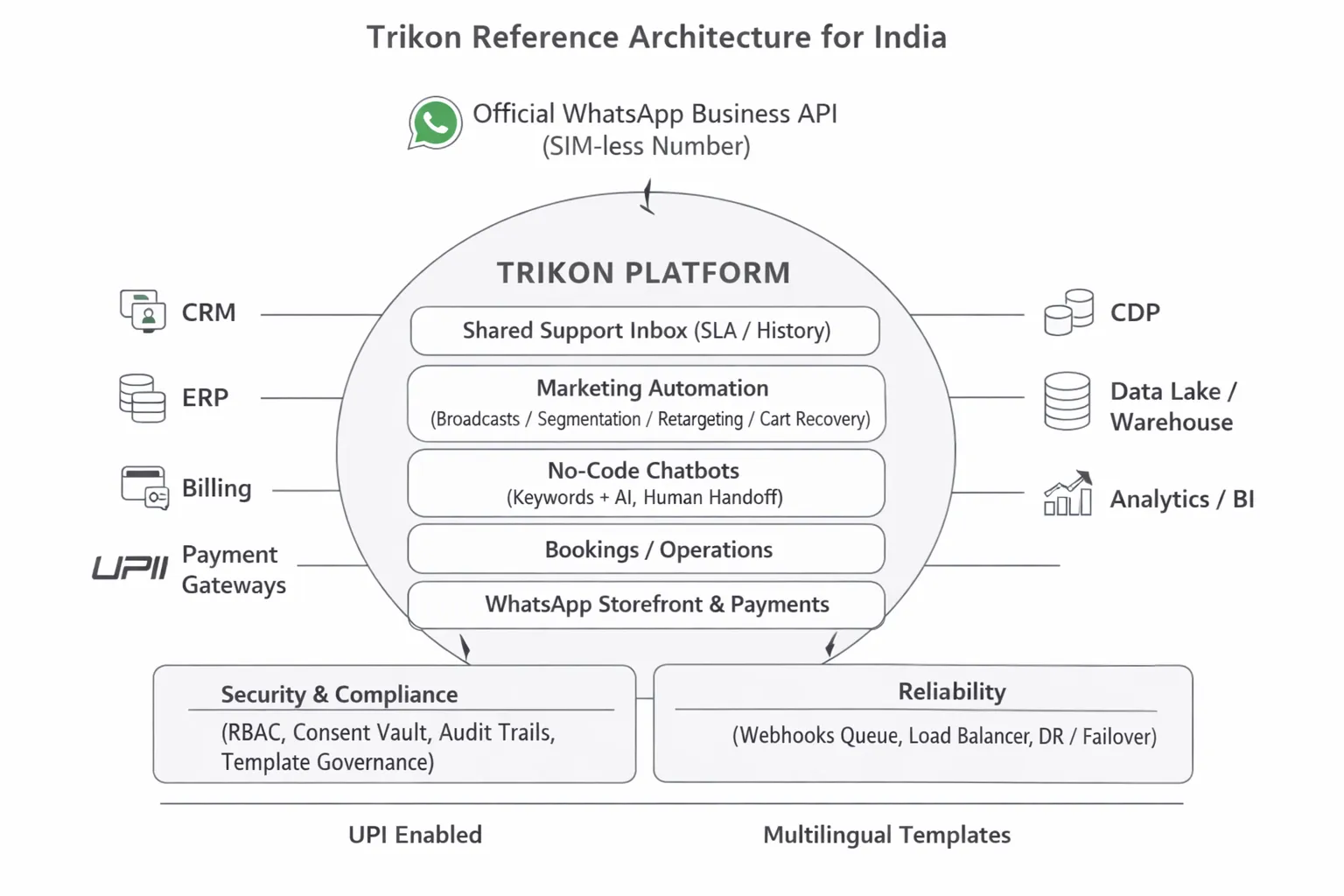
Official WhatsApp Business API via Trikon; shared Support Inbox with SLA and history
SIM‑less, verified numbers provisioned via Meta’s official API; multi‑agent shared inbox with SLA timers, collision control, and full conversation history.
Marketing automation: broadcasts, segmentation, retargeting, cart recovery
Template‑governed campaigns with granular segmentation, A/B testing, browse/cart abandon drips, reorder reminders, and festival/tournament cadence control.
No‑code chatbots: keywords + AI with seamless human handoff
24×7 deflection for FAQs, policy info, and order status; escalate to humans with context. Multilingual support (English/Hindi/regional) tailored for WhatsApp India.
Bookings/operations and in‑chat storefront with payments
Appointments, reservations, ticketing, and WhatsApp Storefront for catalogs, carts, and orders. UPI deep links and webhook‑confirmed payments with automated receipts.
Integrations for India
CRM/ERP, billing, UPI payment gateways, CDPs, data lakes
One‑click connectors or secure webhooks to Salesforce/Zoho, SAP/NetSuite/Tally, UPI gateways, and CDPs.
Stream events to a data lake/warehouse for attribution, ROAS, and LTV modeling across WhatsApp support India and commerce flows.
Bi‑directional sync of customer profiles, preferences, and consent state.
Security and compliance
Role‑based access, audit trails, consent vaults, template governance
RBAC with SSO and least‑privilege; immutable audit trails for agents and templates; consent ledger for opt‑ins/opt‑outs across entry points (CTWA, QR, web forms).
Template lifecycle controls: reviewer workflows, localization QA, frequency caps, and festival sensitivity checks.
Data controls: signed links, tokenized identifiers, retention policies by message category (marketing, utility, authentication).
Reliability and scale
Hybrid automation, agent load balancing, and DR patterns
AI/keyword bots handle repetitive intents; human agents handle edge cases with full history. Auto‑routing and load balancing by skill, language, and priority.
Durable webhooks queue with retries, rate limiting, and backoff; proactive health checks and incident alerts.
Disaster recovery: backup API numbers, failover routing, automated status pages, and surge playbooks for Diwali/tournament traffic.
Why Trikon
An API‑first, SIM‑less foundation purpose‑built for India’s scale and compliance needs - combining support, marketing, chatbots, bookings/operations, and commerce into a single, fast‑to‑deploy WhatsApp stack.
Playbooks to de‑risk high‑stakes moments in India
Match/festive spikes
Pre‑approved campaigns
Lock template approvals 10–14 days prior; localize for Hindi/Hinglish and Tier‑2/3 languages.
Build “spike kits”: 2–3 approved variants per message (short text, image, lightweight video) to rotate if quality scores dip.
Festival sensitivity checks for copy, discounts, delivery promises, and returns windows.
Rate‑limit aware scheduling
Stagger sends by cohorts (city, RFM, language) to keep quality green and avoid hard throttles.
Adopt burst control: warm‑up, steady state, cool‑down; align with match phases (pre‑kickoff, halftime, full‑time).
Auto‑pause policies when blocks/complaints cross thresholds; fail back to Utility messages for critical updates.
Fallback messaging
Prepare low‑media and plain‑text Utility templates for essential alerts (delivery ETA, payment status).
Maintain alternative CTAs (catalog in chat vs web) to preserve conversion when link clicks spike.
Keep a “lightweight promo” variant for networks under load.
How Trikon helps: template governance, throttled broadcasts, language routing, and spike dashboards that track delivery, read rate, and quality score in real time for WhatsApp in India campaigns.
Outage or re‑verification incident
Reroute to backup API number
Publish a “click‑to‑chat” deep link to the backup Business API number on CTWA ads, site headers, and help pages.
Auto‑reply on the primary number with a short Utility message pointing to the backup handle and self‑serve bot paths.
Status updates
Maintain a public status page with timestamps, scope, and ETAs; add an in‑chat banner for ongoing threads.
Cadence: T0 + 15m acknowledgement, hourly updates, TTR post‑mortem within 48 hours.
Priority support SLAs
Internal: on‑call owner (Marketing/CX/IT), 15‑minute triage SLA, 60‑minute mitigation SLA.
External: BSP/Meta escalation path, incident ticket IDs, and snapshot evidence (template IDs, failure codes).
Recovery: re‑sync templates, reopen automation jobs, reconcile undelivered Utility messages.
How Trikon helps: backup API numbers, incident playbooks, automated status banners, and SLA tracking to keep WhatsApp support India responsive.
KYC and number lifecycle
Annual reviews
Verify legal entity KYC, business verification, and documentation for all WhatsApp Business API numbers (including landline/VoIP).
Validate display names, categories, and brand assets; renew authorizations with partners.
Documentation
Maintain a central “number vault”: purchase/port dates, custodians, change history, and ownership proofs.
Store consent policies, template versions, and language QA records.
Ownership transfer SOPs
For brand/agency changes or department handoffs, standardize steps: revoke access, rotate credentials, migrate templates/consent, update CTWA and deep links.
Schedule dark launches and zero‑downtime handovers during off‑peak hours.
How Trikon helps: consent vaults, number lifecycle registry, workspace isolation for agencies/multi‑brand operators, and guided handovers to protect WhatsApp chat India operations.
Continuous improvement
A/B tests
Test hooks, creatives, CTA phrasing (“Pay via UPI” vs “Complete order”), send windows by city/time zone, and media weight (text vs image vs short video).
Rotate underperforming templates quickly to protect quality scores.
Cohort analytics
Track delivered→read→reply→cart→paid per cohort (language, city, RFM, acquisition source).
Attribute revenue to WhatsApp advertising India entry points (CTWA ads, QR, website) and optimize spend.
Template refresh cadence
Monthly refresh for top drivers; quarterly content audits by category (Marketing, Utility, Authentication).
Maintain a festival/tournament library - proven copy, safe discounts, and fraud‑education inserts.
How Trikon helps: end‑to‑end analytics, template scorecards, and a unified, SIM‑less WhatsApp Business API stack that keeps campaigns resilient and compliant - so you can scale WhatsApp of India confidently through every high‑stakes moment.
FAQs: SIM‑binding in India for enterprises
"WhatsApp Business Platform phone numbers can be landline or VoIP and do not require a physical SIM card." - Source
Does SIM‑binding affect Cloud API or BSP‑hosted numbers?
No. Cloud/API numbers are SIM‑less and authenticated via platform tokens. They can be landline or VoIP and are managed in the cloud, so SIM rotation and device custody do not affect access or uptime.
What happens if an employee with device custody leaves?
On device‑bound setups, you risk lockouts and data loss. With Trikon’s API‑first stack, access is agent‑agnostic: disable the user, retain full conversation history, and maintain continuity with RBAC and audit trails.
Can we keep using WhatsApp Business App for limited use cases?
For micro‑teams, yes - but expect SIM‑binding friction during device changes and re‑verification, plus limited analytics and governance. For enterprises, move revenue‑critical and regulated workflows to the Business API.
How do verified business profiles, OTP, and Flows fit in?
Verified profiles improve trust and recognition. Use Authentication templates for OTP and high‑risk actions, and WhatsApp Flows for secure in‑chat forms (onboarding, bookings, KYC steps) with audit‑ready logs through Trikon.
What’s the safest number strategy (mobile vs landline/VoIP) for India?
Choose SIM‑less landline/VoIP numbers on the Business API to avoid recycling and SIM custody risks. Maintain a number registry with KYC docs, renewal dates, and backup lines for failover.
How do we prepare for audits under DoT/TRAI and Meta policies?
Keep a consent ledger, template version control, immutable send/delivery logs, role‑based access reviews, and number lifecycle documentation. Align with DoT/TRAI KYC, and ensure templates and consent language meet Meta policies.
What’s the quickest way to migrate without downtime?
Run a 30‑60‑90 plan: provision an API number, set up core Utility and Authentication templates, and migrate high‑value journeys first (support SLAs, order updates, cart recovery). Use Trikon’s shared inbox, chatbots, and automated broadcasts to stabilize fast, then port legacy numbers when ready.
Conclusion: Minimize SIM risk, maximize WhatsApp growth with Trikon
Why act now
SIM‑binding raises the bar for device‑based operations in India. It increases re‑verification friction, exposes gaps in shared‑phone workflows, and can pause mission‑critical campaigns when you can least afford it. The durable path is API‑first: SIM‑less numbers, centralized control, and automation that scales reliably across support, marketing, and commerce. If WhatsApp is a primary revenue and service channel for your brand in India, moving from device‑bound accounts to the Business API is no longer optional - it’s foundational.
How Trikon helps
All‑in‑one: support, marketing, chatbots, bookings, commerce
Run the entire customer lifecycle in one place - WhatsApp support India with a shared inbox and SLAs, WhatsApp chat India for AI/keyword bots and human handoff, and WhatsApp advertising India follow‑ups with broadcasts, segmentation, and retargeting.
Fast go‑live without heavy engineering; hybrid automation + human handoff
Minimal setup, no complex builders, and quick configuration for templates, flows, and storefront. Let automation handle repetitive queries while agents resolve complex cases with full conversation history.
Reliability, compliance, and scale as an official WhatsApp Business API partner in India
SIM‑less, token‑based architecture; consent vaults, audit logs, and template governance; UPI‑ready commerce with secure, signed links; and multilingual operations designed for India’s scale.
Next steps
Book a strategy call and get your 30‑60‑90 plan to migrate off device‑bound accounts
We’ll map your number strategy (port vs new), essential templates, and fast‑win automations to prove value in weeks - not months.
Start a pilot with Trikon to harden growth, support, and compliance for 2026
Launch a production‑grade pilot for cart recovery, order updates, and shared‑inbox SLAs. Validate higher deliverability, better CX, and risk reduction under a SIM‑less, API‑first stack.
Trikon gives you the secure, scalable, and compliant foundation to turn WhatsApp in India into a full‑funnel growth engine - without SIM‑binding headaches. Ready to move faster? Let’s build your API‑first WhatsApp stack now.