Introduction + Comparison at a Glance
In 2025, inbox fatigue, tightening privacy (think Apple’s Mail Privacy Protection and broader tracking limits), and the rise of conversational commerce have changed how brands win attention. Customers expect timely, two‑way, mobile‑native interactions - not static blasts - and they reward businesses that meet them where they already spend time.
Here’s the landscape in simple terms:
Email marketing: a scalable, low‑cost channel ideal for long‑form content, newsletters, lifecycle education, and formal communications.
WhatsApp marketing: powered via the official WhatsApp Business Platform/API, a real‑time, conversational channel that drives exceptional open rates, fast responses, and in‑chat actions across marketing, support, and commerce.
Who this guide is for: D2C/e‑commerce brands, service businesses, enterprises with SLAs, and agencies balancing engagement vs. cost and speed‑to‑value.
Key takeaway: WhatsApp reliably wins on open rates, response speed, and interactivity; email wins on long‑form content and broad scale. The best results come from combining both with clear roles - email for depth and reach, WhatsApp for instant engagement and conversion. Trikon, an official WhatsApp Business API partner, helps you operationalize WhatsApp for marketing, support, and commerce quickly and compliantly.
At a Glance: Email vs WhatsApp (Quick Table)
Feature | Email Marketing | WhatsApp Marketing (Business Platform/API) |
|---|---|---|
Open rate | ~20–30% typical across industries | ~90–98% typical for opted‑in audiences |
CTR/replies | ~2–4% CTR; replies uncommon | ~20–60% clicks/replies in conversational flows |
Response time (latency) | Hours to days | Minutes; often within 5–15 minutes |
Deliverability risks | Spam/promotions tabs, domain reputation, bounces | Template approvals and strict opt‑in; fewer “spam” folders |
Message length/format | Long‑form HTML, images, links, attachments via links | Short, conversational; buttons, lists, images, video, docs |
Compliance overhead | GDPR/CCPA, unsubscribe, list hygiene | GDPR/CCPA + WhatsApp opt‑in, template policy, 24‑hour session rules |
Cost predictability | Low marginal cost at volume (plan + sends) | Conversation‑based pricing (Meta + provider), predictable per conversation |
Best for | Newsletters, announcements, onboarding, long‑form education | Time‑sensitive promos, support, order updates, cart recovery, bookings, in‑chat commerce |
"Mailchimp reports an average email open rate of 21.33% across all industries." - Source
How Opens Really Work: The Mechanics Behind the Numbers
Email mechanics
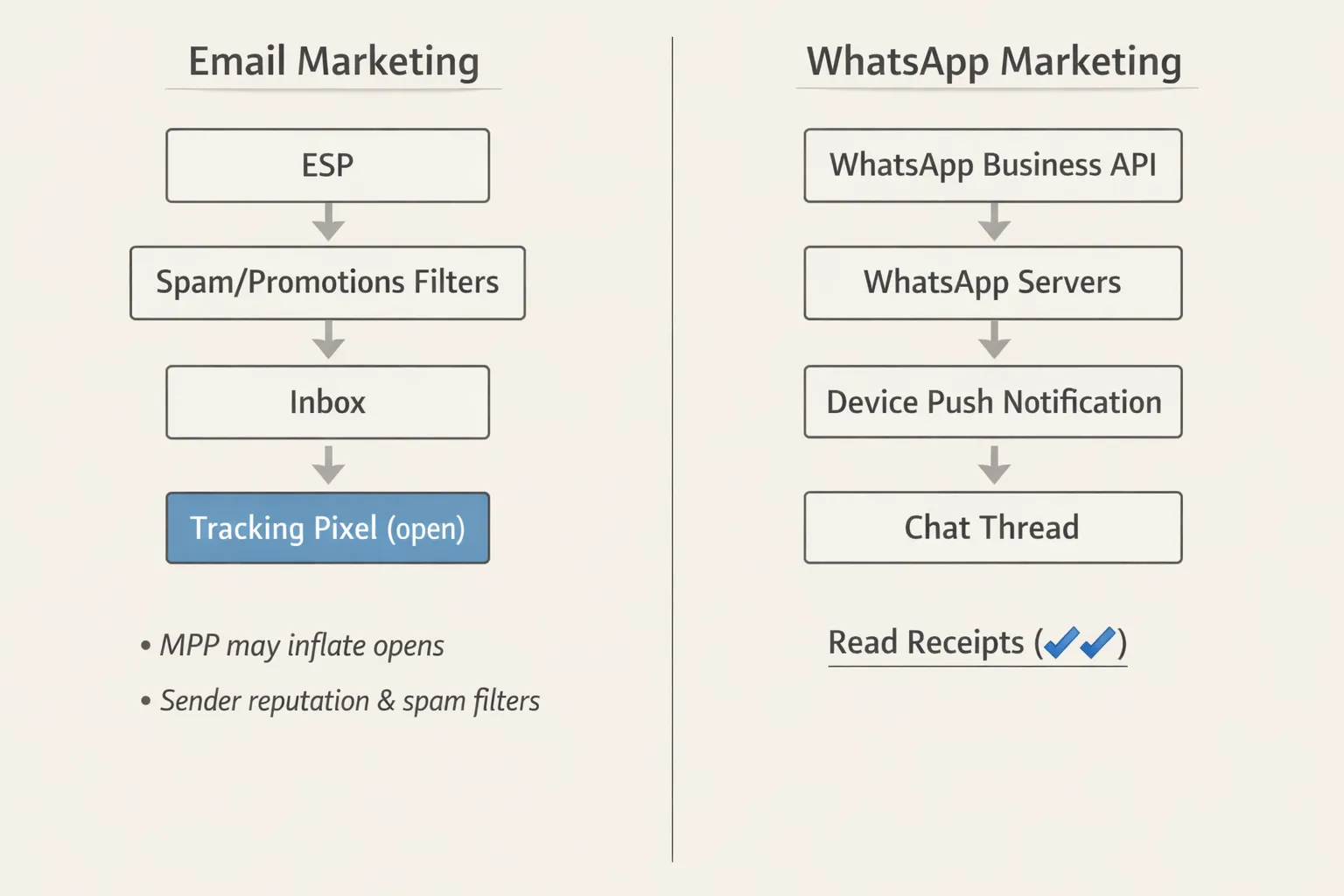
Tracking pixels: “opens” are logged when a tiny image loads; images off = undercounts, preloads = overcounts.
Apple Mail Privacy Protection (MPP): prefetches images via proxy, inflating open rates and masking user/device data.
Promotions tab placement: bulk marketing often bypasses the primary inbox, reducing first-glance visibility.
Sender reputation: domain/IP health and authentication (SPF/DKIM/DMARC) govern inboxing vs. spam.
Spam filters: content, frequency, and complaint signals throttle deliverability and distort “true” attention.
WhatsApp mechanics
Device-level push notifications: messages trigger native mobile alerts that capture real‑time attention.
Verified business senders: branded profiles and trust signals boost recognition and reply likelihood.
Read receipts: double‑blue ticks indicate message viewed - closer to real attention than pixel opens.
Approved message templates: compliance pre-checks reduce filtering ambiguity for outbound notifications.
24‑hour customer care window: conversational sessions enable rapid back‑and‑forth and timely resolution.
Why this matters
Fewer technical hurdles and native notification priority on WhatsApp translate to more authentic, immediate attention vs. email’s “measured opens,” which can be inflated or suppressed by client behavior and filtering.
Implication for strategy
Treat email opens cautiously; optimize for clicks, replies, and downstream conversions.
Use WhatsApp for urgent, time-sensitive, or two‑way interactions (support, order updates, cart recovery, bookings), then sync outcomes back to your CRM.
Engagement Beyond Opens: Clicks, Replies, and Conversions
Why CTR differs
Email introduces friction: open → scan → click → load landing page → act. Each step leaks attention, especially on mobile and slow networks.
WhatsApp is tap‑to‑act: quick replies, buttons, and list pickers trigger deep links, prefilled carts, or in‑chat actions - minimizing steps and boosting tap‑through.
Two-way conversations
WhatsApp turns campaigns into chats: customers ask questions, raise objections, compare options, and get guided checkout in one thread (with seamless bot ↔ human handoff).
Email is mostly one‑way: even with personalization, replies are rare and resolution loops back to other channels (chat, phone, forms).
Short‑form vs long‑form CTA strategy
Email: lead with a single, primary CTA, keep copy skimmable, and reinforce with contextual links; use long‑form to educate, compare, and build consideration.
WhatsApp: one message, one outcome - 2–3 concise quick replies/buttons (e.g., “Apply 10% off,” “View cart,” “Talk to support”); keep copy under a few lines with rich media only when it clarifies action.
Micro‑example: Abandoned cart
WhatsApp nudge (wins speed/intent):
Message 1: “Still interested? Tap to apply 10% off.” Buttons: [Apply code], [Ask a question]
Outcome: Instant recovery from high‑intent shoppers; objections resolved in‑thread.
3‑email sequence (wins depth/consideration):
Email 1 (1–2 hrs): Reminder + benefits
Email 2 (24 hrs): Social proof + comparison
Email 3 (48–72 hrs): Limited‑time incentive
Outcome: Useful for higher AOV, thoughtful purchases, and brand storytelling.
Measurement tip
Attribute chat-driven conversions with:
Channel‑specific deep links and UTM parameters
Unique coupon codes per channel or campaign
In‑chat storefront and payment events mapped to sessions
CRM events for “reply,” “quick‑reply tap,” and “template delivered/read”
With Trikon, you can track broadcast taps, bot handoffs, and in‑chat order events to see true pipeline impact.
"Mailchimp reports an average email CTR of 2.62% across all industries." - Source
Interactive WhatsApp flows commonly drive materially higher tap‑through and replies (range varies by use case), especially for time‑sensitive offers, service updates, and guided purchases.
Where Email Still Wins (And Why You Should Keep It)
Long‑form and narrative content
Email remains the best medium for newsletters, in‑depth product updates, onboarding sequences, and thought leadership. Its canvas supports rich layouts, longer copy, and embedded resources to educate, compare options, and nurture consideration over time.
For complex journeys - multi‑step onboarding, feature adoption, quarterly updates - email’s format lets you frame the story, sequence guidance, and bundle links in one place.
Formality and records
In B2B, legal/finance, and compliance‑sensitive workflows, email is still the default for formal communications. It’s searchable, forwardable, and leaves a durable paper trail for contracts, approvals, and documentation.
Stakeholders expect important PDFs, statements, and policies to arrive via email where they can be archived and referenced later.
Reach and cost at volume
At large list sizes, email’s marginal cost per send is low and predictable, making it ideal for broad reach when you need scale.
Email is a channel of record for many users; it’s platform‑agnostic and accessible across devices, which helps ensure broad, reliable coverage.
Best practices to preserve performance
Segmentation and relevance: build targeted cohorts (lifecycle stage, purchase intent, product interest) to keep content aligned with user needs.
Deliverability setup: authenticate domains (SPF/DKIM/DMARC), monitor sender reputation, warm IPs/domains, and maintain list hygiene (sunset disengaged contacts).
Value‑heavy content: prioritize practical takeaways, clear next steps, and concise design; lead with a single primary CTA.
Cadence discipline: set consistent, expectation‑based schedules; avoid frequency spikes that trigger complaints or spam placement.
Smart pairing with WhatsApp
Use email to educate and nurture; escalate high‑intent or time‑sensitive moments to WhatsApp where immediacy and two‑way conversation lift conversion:
Trigger WhatsApp after an email signal (clicked pricing, viewed returns policy, started checkout) to handle objections or complete checkout in chat.
Move confirmations, appointment reminders, delivery updates, support follow‑ups, and cart recovery to WhatsApp for faster response and resolution.
With Trikon, you can map these handoffs - email for depth and documentation; WhatsApp for instant engagement - so every step happens in the channel that’s most likely to drive action.
Deliverability, Consent, and Compliance: Reality Check
Email: what keeps you in the inbox
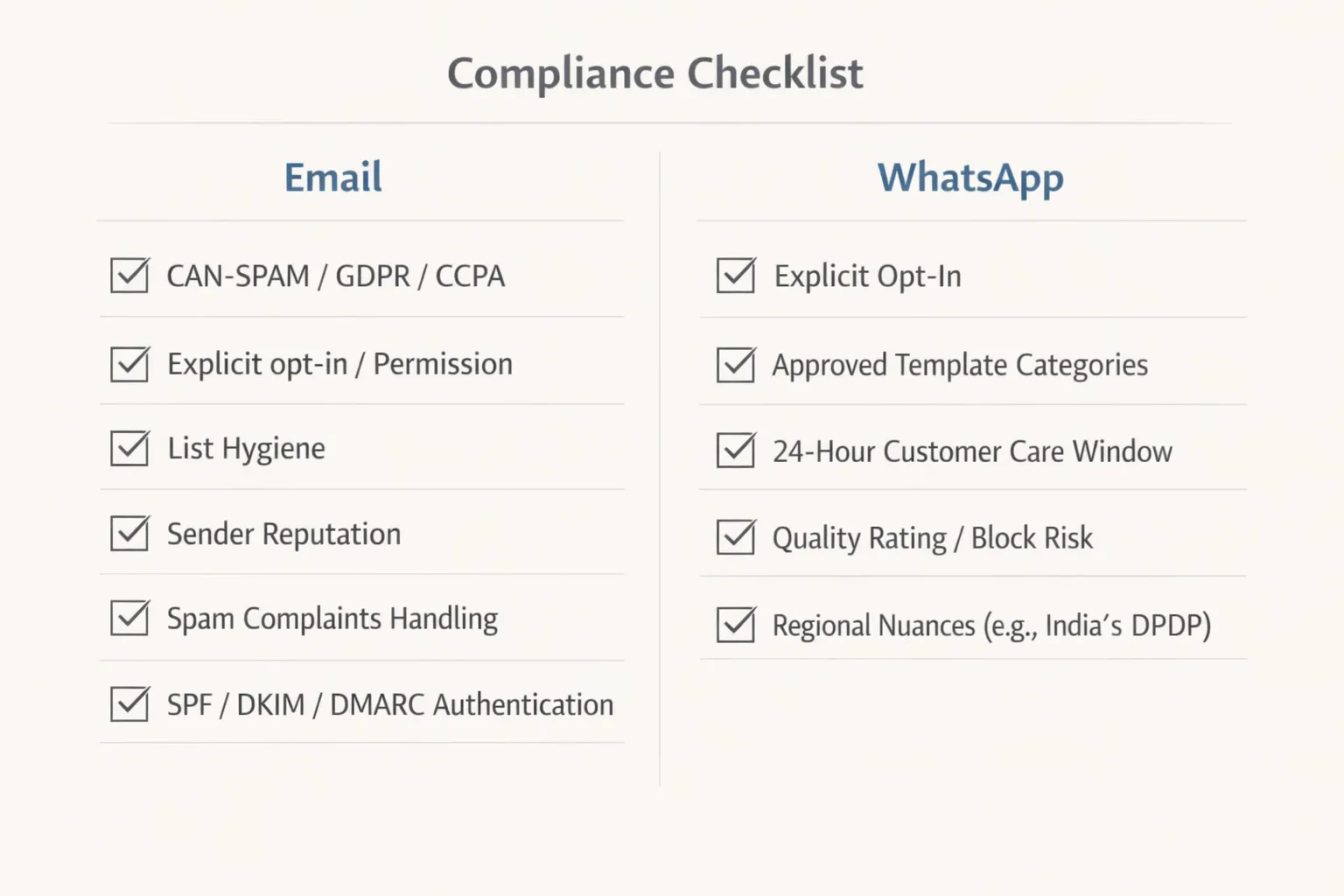
Laws and frameworks: CAN‑SPAM, GDPR, CCPA - obtain consent, honor opt‑outs, retain audit trails.
Opt‑ins and list hygiene: double opt‑in where possible; remove hard bounces/inactives; sunset disengaged users.
Sender reputation: monitor complaints, spam traps, engagement signals; warm new domains/IPs gradually.
Authentication: implement SPF, DKIM, DMARC with alignment; enforce BIMI where eligible.
Complaint handling: immediate unsubscribe processing and preference centers to reduce friction.
WhatsApp: policy‑first by design
Explicit opt‑in: capture clear consent naming your brand and message types.
Templates: use approved categories; monitor template quality and rejection signals; iterate content.
24‑hour service window: respond within the session; use compliant templates to re‑engage outside the window.
Quality rating and block risk: watch phone‑number quality; reduce frequency when blocks increase.
Country nuances: respect regional laws (e.g., India’s DPDP) and carrier/operator policies.
Practical checklist
Clear consent language at collection; store timestamp/source.
Frequency caps per audience/intent; suppress over‑messaging.
Obvious opt‑out paths: one‑tap STOP (WhatsApp quick reply) and one‑click unsubscribe (email).
Template testing: A/B buttons, headers, variables; keep tone on‑brand and helpful.
Data minimization: collect only what’s needed; encrypt and restrict access.
Risk management: protect your sender identity
Email: authenticate (SPF/DKIM/DMARC), segment by engagement, throttle sends, monitor blocklists, and keep a dedicated sending domain for marketing vs. transactional.
WhatsApp: maintain healthy template performance, segment by recency/intent, avoid generic blasts, and pause/balance send volume if quality dips; use verified business profiles to reinforce trust.
Cost, ROI, and Scale: When Each Channel Is More Efficient
Cost models and why engagement-adjusted CPA matters
Email: typically platform tier + volume sends. Low marginal cost can mask low engagement - cheap sends aren’t cheap if they don’t convert.
WhatsApp: conversation-based fees (Meta) + provider fees. Higher per‑conversation cost, but faster responses and in‑chat actions can lower CPA and lift LTV.
Focus on engagement‑adjusted CPA: revenue per delivered/seen, not per sent.
Mini‑model: D2C cart recovery (illustrative)
Assumptions:
Email: 25% open, 3% CTR, 10% CVR post‑click → ~0.075% orders per send
WhatsApp: 90% seen, 25% tap/reply, 20% CVR in‑chat/landing → ~4.5% orders per message
Sensitivity:
Higher AOV magnifies WhatsApp ROI (fewer, higher‑intent recoveries).
Repeat rate compounds gains: one recovered order today can create future WhatsApp sessions for replenishment and support.
Takeaway: even with higher per‑conversation cost, WhatsApp can yield a lower CPA when intent and speed matter.
Scale considerations
Audience size: email scales cheaply to very large lists; WhatsApp excels with opted‑in, engaged segments.
Frequency caps: both channels need guardrails; WhatsApp users expect fewer, higher‑value touches.
Template throughput: WhatsApp templates must be approved; plan buffers for peak campaigns.
Agent capacity: live replies are a feature, not a bug - staff for surge windows or use hybrid bots. Trikon’s shared inbox + AI handoff helps absorb peaks.
When each channel is cheaper in practice
WhatsApp wins: high‑intent, time‑sensitive, or service‑heavy use cases (cart recovery, COD confirmation, appointment reminders, delivery updates, support triage).
Email wins: broad education, low‑urgency promotions, content series, long‑form onboarding.
How to test fairly
A/B split by segment and intent.
Normalize by delivered/seen (not sent).
Measure revenue per recipient, orders per conversation, time‑to‑first‑response, and support deflection (e.g., FAQs resolved by bot).
Track repurchase impact over 30–90 days for LTV.
Cost & ROI Levers Matrix
Cost driver | How it’s billed (Email) | How it’s billed (WhatsApp) | Impact on CPA/LTV | Optimization lever |
|---|---|---|---|---|
Platform fees | Tiered plan + monthly contact/volume caps | Provider platform fee | Fixed overhead; amortize with volume | Right‑size plan; compress tool stack |
Message sends/conversations | Per‑thousand sends or included allotments | Per conversation (Meta) + provider fee | Drives CPA; low engagement inflates cost per outcome | Segment for intent; suppress low‑propensity cohorts |
Deliverability/quality | Domain/IP reputation affects inboxing | Template quality rating affects reach | Poor quality elevates CPA and churn | Warmup, SPF/DKIM/DMARC; iterate templates, monitor quality |
Response handling | Minimal direct cost; indirect support load | Agent time for live replies | Faster resolution can raise LTV; staffing affects CPA | Hybrid bots + SLAs; deflect FAQs with automation |
Conversion path | Multi‑step (email → site → checkout) | Tap‑to‑act (buttons, deep links, in‑chat) | Fewer steps lower CPA; reduce drop‑off | Use deep links/UTMs; in‑chat checkout/storefront |
Frequency | Often higher to counter low engagement | Lower, value‑dense touchpoints | Over‑messaging lifts churn/blocks | Frequency caps; recency/intent sequencing |
Retention lift | Drip/education grows consideration | Conversational CX boosts satisfaction/repeat | Higher LTV lowers blended CPA | Post‑purchase care; reorders via WhatsApp |
"WhatsApp recommends measuring uplift using control vs. exposed groups and tracking both in‑thread and off‑thread conversions with an attribution table." - Source
Lifecycle Playbooks: The Right Channel for Each Moment
Awareness
Email: Use storytelling and seasonal drops to introduce collections, launches, and brand narratives. Feature-rich formats (hero + modules) work well for education and comparison.
WhatsApp: Build VIP early-access lists and run limited-time promos or waitlist confirmations. Keep messages short with buttons (e.g., “View drop,” “Remind me,” “Ask a question”).
Activation
Email: Onboarding sequences that explain value, how‑to steps, and social proof. Space content over several touches with one clear CTA per send.
WhatsApp: Send a concise welcome, ask 1–2 quick questions (size/style/category), and nudge the first purchase with a time‑boxed incentive. Use list pickers and buttons to reduce friction.
Purchase
Email: Curated offers, catalogs, bundles, and cross‑category highlights. Great for browsing and long‑form comparison before checkout.
WhatsApp: Guided selling via quick replies (e.g., color/size), coupon buttons, in‑chat checkout/storefront links, and payment reminders. Recover carts with a single tap (“Apply code”) and fast objection handling.
Retention
Email: Loyalty education (tier benefits), community roundups, curated recommendations, and content series (how to use, care guides, feature drops).
WhatsApp: Reorder prompts, replenishment nudges, back‑in‑stock alerts, and personalized “you may also like” messages that drive immediate action. Use recency/frequency caps to keep value high.
Support/Operations
Email: Tickets, receipts, policy docs, long‑form troubleshooting, and records for approvals and compliance.
WhatsApp: Real‑time SLAs for high‑urgency cases, appointment reminders/confirmations, order status updates, and human escalations after bot triage.
How Trikon maps to each stage
Broadcasts & segmentation: Build VIP/interest segments for awareness; trigger targeted promos and seasonal drops.
Drip & retargeting: Automate onboarding, win‑back, and cart/checkout sequences across moments that matter.
AI/keyword bots with human handoff: Qualify queries, answer FAQs, and route complex cases to agents in one thread.
Bookings & payments: Run appointments, confirmations, and secure payment links directly inside WhatsApp.
Unified inbox with SLAs: Centralize conversations, track response times, preserve full context, and maintain quality at scale.
Tooling & Setup: From Zero to Live in a Week
WhatsApp essentials
Create/verify your WhatsApp Business Account and connect a verified number.
Prepare and submit message templates (marketing, utility, authentication) for approval.
Choose an official WhatsApp Business API partner - Trikon - for reliability, compliance, and speed‑to‑value (shared inbox, automation, SLAs).
Email essentials
Pick an ESP and stand up your core stack: authenticated sending domain (SPF/DKIM/DMARC), branded templates, and foundational segments (new subscribers, customers, high‑intent clickers).
Set your deliverability guardrails: list hygiene, complaint monitoring, and warmup if you’re moving to a new domain/IP.
Fast start with Trikon (one‑week plan)
Day 1–2: Connect WhatsApp, import consent‑aware contacts, map key segments (VIP, recent purchasers, high‑intent browsers).
Day 3: Launch first broadcast (welcome/VIP drop). Enable AI/keyword chatbot with clear human handoff.
Day 4–5: Add abandoned‑cart and order update flows with approved templates and deep links.
Day 6–7: QA template rendering, test opt‑out, set frequency caps, and go live with a limited‑scope campaign.
Integrations
E‑commerce: sync catalogs, carts, and orders; enable in‑chat storefront and payment links.
CRM: unify profiles, events, and consent; trigger lifecycle actions from status changes.
Analytics: define UTMs, event naming, and attribution windows across both channels; capture in‑thread vs off‑thread conversions.
Team workflow
Centralized inbox with agent routing, SLA policies, and conversation history.
Approval flows for templates and broadcasts; compliance guardrails (consent checks, frequency caps, opt‑out handling).
Hybrid ops: bots handle FAQs/qualification; agents manage complex cases and escalations.
Decision Framework and Final Verdict
Decision tree: pick the right channel by scenario
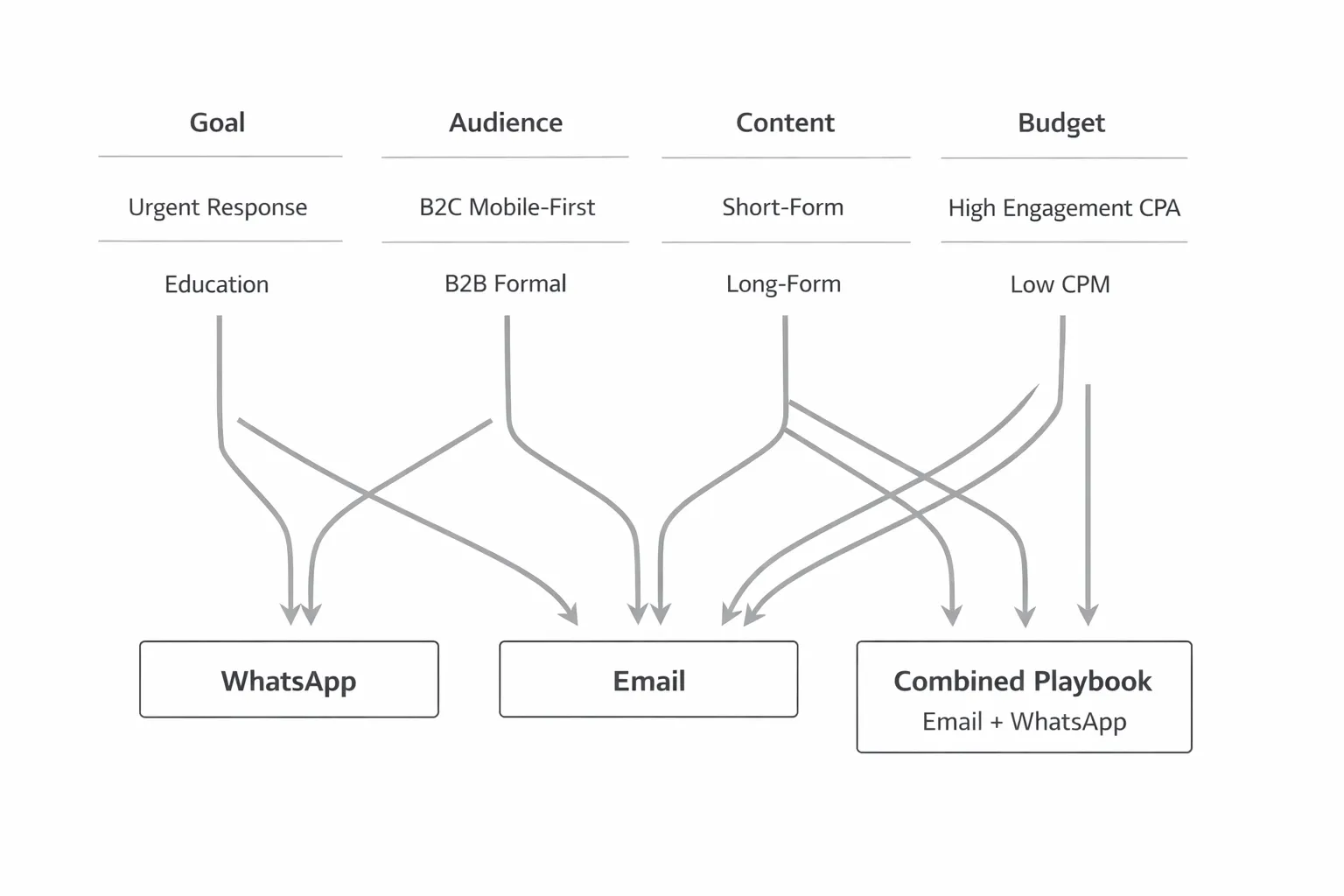
Goal: urgent response, time‑sensitive, or two‑way? Choose WhatsApp. Education, narrative, or long‑form? Choose Email.
Audience: B2C, mobile‑first, chat‑friendly? WhatsApp. B2B, formal industries, or procurement workflows? Email.
Content length: short prompts, buttons, quick replies? WhatsApp. Detailed guides, comparisons, documentation? Email.
Budget: optimize for engagement‑adjusted CPA? WhatsApp shines at high intent. Maximize reach per dollar? Email scales efficiently.
Channel orchestration guidelines
Honor user preference at opt‑in; set reachability checks with fallback paths.
Cap frequency per segment and intent; reserve WhatsApp for high‑value moments.
Align creative to context: one message, one action on WhatsApp; structured modules and a single primary CTA in email.
Final verdict
For pure engagement speed and response, WhatsApp leads.
Email remains essential for depth, documentation, and scale.
The winning strategy pairs them with clear roles across the lifecycle.
Where Trikon fits
Trikon is the fastest path to compliant, revenue‑driving WhatsApp at scale - broadcasts, segmentation, AI/keyword bots with human handoff, bookings/payments, in‑chat storefront, and analytics tied to revenue and SLAs.
Next step
Run a 14‑day WhatsApp pilot alongside your existing email: benchmark revenue per recipient, support deflection, and time‑to‑first‑response - then expand the combined playbook.